

Most people with mild whiplash improve within days to a few weeks, and many reach substantial recovery by 6 to 12 weeks. A meaningful minority, though, still have symptoms at 3 months and beyond, which is the point where recovery patterns start to diverge. Stay as active as pain allows from the start, and if symptoms are severe or getting worse rather than better, get a follow-up evaluation instead of waiting it out.
TL;DR:
- Most people recover within 6 to 12 weeks, but a significant minority still experience symptoms beyond three months, requiring reassessment.
- Early activity and gentle movement are recommended, with soft collar use limited to a few hours daily to prevent weakening neck muscles.
- Key factors influencing recovery include high initial pain, stress, poor coping strategies, and psychological stress, which can extend healing time.
- Progress typically peaks in the first six weeks, with slow improvement afterward; persistent symptoms at 12 weeks warrant further evaluation.
- Urgent medical care is necessary if neurological symptoms worsen, bladder or bowel control is lost, or pain remains severe and unresponsive to treatment.
Table of Contents
- How Long Does Whiplash Recovery Actually Take?
- What Happens Inside Your Neck During Recovery?
- Why Do Some People Recover Faster Than Others?
- What Treatments Actually Speed Up Whiplash Recovery?
- When Should You Seek Urgent Medical Care?
- How Does Structured Follow-Up Care Support Recovery?
- A Clinic's View on Common Whiplash Myths
- Get Hands-On Care for Whiplash in North Miami
- Sources
How Long Does Whiplash Recovery Actually Take?
There's no single number, but there is a pattern. Cleveland Clinic notes that most people improve within a few weeks, especially with mild strains, while more serious cases can stretch to several months before symptoms fully settle, according to its whiplash overview. A systematic review of whiplash-associated disorder cohorts puts median recovery often occurs within a few months (https://chiro.org/Whiplash/GRAPHICS/THE_COURSE_AND_FACTORS_ASSOCIATED/THE_COURSE_AND_FACTORS_ASSOCIATED.pdf), depending on how "recovered" gets defined in each study.
Here's roughly how that plays out:
- Days 0 to 7: Pain and stiffness usually peak here, sometimes a day or two after the crash rather than immediately. Short rest, basic pain control, and gentle neck motion (not stillness) are the priorities.
- Weeks 2 to 6: Most people see steady, noticeable gains during this stretch. Range of motion improves, headaches ease, and most return to driving, work, and normal chores.
- Weeks 6 to 12: Progress usually continues but slows. This is when strengthening and conditioning matter more than rest, and when return-to-work planning becomes relevant for anyone still limited.
- Beyond 3 months: Recovery odds drop for people still symptomatic here. It doesn't mean permanent injury, but it does mean the StatPearls chapter on cervical sprain flags this window as a signal to reassess the treatment plan rather than keep doing more of the same.
What Happens Inside Your Neck During Recovery?
Whiplash recovery follows the same biological script as most soft-tissue injuries, just compressed or stretched depending on severity.
- Inflammatory phase (days 0 to 7): Swelling and muscle guarding cause most of the early pain. Sleep is often disrupted. A soft collar can help for brief stretches, but it's not meant to become a daily habit.
- Repair phase (weeks 1 to 6): Damaged tissue rebuilds. This is when graded movement and light exercise actually help fibers heal in a way that supports normal motion, rather than in a stiff, shortened position.
- Remodeling phase (weeks 6 to 12 and beyond): Strength and endurance return, ideally matched to whatever your job or daily routine demands.
One quirk worth knowing: imaging often looks normal even when someone is still in real pain, because whiplash is mostly a soft-tissue and muscular injury that X-rays and even MRIs don't always capture well.
Pro Tip: Track your neck's range of motion with a simple phone photo or note each week. Numbers on a pain scale are subjective, but "I can now check my blind spot without turning my shoulders" is a concrete milestone you can compare week over week.
Why Do Some People Recover Faster Than Others?
Two people with nearly identical crashes can have very different recovery timelines, and it usually comes down to a mix of fixed and changeable factors.
Nonmodifiable factors include age, sex, and whether the collision involved a high-impact mechanism, though a hard hit doesn't automatically mean a harder recovery. Modifiable and psychosocial factors carry more weight than people expect: high initial pain intensity, headache at onset, poor coping strategies, and post-traumatic stress symptoms all correlate with slower healing. Harvard Health points out that addressing trauma-related stress directly, sometimes through cognitive behavioral approaches, improves pain and disability outcomes compared with treatment as usual.
A significant portion of patients remain symptomatic at 1 year under stringent study criteria, according to research on prognostic factors in whiplash. That figure varies a lot by how "symptomatic" gets defined, but it's a real reason early, active management matters.
- Early active rehab beats a wait-and-see approach for almost everyone.
- Psychological support helps when stress or anxiety about the crash itself is part of the picture.
- A clinical reassessment at the 6 to 12 week mark catches stalled recovery before it becomes chronic.
What Treatments Actually Speed Up Whiplash Recovery?
Staying active beats staying still, and the research consensus on this is fairly blunt about it. Guidance from the Recover Centre recommends limiting soft collar use to short periods, no more than about 72 hours total or a few hours a day if a clinician suggests it, since prolonged immobilization weakens neck muscles rather than protecting them.
A practical approach usually looks like this:
- Rest for a day or two at most, then start gentle range-of-motion exercises even if it's uncomfortable.
- Use over-the-counter pain relief or prescribed medication as needed, not as a substitute for movement.
- Add supervised physical therapy or manual therapy, including chiropractic techniques, once acute pain settles enough to tolerate hands-on work.
- Prioritize sleep and stress management, since both directly affect pain perception.
- Return to work gradually, adjusting duties rather than pushing through or avoiding entirely.
Pro Tip: If sitting at a desk aggravates your neck, try 5 minute movement breaks every half hour instead of powering through a full shift. Micro-breaks often prevent the stiffness spiral that turns a good day into a bad one. For more specifics on daily management, see these recovery tips.
When Should You Seek Urgent Medical Care?
Most whiplash cases don't need emergency care, but certain signs do.
- Progressive weakness, numbness, or tingling spreading down an arm.
- Sudden changes in bladder or bowel control.
- Severe, worsening pain that doesn't respond to rest or medication.
- Suspected fracture, or any neurological symptom appearing after the initial injury rather than at the start.
Contact your primary care provider or urgent care promptly for these; go to the ER for anything involving bladder or bowel changes or clear neurological deficits. If you're still significantly limited at the 6 to 12 week mark, that's the cue for a specialist reassessment rather than continued passive care. Keep copies of every diagnosis, referral, and treatment note. That paperwork matters if you're also navigating a claim, which is a separate process worth understanding on its own.
How Does Structured Follow-Up Care Support Recovery?
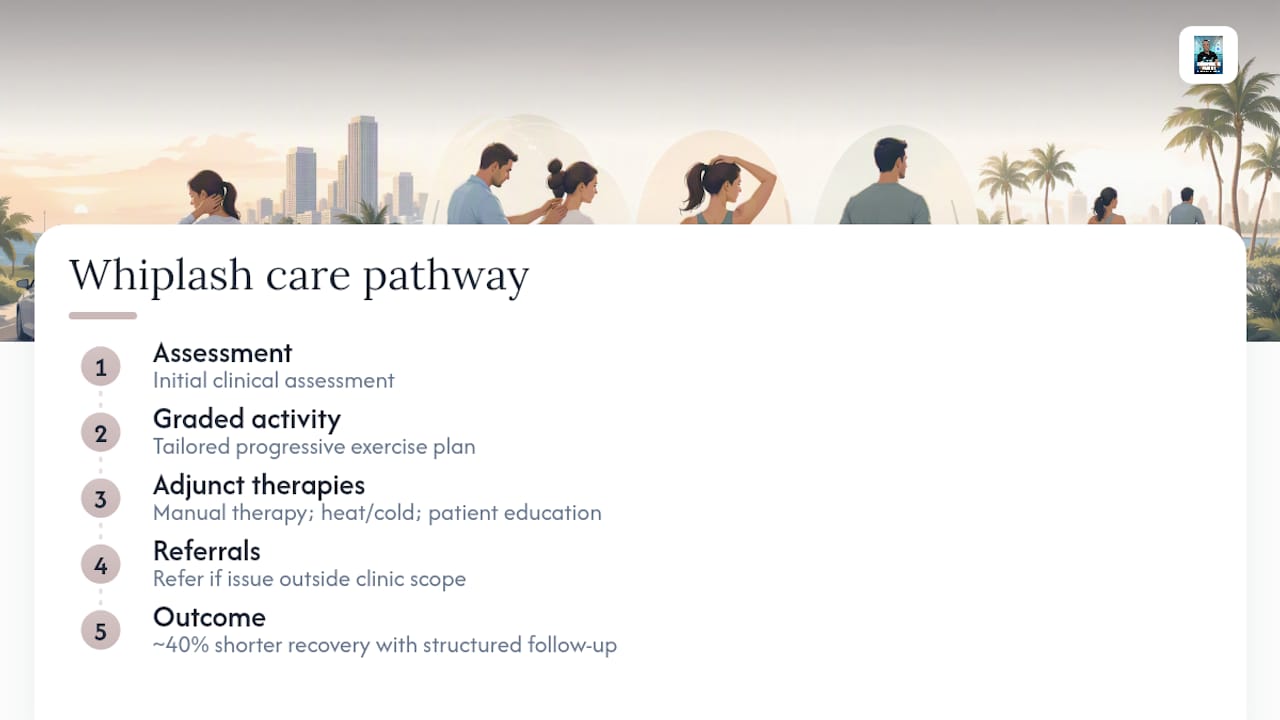
A typical care pathway after whiplash starts with an assessment, moves into a graded activity plan, and layers in manual therapy, heat or cold modalities, and patient education as needed, with referrals out when something falls outside a clinic's scope. Internal outcome data from Sparkmed's own patient follow-up found that structured chiropractic follow-up shortened recovery time by roughly 40% compared with less consistent care. Individual prognosis still varies, so ask any clinic directly what outcomes to expect for your specific injury.
A Clinic's View on Common Whiplash Myths
The biggest myth is that rest equals recovery. It doesn't. Controlled, early movement outperforms lying still, even when it feels counterintuitive on day two. Expect a bumpy, non-linear improvement curve rather than a straight line, and don't panic over a bad day. If progress genuinely stalls, or new symptoms show up, that's the moment to get reassessed rather than push through alone.
— Spark
Get Hands-On Care for Whiplash in North Miami
Sparkmed treats whiplash the way the research above actually supports: early evaluation, graded activity, and manual therapy instead of weeks of waiting around in a collar. A first visit typically includes a physical assessment, a review of your accident details, and the start of a personalized activity plan, with additional therapies as guided by your clinician.
New patients can get started with a $25 chiropractic adjustment, no insurance required, and multilingual support in English, Spanish, and Creole makes the first visit easier for more of North Miami. Reasons behind that early-adjustment approach are explained in more detail in why adjusting after a crash matters. If you're dealing with the claims side of a crash rather than just the physical recovery, resources like Miami car accident claims guidance cover that separate process. To get started with the physical recovery, book a visit through the services page and get a plan built around your actual injury, not a generic template.
Sources
The OPTIMa systematic review, StatPearls on cervical sprain, and Mayo Clinic's treatment guidance cover the clinical detail behind this article.
This article is general information, not a substitute for advice from a qualified doctor. Consult a qualified healthcare professional about your own circumstances before acting on anything here.
- Factors associated with a slower recovery or higher risk of chronic symptoms
- Cervical Sprain - StatPearls - NCBI Bookshelf
- Recover Centre — collar guidance
- Harvard Health — Whiplash injury: relieving the pain in your neck
- Cleveland Clinic — Whiplash (Neck Strain)