

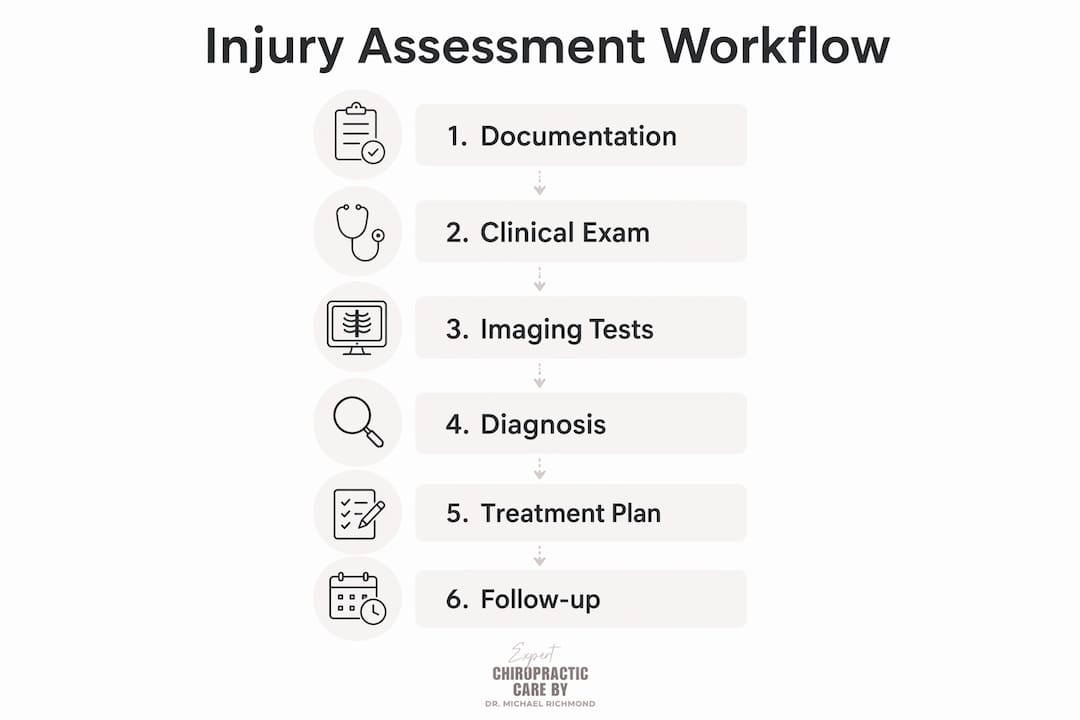
The most effective workflow for accident injury recovery assessment runs in five stages: document the mechanism of injury, complete a focused clinical history, perform a focused physical exam, make immediate triage and intervention decisions, and finalize documentation and coding for claims. If you have any of the following right now — loss of bowel or bladder control, numbness spreading down both legs, uncontrolled bleeding, or signs of stroke — stop reading and call 911. For everyone else, the structured clinical process below is what OSHA-aligned intake workflows and emergency MSK evaluation frameworks both recommend, and it is the same process Sparkmed applies at intake in North Miami.
Red-flag callout: Neurologic compromise, rapidly expanding swelling, or any loss of consciousness after an accident requires emergency evaluation before any outpatient workflow begins.
Table of Contents
- What does the step-by-step injury assessment workflow look like?
- Which imaging and diagnostic tests should you order, and when?
- How do you turn exam findings into a real treatment plan?
- How do emotional responses and work fit into recovery?
- What follow-up schedule and red flags should you know?
- What are typical recovery timelines and what do insurers need?
- What should you do right now?
- Key Takeaways
- The case for a structured workflow, not just a clinic visit
- Sparkmed is ready to run this workflow with you
What does the step-by-step injury assessment workflow look like?
A structured clinical assessment for musculoskeletal injuries follows five numbered stages. Each stage feeds the next, so skipping one creates gaps that can delay your claim or miss a serious injury.
-
Document the mechanism of injury. Record the exact time, direction of impact, your body position at impact, vehicle speed estimates, seatbelt use, airbag deployment, and any immediate symptoms. For work injuries, add your job title and the specific task you were performing. These details directly affect OSHA recordability and insurance claim validity.
-
Focused clinical history. Tell your clinician about prior injuries to the same area, current medications, your baseline function before the accident, and how your pain behaves (sharp vs. aching, constant vs. intermittent, what makes it worse). A complete history shapes every decision that follows.
-
Focused physical exam. This covers inspection (visible bruising, swelling, posture), palpation (tenderness location and depth), neurovascular assessment (pulses, sensation, reflexes), range of motion with goniometric measurement, and special orthopedic tests relevant to the injured region. Your clinician should document findings in objective, measurable terms, not just "patient reports pain."
-
Immediate triage and initial interventions. Based on steps 1–3, the provider decides: treat in-office, refer to imaging, refer to a specialist, or send to the ED. Initial interventions may include spinal adjustment, soft-tissue therapy, ultrasound, heat or cold application, or a temporary brace.
-
Documentation and coding for claims. Every note should include timestamps, mechanism language (use the exact words from step 1), and task-at-injury for occupational cases. Gaps in documentation are the most common reason claims are reduced or denied.
Checklist to bring to your first visit:
- Written timeline of symptoms from the moment of impact
- Photos of vehicle damage, visible injuries, and the scene
- Witness names and contact information
- Police report number
- List of current medications and known allergies
- Insurance cards (health, auto, and workers' comp if applicable)
Pro Tip: When describing symptoms to a clinician or insurer, stick to what you feel and when it started. Avoid minimizing language like "it's not that bad" or speculating about fault. Recorded statements to an at-fault driver's insurer are not legally required, and you can decline them without jeopardizing your claim.
Which imaging and diagnostic tests should you order, and when?
The goal of imaging in the accident recovery process is not to confirm pain. It is to rule out injuries that would change treatment. Systematic MOI assessment and targeted imaging reduce the rate of missed high-risk injuries such as Achilles tendon rupture, scaphoid fracture, and Lisfranc injury.

Plain X-rays are the first-line choice for suspected fractures and dislocations. They are fast, widely available, and sufficient for most bony injuries. What they miss: soft-tissue tears, tendon ruptures, early stress fractures, and disc injuries.
Ultrasound fills a specific gap for tendon and muscle injuries. Point-of-care ultrasound has an evolving role in acute MSK evaluation and can identify effusion, partial tears, and foreign bodies without radiation. It is particularly useful for shoulder, Achilles, and patellar tendon assessment.
MRI is the standard for neurologic symptoms, suspected disc herniation, ligament tears, and any injury where X-ray is negative but pain is severe or worsening. Order it early when neurologic signs are present; waiting weeks costs recovery time.
Validated decision rules such as the Ottawa ankle and knee rules help clinicians decide when imaging is genuinely necessary, reducing unnecessary radiation and cost without increasing missed fractures.
Labs are appropriate when systemic injury is suspected: rhabdomyolysis after crush or prolonged compression (order creatine kinase), infection after open wounds, or coagulopathy in patients on blood thinners. Most soft-tissue accident injuries do not require bloodwork.
For a structured MSK evaluation approach, the sports injury treatment workflow used in orthopedic settings applies the same modality-selection logic to high-risk injuries.
How do you turn exam findings into a real treatment plan?
A diagnosis without measurable goals is just a label. Every post-accident rehabilitation plan should include specific, time-bound targets the patient and provider can track together.
Sample short-term goals (weeks 1–4):
- Pain at rest below 3/10 on the Numeric Rating Scale
- Cervical rotation within 15° of the unaffected side
- Able to perform job-specific task (e.g., lifting 20 lbs) without symptom increase
Restriction templates should be task-based, not vague. "Avoid heavy lifting" is not useful. "No lifting above 10 lbs, no overhead reaching, seated work only for 2 weeks with reassessment on [date]" is. This language maps directly to modified-duty job offers and protects both the patient and the employer.
Provider roles in the plan:
- Primary care physician or urgent care: initial evaluation, imaging orders, referral coordination
- Chiropractor: spinal and extremity adjustment, soft-tissue therapy, functional reassessment
- Physical therapist: progressive strengthening, neuromuscular re-education, return-to-activity progression
- Orthopedic surgeon or pain specialist: indicated when conservative care plateaus or surgical pathology is confirmed
For a deeper look at post-accident rehab roles, including when to escalate to a specialist, Sparkmed's blog covers the handoff criteria in plain language.
How do emotional responses and work fit into recovery?
Patients commonly experience fear, sadness, guilt, or anger after a crash. These responses usually reduce over days to weeks, but when they persist, they slow physical recovery. Screening for them at intake is part of a complete injury assessment workflow.
Brief psychosocial screening questions to ask yourself or your provider:
- Are you sleeping more than two hours less than before the accident?
- Are you avoiding driving, passengers, or locations associated with the crash?
- Has your mood been consistently low or irritable for more than a week?
- Have you withdrawn from activities or people you normally enjoy?
A "yes" to two or more of these warrants a referral to a behavioral health provider alongside physical treatment. Early, gentle resumption of activities with appropriate modification consistently produces better outcomes than total rest. Staying connected to work and social supports is clinically recommended, not just practical advice.
Employer communication essentials:
- Notify your employer in writing within 24–48 hours of the injury
- State your functional limitations specifically (e.g., "unable to stand more than 20 minutes")
- Propose a modified-duty review date
- Keep a copy of every communication
Occupational health best practices consistently link proactive employer contact and early modified duties to faster, more successful return-to-work outcomes.
Pro Tip: Request modified duty in writing and frame it around what you CAN do, not what you cannot. This keeps you connected to income and demonstrates good faith, which matters if your claim is disputed.
What follow-up schedule and red flags should you know?
| Date | Measure | Score/Finding | Disposition |
|---|---|---|---|
| Day 1–3 | Pain NRS, ROM | Baseline | Initial plan set |
| Week 1–2 | Pain NRS, ROM, function | Progress check | Adjust plan or refer |
| Week 4 | Oswestry / StartBack | Functional score | Continue, escalate, or discharge |
| — | Strength, RTW readiness | Objective measures | RTW decision |
Follow-up intervals: Recheck within 24–72 hours for acute injuries, then every 1–2 weeks during active treatment. If symptoms worsen between visits, come in sooner.
Red flags requiring immediate re-evaluation or ED visit:
- New or worsening numbness, tingling, or weakness in arms or legs
- Loss of bowel or bladder control
- Fever with neck stiffness or back pain
- Rapidly increasing swelling with skin color change
- Severe headache that is different from any prior headache
See a clinician within 24–72 hours of any accident, even if you feel fine. Adrenaline masks injuries reliably, and early documentation protects your claim value.
What are typical recovery timelines and what do insurers need?
| Injury Type | Typical Recovery Range | Key Documentation |
|---|---|---|
| Soft-tissue sprain/strain | 4 weeks | Mechanism note, exam findings, treatment log |
| Uncomplicated fracture | — | X-ray report, casting/splinting notes, follow-up imaging |
| Tendon repair (surgical) | — | Operative report, PT notes, functional progress |
| Disc herniation with radiculopathy | — | MRI report, neurologic exam, pain scale logs |
Documentation your insurer will likely request:
- Mechanism of injury with timestamps
- All treatment notes with objective findings
- Diagnostic reports (imaging, labs)
- Itemized bills and receipts
- Mileage logs for medical appointments
- Lost-wage documentation from your employer
Submitting your Report of Accident or Physician Initial Report within 2 business days reduces administrative delays and keeps claim movement on track. California's DMV requires accident reporting within a specified time period when injuries are involved or significant vehicle damage occurs.
What should you do right now?
Three immediate actions matter most after any accident injury:
- Document the mechanism today. Write down everything you remember about the crash: time, speed, direction, your position, and your first symptoms. Do it now, before memory fades.
- Get evaluated within 24–72 hours. Even if pain is mild. Bring your symptom timeline, photos, and insurance information.
- Save every receipt and decline recorded statements to the at-fault insurer until you have spoken with your own provider or an attorney.
At your first follow-up, bring the checklist from Section 2, ask for task-based written restrictions, and confirm your next appointment date in writing. For a broader post-accident wellness plan, Sparkmed's patient guides walk through each recovery phase in plain language.
Key Takeaways
A structured, stage-based injury assessment workflow — from mechanism documentation through measurable return-to-activity goals — is the single most reliable way to protect both your health and your claim after an accident.
| Point | Details |
|---|---|
| Document mechanism immediately | Record time, forces, position, and first symptoms before memory fades. |
| See a clinician within 24–72 hours | Adrenaline masks injuries; early evaluation protects your claim value. |
| Order imaging strategically | Use Ottawa rules and clinical findings to guide X-ray, ultrasound, or MRI decisions. |
| Use task-based restrictions | Vague limits don't hold up; specific functional restrictions protect you at work and in claims. |
| Sparkmed for North Miami patients | Sparkmed provides licensed chiropractic evaluation, on-site diagnostics, and return-to-work documentation at an accessible price point. |
The case for a structured workflow, not just a clinic visit
Most people who come in after an accident have already waited too long. They felt fine for two or three days, then the stiffness set in, and by the time they arrived, the documentation window for their claim had narrowed considerably. The workflow in this article exists precisely to prevent that gap.
What gets underestimated is how much the order of steps matters. Imaging ordered before a focused exam frequently produces findings that look alarming but are clinically irrelevant, while the actual injury — a partial tendon tear, a subtle instability — goes undetected because no one performed the right special test first. A systematic approach to evaluation, the kind that emergency MSK frameworks and OSHA intake protocols both endorse, is not bureaucratic overhead. It is how missed injuries get caught.
The emotional side of recovery deserves the same attention. Patients who stay connected to work and social life, even in a modified capacity, recover faster than those who rest completely. That is not intuition; it is what the clinical evidence on holistic injury care consistently shows. Treating the whole person from day one is not a luxury add-on. It is the workflow.
Sparkmed is ready to run this workflow with you
Sparkmed, located in North Miami, applies this exact clinical workflow at every accident-injury intake: mechanism documentation, focused chiropractic assessment, on-site therapeutic modalities including ultrasound and shockwave therapy, and written return-to-work restrictions your employer can act on. The initial adjustment is available for $25, no insurance required, and the clinic offers multilingual support in English, Spanish, and Creole. Uber Health transport is available for patients who cannot drive after an injury.
Bring your symptom timeline, photos, and insurance cards. Walk-in appointments are accepted, and online booking is available at sparkmed.net. Call or book online today to get your written assessment and return-to-activity plan started.
This article provides general health information, not medical advice. Confirm current clinical guidelines and legal requirements with a licensed provider or qualified professional for your specific situation.