
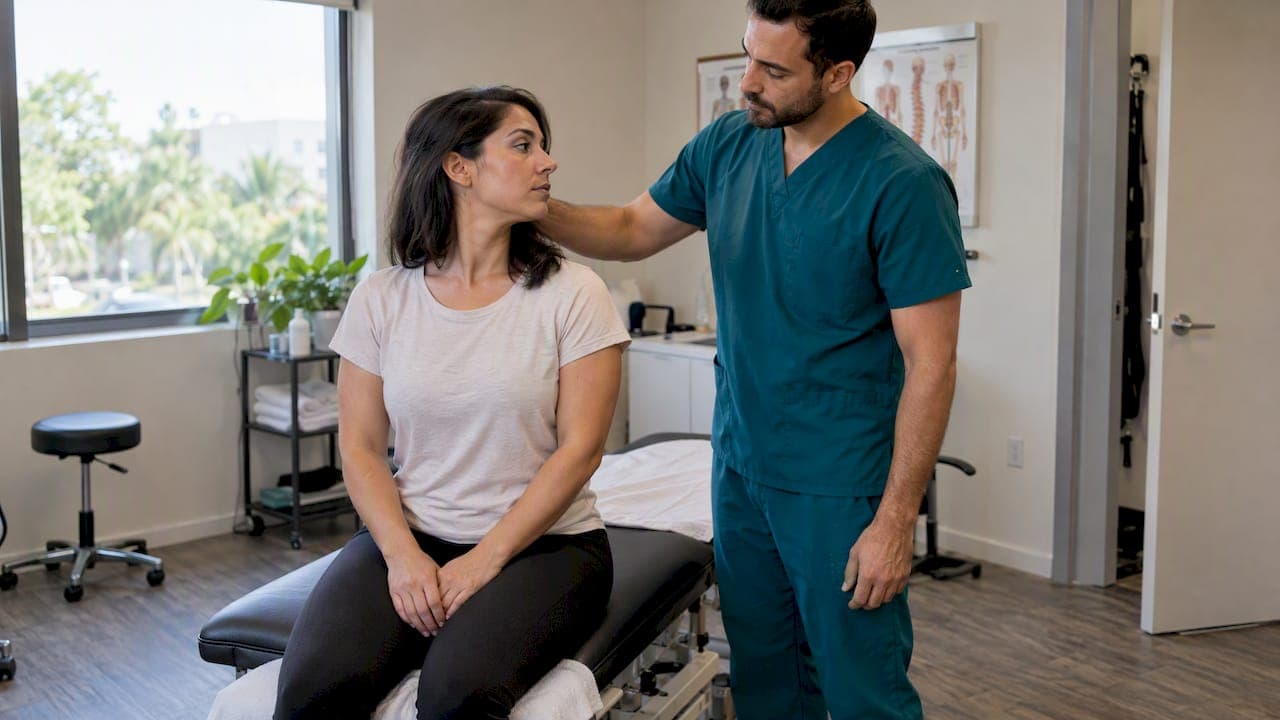
Yes, a neck injury from a car crash can cause a cervicogenic headache, and the first step is to rule out anything dangerous. If you notice a worsening headache, repeated vomiting, confusion, weakness, or loss of consciousness, that calls for emergency evaluation right away. Without those signs, the right move is a focused clinical exam within a few days, not a wait-and-see approach.
TL;DR:
- Most cervicogenic headaches post-accident occur with neck stiffness, reduced motion, and pain radiating from the skull base to the temple or eye.
- Emergency signs such as worsening headache, repeated vomiting, confusion, weakness, or seizures indicate the need for immediate medical evaluation.
- Imaging often appears normal despite symptoms because soft tissue injuries causing cervicogenic headaches are difficult to detect with X-rays or MRI.
- Manual therapy combined with active exercise is the most effective treatment, usually resulting in improvement within weeks to months.
- Delayed onset of symptoms after a crash is common due to shock and inflammation, but persistent or worsening symptoms require reassessment.
Table of Contents
- What is a cervicogenic headache and how does it differ from migraine or concussion pain?
- Symptoms after a car accident and the red flags that mean emergency care
- How a crash causes neck-origin headaches
- Diagnosis and timing: how clinicians decide if a headache is cervicogenic
- Treatment options after an accident: what the evidence supports
- What recovery looks like after a cervicogenic headache from an accident
- How we evaluate and treat post-accident neck headaches
- What matters most after a neck injury headache
- Book a post-accident evaluation with us
- FAQ
- Sources
What is a cervicogenic headache and how does it differ from migraine or concussion pain?
A cervicogenic headache is a secondary headache, meaning it is caused by a problem somewhere else in the body rather than originating in the brain itself. The ICHD-3 classification defines it as pain attributed to a disorder of the cervical spine, with a clear temporal relationship between the neck problem and the headache onset.
The hallmark features set it apart from other headache types. Pain typically starts at the back of the head or neck and spreads forward toward the forehead or temple, usually on one side. Turning your head, holding a sustained neck posture, or pressing on specific points in the upper neck tends to reproduce or worsen the pain.
That overlap with migraine and tension-type headache is exactly why self-diagnosis gets tricky. Migraines can also be one-sided and worsened by movement, and tension headaches share the band-like quality some people describe after a crash. This is also where our headaches after a car accident guide breaks down the different types people commonly report post-collision. Clinicians rely on timing, physical provocation testing, and a detailed history to tell them apart, not symptoms alone.
Symptoms after a car accident and the red flags that mean emergency care
Most cervicogenic headaches after a crash come with a recognizable pattern. Neck stiffness and reduced range of motion are common companions, along with pain that radiates from the base of the skull toward the temple or behind the eye.
Common accompanying symptoms include:
- Dizziness or a sense of unsteadiness when turning the head.
- Sensitivity to light that comes and goes rather than staying constant.
- Brief nausea, especially right after neck movement.
- Tenderness over the upper neck or base of the skull.
- Pain that worsens with prolonged sitting or screen use.
These symptoms are uncomfortable but typically not dangerous on their own. Danger signs are a different matter entirely. According to the CDC's guidance on traumatic brain injury, a headache that keeps getting worse, repeated vomiting, slurred speech, confusion, slurred thinking, weakness or numbness, seizures, or unequal pupils are signs of a possible brain bleed or severe injury, and they require a call to 911 or an emergency department visit, not a scheduled appointment. Our symptoms checklist after car accidents covers the fuller range of post-collision signs worth tracking in the days after a crash.
How a crash causes neck-origin headaches
Whiplash happens when the head snaps forward and backward faster than the neck muscles can control, straining soft tissue and irritating small joints in the upper cervical spine. The structures most often responsible for referred head pain sit in the top three vertebrae: the C1 through C3 facet joints, the occipital nerves that run near them, and surrounding muscles that can develop trigger points after sudden strain.

Because these injuries largely involve soft tissue and small joints rather than fractures, standard imaging often looks unremarkable. The CDC notes that imaging frequently fails to capture soft-tissue injuries that still cause real symptoms, so a normal X-ray or MRI does not rule out a cervicogenic source.
Delayed onset is also common and not a sign that something new has gone wrong. Adrenaline and the general shock of a collision can mask pain in the first hours, with stiffness and headache building over the following day or two as inflammation sets in and muscles that were strained start to tighten and guard.
Diagnosis and timing: how clinicians decide if a headache is cervicogenic
The ICHD-3 criteria use a temporal relation to the neck injury, often within about seven days, as a diagnostic anchor. In practice, clinicians recognize that some cases emerge later and still warrant a cervicogenic diagnosis when the clinical picture fits, so a headache that shows up on day ten after a crash is not automatically excluded.
Physical examination carries real diagnostic weight. A clinician will typically check for:
- Reproduction of headache pain when the neck is moved or a specific joint is pressed.
- Reduced cervical range of motion compared to normal.
- A positive flexion-rotation test, which checks upper neck mobility in a position that isolates the C1-C2 joint.
- Tenderness over the upper cervical facet joints or occipital nerve region.
Imaging or urgent referral becomes necessary when the picture includes neurological deficits, a rapidly worsening course, or concern for fracture or bleeding, situations that move well beyond a routine cervicogenic presentation. Our recovery guide on why adjustment matters after a crash walks through why early musculoskeletal evaluation matters even when imaging comes back clear.
Treatment options after an accident: what the evidence supports
The strongest evidence for cervicogenic headache points toward hands-on care paired with active exercise rather than passive treatment alone. A 2025 systematic review and network meta-analysis found that cervical spinal manipulation and SNAG mobilization (a sustained natural apophyseal glide technique) ranked among the most effective interventions for both pain and function, outperforming mobilization alone, exercise alone, or massage alone on measures of pain improvement. A separate systematic review and meta-analysis covering 20 studies and 1,439 patients reached a similar conclusion: manual therapy combined with exercise reduces headache intensity, frequency, and related disability more reliably than either approach used in isolation.
A typical conservative course looks like this:
- An initial trial of multiple sessions spread over several weeks.
- Measurable goals tracked along the way: pain scale reduction, improved neck range of motion, and fewer headache days per week.
- Home exercises prescribed alongside in-clinic manual therapy, since the evidence favors combined care over manipulation by itself.
- Reassessment at the midpoint to confirm the plan is working before continuing.
Pro Tip: Track your headache frequency and intensity in a simple daily log for the first two weeks. It gives both you and your clinician a clear baseline to judge whether treatment is actually working.
For cases where conservative care plateaus, a greater occipital nerve block is sometimes used to confirm the diagnosis or provide short-term relief, and a specialist referral becomes appropriate when symptoms persist well beyond the expected window or a neurological exam raises concern. Safety-wise, manual therapy is generally well tolerated in uncomplicated cases, but any treatment that increases neurological symptoms, such as new numbness, weakness, or worsening dizziness, is a signal to stop and get reassessed rather than push through. Our guide to chiropractic methods that aid healing after car accidents covers how these techniques are applied in practice, including adjunct therapies like ultrasound and shockwave.
What recovery looks like after a cervicogenic headache from an accident
Most people see meaningful improvement within a few weeks to a few months of starting appropriate care. That said, a subset of patients still has symptoms past the three-month mark, and that group generally needs a more thorough re-assessment rather than simply continuing the same plan indefinitely.
A few factors tend to predict a slower recovery: a prior history of headaches before the accident, significant anxiety or stress tied to the crash itself, and a more severe initial symptom presentation. None of these guarantee a prolonged course, but they are worth mentioning to your clinician early on.
Return to normal activity usually happens in stages rather than all at once, starting with gentle range-of-motion work and gradually reintroducing the postures and movements that provoke symptoms. Our 2026 recovery guide walks through pacing activity and home exercises during this staged return.
How we evaluate and treat post-accident neck headaches
Our care pathway for post-accident headaches starts with a focused evaluation of the neck and surrounding structures, matched to the services the evidence supports. We offer spinal manipulation, mobilization techniques, guided exercise programs, massage therapy, shockwave therapy, ultrasound therapy, and electrical stimulation, each selected based on what the exam shows rather than applied as a default package.
A typical first visit includes a detailed history of the accident, a physical exam focused on cervical range of motion and provocation testing, and a home-exercise prescription to start the same day. We also document findings thoroughly, which matters for patients managing an insurance claim alongside their recovery.
What matters most after a neck injury headache
The conventional advice after a crash tends to focus heavily on imaging, as if a clear X-ray or MRI settles the question of whether something is wrong. It does not. Soft-tissue and small-joint injuries that cause cervicogenic headache routinely look normal on a scan, and treating a clean image as reassurance that nothing needs attention delays care that actually helps.
What the evidence here actually supports is less about finding the perfect diagnostic label and more about getting into physical examination and movement-based treatment early. A clinician checking how your neck moves and whether specific pressure reproduces your headache tells you more than another scan will. The bigger mistake I see in how this topic gets discussed is treating rest as the safe default. Prolonged inactivity after whiplash tends to prolong stiffness and pain rather than resolve it; graded movement paired with manual therapy is what the research consistently favors.
If you take one thing from this, let it be: rule out the emergency signs first, then get a hands-on exam within days, not weeks.
— Spark
Book a post-accident evaluation with us
If your headache symptoms do not match the emergency red flags above, the practical next step is a focused evaluation rather than waiting to see if things improve on their own. We provide chiropractic adjustments alongside the manual therapy and exercise-based care that current evidence supports for cervicogenic headache, with direct insurance billing and documentation built into the visit for anyone managing a claim.

Bring a brief symptom diary if you have one, any imaging already done, and your insurance or claim information so we can get a complete picture from the first visit. Our pricing and services page lists current package options, including the Essential, Performance, and Elite plans, and our services overview details adjunct therapies like massage, ultrasound, and electrical stimulation. Support is available in English, Spanish, and Creole, and transportation assistance is available for patients who need it getting to appointments.
This article is general information, not a substitute for advice from a qualified doctor. Consult a qualified healthcare professional about your own circumstances before acting on anything here.

FAQ
Can trauma cause cervicogenic headaches?
Yes, trauma to the neck, including whiplash from a car accident, is a recognized cause of cervicogenic headache because it can irritate upper cervical joints, nerves, and surrounding muscle tissue. The ICHD-3 criteria require a clear temporal link between the neck injury and headache onset to confirm the diagnosis.
What are common symptoms of delayed shock after an accident?
Delayed symptoms after a crash often include headache, neck stiffness, dizziness, and general soreness that were not noticeable in the first hours due to adrenaline. The CDC notes that this delayed presentation is common and does not mean the injury is new or worsening, though any worsening headache or neurological symptom still warrants prompt evaluation.
How long does it take for cervicogenic headaches to heal?
Many people improve within weeks to a few months with appropriate manual therapy and exercise, based on outcomes reported in systematic reviews of manual and exercise therapy. Some cases persist beyond three months and benefit from a re-assessment to adjust the treatment plan or rule out other contributing factors.
What are common symptoms of anxiety after a car accident?
Anxiety after a crash can show up as a racing heart, trouble sleeping, irritability, and heightened alertness to traffic or driving situations. These symptoms can also overlap with physical ones like tension headache or muscle tightness, which is part of why a thorough evaluation distinguishes between physical and psychological contributors to ongoing discomfort.
Sources
- CDC — Signs and symptoms of traumatic brain injury
- Comparative safety and efficacy of manual therapy interventions for cervicogenic headache: a systematic review and network meta-analysis
- The effectiveness of manual and exercise therapy on headache intensity and frequency among patients with cervicogenic headache: a systematic review and meta-analysis
- ICHD-3 — 11.2.1 Cervicogenic headache