
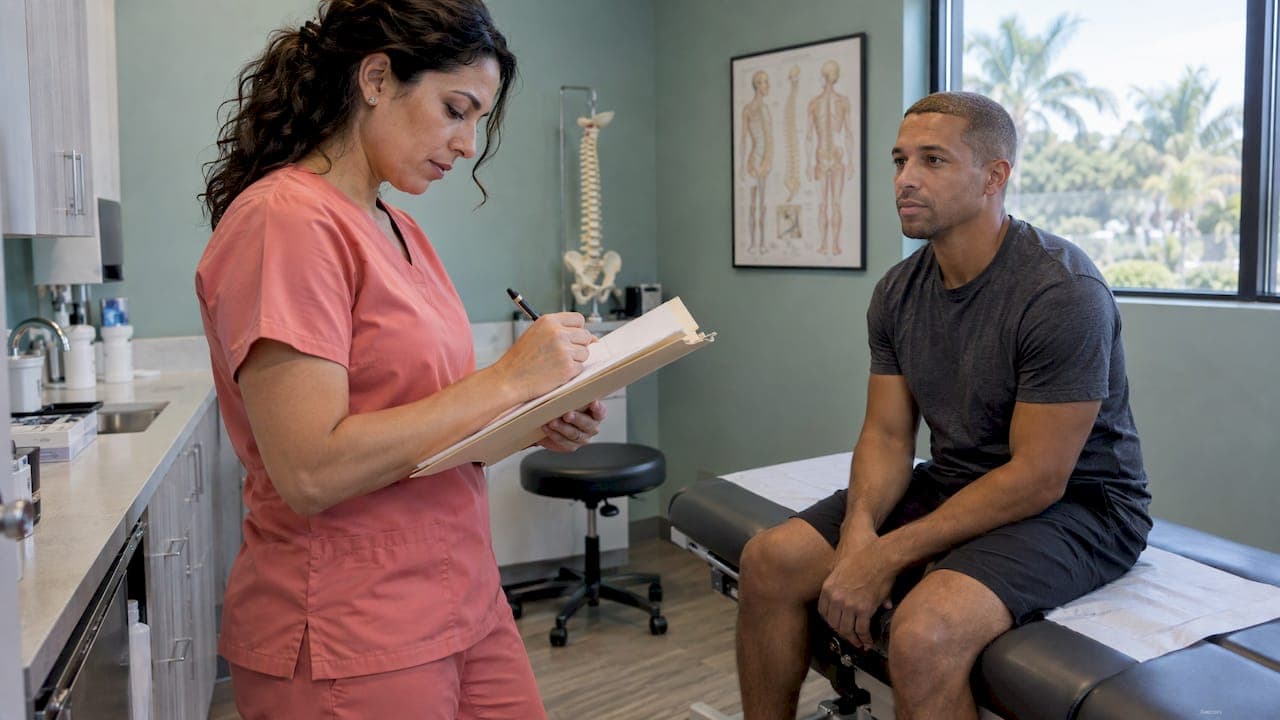
Chiropractic records support an injury claim when they tell one clear, dated story: how the accident happened, what you felt, what the exam found, what treatment you received, and how you responded. Gaps, vague notes and missing visits weaken that story. Complete, consistent charts strengthen it. Below is what a strong file contains, how to keep it that way, and what to check before and after your first adjustment.
TL;DR
- A claim-ready chart includes the accident mechanism, symptom details, objective exam findings, a diagnosis, a written treatment plan and a note on your response at every visit.
- A record that only says "patient reports pain" is thin. Federal guidance for chiropractic documentation asks for more than pain alone.
- Start care promptly and keep appointments consistent, so the chart shows a continuous timeline from the collision to recovery.
- Adjustments are generally low risk, but neck pain with weakness, numbness or confusion needs urgent medical evaluation first.
- Coverage depends on your policy, your state and the crash, so confirm benefits with your insurer or attorney.
Table of Contents
- Why chiropractic records matter in an injury claim
- What a strong chiropractic record includes
- Quick reference: what each part of the chart proves
- Start early and stay consistent
- Is an adjustment safe after a car accident?
- What the claim reviewer is looking for
- How to protect your own file
- What happens at a documentation-focused first visit
- Perspective: why we treat the chart as part of the care
- Care and pricing at Sparkmed
- Common mistakes that weaken chiropractic records
- Frequently asked questions
- Sources
Why chiropractic records matter in an injury claim
The records are the evidence. Anyone reviewing your claim, whether an insurer, an adjuster or an attorney, was not in the exam room. They read the chart to decide whether the care was connected to the collision, supported by examination findings, and reasonably necessary.
A chart does two jobs at once. It guides your treatment, and it documents the injury. A well-kept file shows when symptoms began, how they changed and what the clinician did about them. A clinical article on charts as courtroom evidence stresses that documenting functional progress, such as improved range of motion or a greater ability to perform physical tasks, serves as objective proof that care is working and justifies continuing it.
That is why two patients with the same injury can end up with very different files. One chart has measurements, dates and a plan. The other has the same sentence copied into every visit.

What a strong chiropractic record includes
No single national checklist governs every claim, but the most detailed public standards agree on the core elements. The federal Medicare documentation checklist for chiropractors is a useful benchmark, even if you are not a Medicare patient, because it spells out what reviewers expect to see.
The initial evaluation
The first visit sets the foundation. According to the CMS documentation checklist for chiropractic doctors, the initial evaluation should capture:
- The accident or trauma mechanism
- Symptom quality, onset, duration, intensity, frequency, location and radiation
- Aggravating and relieving factors
- Prior treatment, medications and secondary complaints
- Any contraindications or risk discussion
- A musculoskeletal and nervous-system examination
The same checklist asks for the patient's name and service date, medical-necessity support, a diagnosis tied to a spinal level, and a treatment plan that states visit frequency, duration, goals and objective measures.
For a car accident, the mechanism matters more than most people expect. Where were you sitting? Which direction was the impact? Were you braced or caught off guard? Was your head turned? A chart that says only "MVA" gives a reviewer nothing to connect to a diagnosis.
A SOAP-style structure
A peer-reviewed chiropractic journal article on whiplash recommends SOAP-style notes: a subjective history of the injury mechanism and where the tissue was injured, whether the problem is new or old, what provokes and relieves it, pain quality and distribution, timing and treatment history. Then come objective examination findings, working diagnoses, treatment interventions and goals, and outcomes.

The authors explain that combining your account with objective data helps a clinician rule diagnoses in or out, choose a patient-centered treatment, and demonstrate improvement. That last part is what a claim reviewer is looking for.
Notes at every follow-up visit
Follow-up notes are where many files fall apart. Under the CMS checklist, subsequent visits should record changes in the patient's condition, findings, the treatment given and an evaluation of whether it worked. A note that simply repeats the first visit tells a reviewer nothing about progress.
Legibility, dates and communications
A Medicaid managed-care record-keeping standard for chiropractic care requires legible, dated records that identify the patient and the treating chiropractor. They must also include subjective complaints, objective findings, assessment, diagnosis, treatment or diagnostic studies, recommendations or education, and relevant communications or referrals.
Some state boards go further. Oregon's chiropractic rule also asks for the reasoning behind changes to a treatment plan, the body areas treated, the patient's response, written informed consent and clinically relevant communications. These are rules from other states, not Florida requirements, but they show what thorough documentation looks like.
Quick reference: what each part of the chart proves
| Record element | What it shows a reviewer |
|---|---|
| Accident mechanism | Why the injury is plausible and tied to the collision |
| Onset and symptom details | The timeline from crash to complaint |
| Objective exam findings | Measurable problems beyond your own report |
| Diagnosis | What is being treated, and where |
| Treatment plan with frequency and goals | Why the care is organized and necessary |
| Per-visit progress notes | Whether you are improving, and why care continues |
| Referrals and communications | Coordination with other providers |
| Discharge or reevaluation summary | The outcome and any remaining limits |
Start early and stay consistent
Symptoms from whiplash and similar injuries can be delayed, partly because adrenaline masks pain right after a crash. One legal guide for chiropractic patients advises prompt evaluation after a collision, both to catch latent injuries and to establish a timely, documented link between the accident and later symptoms.
In practice, three habits keep the timeline clean:
- Get evaluated soon. The earlier the first dated note, the easier it is to connect your symptoms to the collision.
- Describe symptoms the same way each time. If your neck pain moves into your shoulder, say so. If it has improved, say that too. Inconsistent descriptions invite questions.
- Keep your appointments, or explain a gap. If you miss weeks of care because of work, travel or illness, make sure the chart says why.
For a deeper walk-through, see our guide on how to document accident injuries for chiropractic records and the step-by-step injury documentation process.
Is an adjustment safe after a car accident?
For most people with soft-tissue neck and back complaints, a careful, properly assessed adjustment is a reasonable option. The National Center for Complementary and Integrative Health says spinal manipulation can cause temporary pain, stiffness or headache. It describes serious spinal, neurological or neck-artery complications as rare, and says practitioners should assess patients thoroughly, especially for underlying health problems.
That last point is why the initial exam and the record go together. The assessment, the screening for risk and your informed consent all belong in the chart before any adjustment happens.
Some situations call for medical evaluation first. Mayo Clinic notes that emergency diagnostic tests may be needed for a spinal cord injury when a person has neck pain and is not fully awake, or shows obvious weakness or neurological injury. It adds that urgent attention is critical to limit the effects of a head or neck injury. So if you have any of the following after a crash, go to an emergency room before a chiropractic visit:
- Severe neck pain together with numbness, tingling or weakness in the arms or legs
- Loss of consciousness, confusion or a head injury
- Loss of bladder or bowel control
- Sudden severe headache, vision changes or trouble speaking
After ER clearance, bring your discharge paperwork and any imaging to your first chiropractic visit. It becomes part of your timeline.
Mayo Clinic also advises that neck manipulation should not involve quick, forceful motions, since rarely it can damage blood vessels. It is fair to ask your clinician what technique they plan to use and why. For more on what to expect, read our chiropractic tips after a car accident.
What the claim reviewer is looking for
Insurers and adjusters tend to ask the same few questions of a chiropractic file:
- Is the care related to the accident? The mechanism, onset and body regions should line up.
- Is it supported by exam findings? Objective data, not just your report.
- Is it necessary? A plan with goals and measurable progress answers this.
- Is the timeline continuous? Long unexplained gaps raise doubts.
- Is it consistent with your policy? Coverage terms differ by policy and state.
CMS states plainly that a claim reporting only pain is not enough. It expects pain location and vertebral level, medical-necessity support, a treatment plan and a record of treatment effectiveness. That is Medicare's standard, but it is a sound model for any file.
How to protect your own file
You do not write the chart, but you influence it.
- Tell the full story at intake. Include prior injuries and earlier neck or back problems. Accurate history protects you.
- Report every symptom, including headaches, sleep trouble, numbness and limits at work or home. A symptom that never reaches the chart cannot support a claim.
- Ask what the plan is. You should know the visit frequency, the goals and how progress will be measured.
- Keep your own log. A short daily note on pain level and what you could not do helps you describe your symptoms consistently.
- Request copies periodically. Ask for your records, bills and any imaging reports so you can spot errors early. Florida patients should confirm the current request process with the clinic.
- Stay in touch with your attorney or insurer. If you have a claim, tell them where you are treated so billing and records reach the right place.
Who pays: PIP, MedPay, liability and health insurance
Whether chiropractic care is covered depends on your policy, your state and the circumstances of the crash. Personal injury protection, medical payments coverage, another driver's liability coverage and your health plan each follow their own rules, so ask your insurer which applies to you and what limits and conditions come with it. Florida is a no-fault state with its own timing requirements for starting treatment, so confirm those with your insurer or an attorney soon after the crash, not months later. Our article on how to maximize your insurance for chiropractic care after an accident covers the practical side.
What happens at a documentation-focused first visit
A thorough accident visit usually follows a predictable order, and knowing it helps you prepare:
- Intake and history. You describe the collision, your symptoms and your medical history.
- Examination. Range of motion, posture, palpation, neurological and orthopedic tests.
- Diagnosis and plan. A working diagnosis, the recommended treatments, visit frequency and goals.
- Consent. You are told the risks and benefits and agree in writing.
- First treatment, if appropriate. Some patients start the same day; others need imaging or an ER clearance first.
- Follow-ups. Each note records changes, treatment and response.
If your pain involves headaches, see our piece on post-accident cervicogenic headache. If you spend long hours on a phone or laptop, the text neck after an accident guide explains why that history belongs in the chart too.
Perspective: why we treat the chart as part of the care
At our clinic, we do not see documentation as paperwork that happens after treatment. We see it as part of treatment. When a patient arrives after a collision, we record how the crash happened, what hurts, what we measure and what we plan to do, because that is how we know whether care is working.
For more than 20 years we have treated accident victims in North Miami, and we have seen how often a good recovery is undermined by a thin file. That is why we aim for clear, dated, consistent notes at every visit, and why we bill insurance directly where coverage applies.
We also know that cost keeps people from getting evaluated. So we publish our prices, offer English, Spanish and Creole support, and provide Uber Health transport in North Miami, so getting to the first appointment is not the hardest part of recovery.
Spark
Care and pricing at Sparkmed
If you were hurt in a car accident, a work incident or a slip and fall in North Miami, we can start with an auto accident evaluation and build a documented plan around your findings. Our chiropractic adjustment is $45, and shockwave therapy is $75 per session. Our monthly wellness plans are listed on our pricing page: Essential at $149 per month, Performance at $249 per month and Elite at $399 per month.

Other therapies, including ultrasound, electrical stimulation, traction and decompression, and massage, are described on our services page. You can also read how shockwave therapy fits car accident recovery in North Miami before you book.
Common mistakes that weaken chiropractic records
- Waiting to start care. A long delay between the crash and the first note leaves room for doubt.
- Understating symptoms. Saying "I'm fine" at one visit can contradict a later complaint.
- Skipping visits without explanation. Gaps are one of the first things reviewers notice.
- Treating without a plan. Care with no stated goals is harder to justify as necessary.
- Leaving out prior history. Hidden earlier injuries tend to surface later and cause more trouble than disclosure would have.
- Never checking your records. Errors in dates or body regions are easiest to fix early.
Frequently asked questions
How long should I wait before seeing a chiropractor after a car accident?
See someone as soon as you reasonably can, ideally within days. Symptoms may be delayed, and an early dated evaluation links your complaints to the crash. If you have red-flag symptoms such as weakness, numbness, confusion or severe neck pain, go to the ER first.
What should my chiropractor write in my records?
At minimum: the accident mechanism, symptom details, exam findings, a diagnosis, a treatment plan with frequency and goals, and a progress note at each visit. Federal Medicare guidance also asks for medical-necessity support and an evaluation of treatment effectiveness.
Is a chiropractic adjustment safe after a car accident?
For most patients with soft-tissue complaints, a thorough exam followed by an appropriate adjustment is considered low risk. Temporary soreness or headache can happen, and serious complications are rare. A head injury or neurological symptoms need medical evaluation first.
Will insurance pay for my chiropractic care?
It depends on your policy, your state and how the crash happened. PIP, MedPay, liability coverage and health insurance each have different rules, so ask your insurer or attorney which applies and what documentation they require.
Can I get a copy of my chiropractic records?
Yes, you can ask the clinic for your records and bills. Ask early and again as treatment continues, so you can review them for errors and give them to your attorney or insurer when needed.
Sources
- Medicare documentation checklist for chiropractic doctors (CMS)
- Medical necessity and whiplash evaluation (Parker University journal)
- From clinic to courtroom: when the patient chart becomes evidence (Dynamic Chiropractic)
- Record keeping and documentation standards for chiropractic care (Louisiana Department of Health)
- OAR 811-015-0005 (Oregon chiropractic records rule)
- Chiropractic patient's guide to dealing with car accidents
- Spinal manipulation: what you need to know (NCCIH)
- Spinal cord injury diagnosis and treatment (Mayo Clinic)
- Most neck pain improves with self-care and time (Mayo Clinic)