
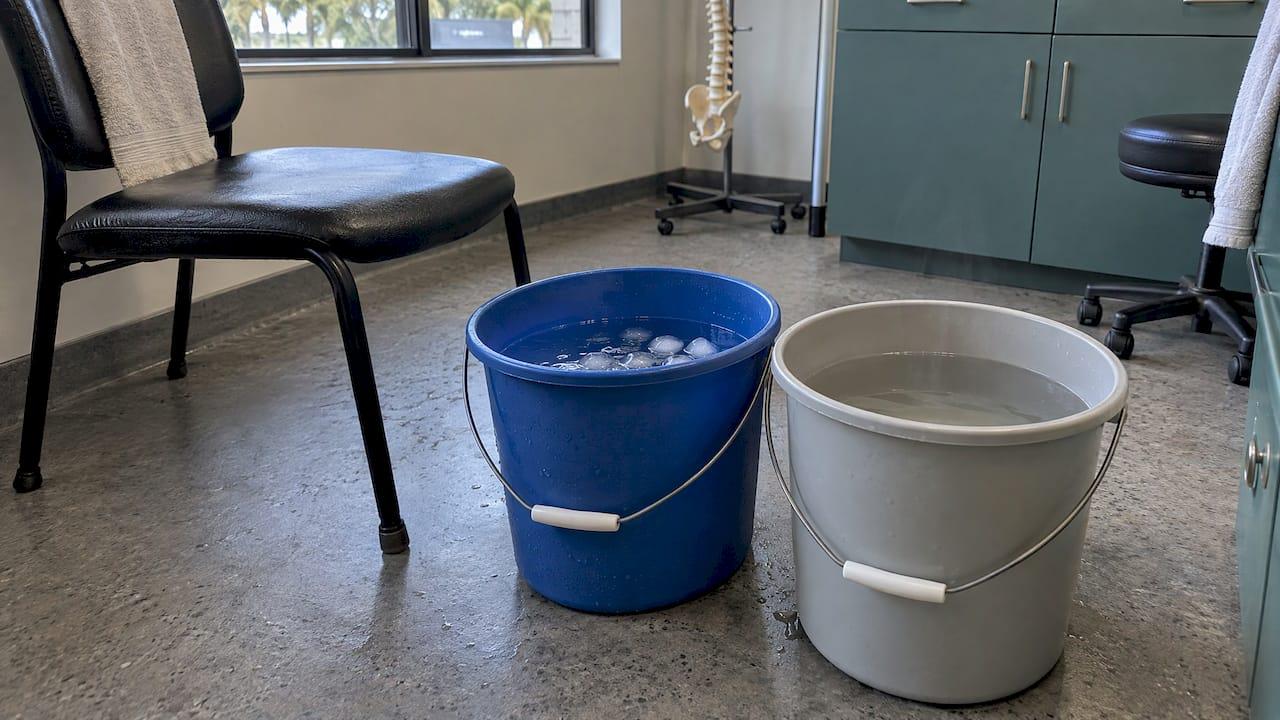
Contrast therapy means alternating heat and cold on an injured area. After a new injury, it does not come first. The first 24 to 72 hours belong to cold alone, and contrast comes in once the acute phase has settled. If you were hurt in a car accident, a fall or on the job, get the injury examined before you start, so the heat and cold support a plan instead of masking a problem. At Sparkmed in North Miami, heat/cold therapy is part of our care alongside adjustments, ultrasound and shockwave therapy.
TL;DR
- Use cold only during the acute inflammatory phase, roughly the first 24 to 72 hours after an injury. Contrast therapy comes after that.
- A common routine alternates warm and cold in a ratio of 1 to 3 parts warm to 1 part cold, for 10 to 20 minutes in total.
- Typical temperatures are 10 to 15 °C (50 to 59 °F) for cold and 38 to 40 °C (100 to 104 °F) for warm. Tissue above 45 °C (113 °F) can burn.
- People with heart or vascular disease, poor circulation, numbness or open wounds should check with a doctor first.
- After a crash, a fall or a work injury, have the area assessed first. Contrast therapy works best as one part of a recovery plan.
Table of Contents
- What contrast therapy is
- What the research says
- When to use it: new injury versus lingering pain
- How to do it: temperatures, ratios and time
- Who should skip it or check first
- When an injury needs an exam first
- How contrast therapy fits into a care plan
- Our perspective
- Start with an evaluation at Sparkmed
- FAQ
- Sources
What contrast therapy is
Contrast therapy alternates a warm application with a cold one. That can be a whirlpool or two buckets, or a heating pad followed by an ice pack. A sports medicine reference describes it as alternating thermotherapy and cryotherapy. The goal is pain control, less swelling and less soreness, and the whirlpool is the most common method.
The idea is simple. Cold narrows blood vessels and temporarily dulls pain. Heat relaxes muscle and improves mobility. A sports medicine physician explained to the AMA that the pairing creates a cycle of vessel contraction and then widening, which can lead to pain reduction and healing.
What the research says
A February 2025 scoping review in the Journal of Clinical Medicine covered 7 randomized controlled trials and 303 patients with painful musculoskeletal conditions treated with contrast therapy. Every study showed improvement from the starting condition. The authors also said the trials were of modest quality and that there are no clear clinical guidelines yet.
They concluded that contrast therapy should not be discouraged. They described its mix of better circulation, less inflammation, pain relief and faster recovery as a complementary option in pain management and functional recovery. They also called for larger studies on the best ratio, intensity, duration and patient groups.
The AMA's sports medicine source puts it in practical terms: it is a supportive recovery tool, not a therapy on its own. That is how we use heat and cold at Sparkmed too: next to hands-on care and rehabilitation, not instead of it.

When to use it: new injury versus lingering pain
Timing is the most common mistake, so here it is plainly.
The first 24 to 72 hours: cold only
Netter's Sports Medicine states that only cryotherapy should be used during the acute inflammatory phase, approximately 24 to 72 hours after injury. Heat applied too early can add to swelling. HealthyChildren.org, updated in January 2026, says heat should not be used right after an acute injury, because it may increase swelling and inflammation.
For a fresh sprain or a post-crash neck strain, that means ice, rest and getting the area evaluated. Our guide to cold therapy for sprains in the first 48 to 72 hours walks through the steps. If you suspect a broken bone, swelling is a bigger concern. See this explanation of compression therapy for fracture swelling and have the injury imaged.
Days 3 to 7 and beyond: contrast can enter
Once the acute phase passes, contrast therapy becomes an option. The ankle research shows how much timing matters:
- A 1988 study of postacute ankle sprains compared cold, heat and contrast baths on days 3 to 5. Cold produced the least swelling. Heat and contrast baths produced nearly identical increases. The authors concluded that cold was the best choice to minimize swelling before rehab exercise in that window.
- A later trial of 118 volunteers with subacute lateral ankle sprains, described in the 2020 Greenhalgh review, used lower-leg immersion alternating between 0 to 10 °C and 40 to 50 °C every minute for 15 minutes. Contrast therapy reduced swelling 3 days after treatment, while heat alone increased it. Heat eased pain more right away, with no significant pain difference after 3 days.
The 2025 review reports the same trial's swelling and pain findings for days 5 to 7 after injury. Contrast therapy reduced ankle volume at the end of each treatment day, and heat improved pain and range of motion.
The ACOEM guideline for ankle and foot disorders, effective January 29, 2026, gives contrast bath therapy for acute ankle sprain a rating of "No Recommendation, Insufficient Evidence." In practice, this means you should not use contrast baths in place of cold in the early days. Use them later, and treat them as one part of a plan.
Lingering stiffness and soreness
For pain that lingers weeks after a crash, a slip or repetitive work strain, there is no fixed calendar. The tissue is no longer in the acute phase, so heat has a role: it relaxes muscle and improves mobility. Alternating it with cold is a reasonable choice for stiff, achy areas before gentle movement. If the pain is not settling, that is a reason for an exam, not more heat and ice.
How to do it: temperatures, ratios and time
There is no official dosing standard. Researchers note significant variation among protocols, but the consensus ranges are 10 to 15 °C for cold and 38 to 40 °C for hot. The AMA article gives similar figures in household terms: cold at 10 to 15 °C (50 to 59 °F), hot tubs typically 100 to 104 °F.
Here is a routine that fits those ranges, using the duration Netter's describes: a warm-to-cold ratio of 1 to 3 parts warm per 1 part cold, for 10 to 20 minutes total.
- Confirm the phase. Make sure you are past the first 24 to 72 hours and that the injury has been examined.
- Prepare two containers or two packs. Use a warm one at about 100 to 104 °F and a cold one at about 50 to 59 °F. Check the warm one with your hand or a thermometer. Tissue above 45 °C (113 °F) can burn, so never use a heating pad on high.
- Start warm. Apply warmth for a few minutes. Use a towel barrier if you use a pad.
- Switch to cold for a shorter stretch, around one minute for each three of warm if you follow the 3 to 1 pattern.
- Repeat for a total of 10 to 20 minutes. Many protocols finish on cold when swelling is the concern. There is no proven best order, so go by how the area feels.
- Move gently afterward with the exercises your clinician gave you.
Stop if pain sharpens, the skin turns very red or white, or numbness or tingling appears.
Who should skip it or check first
This is the safety part, and it matters more than the technique.
- Heart and blood pressure conditions. The AMA article reports a sports medicine physician's caution that people with cardiac arrhythmias, uncontrolled high blood pressure, heart disease or vascular disease should be careful or avoid it. Cold raises heart rate, blood pressure and breathing rate.
- Circulation problems. UCSF lists poor circulation, peripheral vascular disease and Raynaud's phenomenon as reasons to avoid cold. It lists bleeding, vascular disease and deep vein thrombosis (a clot in a deep vein) among reasons to avoid heat.
- Skin and sensation. Do not apply heat over a numb area, an open wound or a burn. The same UCSF page lists burned or radiated skin and medicated ointments or menthol creams as reasons to avoid heat.
- Fever or heat stress. HealthyChildren.org advises against heat when body temperature is raised from fever or heat stress.
- Pregnancy, very young or older patients, and swelling. Hand therapists' training materials list pregnancy, impaired circulation, edema and very young or very old patients as precautions for superficial heat. In pregnancy, that includes no heat to the low back or abdomen and no full-body whirlpool.
If any of these applies to you, talk to your doctor before trying contrast therapy at home. If you are not sure, ask us when you come in.
When an injury needs an exam first
Contrast therapy treats symptoms. It cannot tell you what is damaged. These situations call for an assessment before any home routine:
- You were in a car accident, even a low-speed one, and have neck, back or shoulder pain, headaches or stiffness. Symptoms can appear days later.
- You slipped, fell or strained something at work and cannot bear weight or move the joint normally.
- Swelling, bruising or pain is increasing instead of easing after the first few days.
- You have numbness, tingling or weakness spreading into an arm or leg.
Two of our guides cover what to expect: how to reduce inflammation after an accident and a list of pain relief strategies for car accident recovery. For injuries from a crash, our overview of chiropractic methods that help healing after car accidents shows how care is usually layered.
How contrast therapy fits into a care plan
Heat and cold work best when they prepare the body for what comes next: gentle movement, hands-on treatment and rehab exercise. Done at home, the routine is only as good as the diagnosis behind it. In the clinic, it sits alongside other options on our services page, including ultrasound therapy, electrical stimulation, massage therapy and traction or decompression. We also offer an auto accident evaluation, so the plan starts from what is actually injured.

For stubborn soft tissue pain, shockwave therapy and electrical stimulation are part of our advanced options. Our guide to massage therapy after a car accident explains how soft tissue work can fit in, and what soft tissue therapy is covers the basics.
Our perspective
We treat accident and injury patients in North Miami, and the question we hear most about home care is when to use heat and when to use ice. Our answer is to start with an exam.
Cold belongs in the first days. Heat and contrast routines come later, when the injury has settled and the goal shifts to mobility. Research on contrast therapy is still developing, and the authors of the latest review say it should not be discouraged and that it can complement other treatment. That matches how we use heat and cold: as a supportive part of a plan built around a proper evaluation.
Our team offers spinal adjustments, ultrasound, shockwave therapy, electrical stimulation, traction and massage in one place, so heat and cold are one tool among several. Patients can get support in English, Spanish and Creole, and we offer Uber Health transport in North Miami. For accident cases we bill insurance directly and document the injuries thoroughly for claims.
Spark
Start with an evaluation at Sparkmed
If you are hurting after a crash, a fall or a work injury, the most useful next step is a visit. Chiropractic adjustments at Sparkmed are $45 per session. Shockwave therapy is $75 per session. Our monthly plans are Essential at $149, Performance at $249 and Elite at $399 per month. Details are on our pricing page. You can also book a chiropractic adjustment directly.
If you are not sure what happened to your body in the accident, ask for an auto accident evaluation. We will tell you which phase you are in and what to do at home.
FAQ
Does contrast therapy really help?
In a 2025 review of 7 randomized trials, all studies showed improvement in patients with painful musculoskeletal conditions. The trials were of modest quality, so the authors said clear conclusions on how it compares with other therapies are not yet possible. It is best used as a supportive tool alongside the rest of your care.
Can contrast baths help with a sprained ankle?
Sometimes, but not at the start. Cold alone is the choice in the first days. A trial in subacute sprains found contrast therapy reduced swelling three days after treatment, while heat alone increased swelling. Because the evidence for contrast baths in acute sprains is rated insufficient by one 2026 US guideline, have the ankle examined and use cold first.
How long should a contrast session last?
A commonly described pattern is 10 to 20 minutes in total, with 1 to 3 parts warm for every part cold. There is no proven best dose, so keep it moderate. Stop if the skin looks very red or white or you feel pain, numbness or tingling.
Is it safe if I have high blood pressure or heart disease?
Talk to your doctor first. Cold exposure raises heart rate, blood pressure and breathing rate, and sports medicine physicians advise caution or avoidance for people with arrhythmias, uncontrolled high blood pressure, heart disease or vascular disease.
When should I use contrast therapy for lingering pain?
Use it once the acute phase has passed and a clinician has confirmed there is no injury that needs other care. It suits stiff, achy soft tissue before gentle movement. If pain is not improving after a couple of weeks, schedule an evaluation.
Sources
- Mechanisms and Efficacy of Contrast Therapy, J Clin Med 2025 (PMC)
- Mechanisms and Efficacy of Contrast Therapy, J Clin Med 2025 (MDPI)
- AMA: 4 things to know about cold plunges and contrast therapy
- Physical Modalities in Sports Medicine (Netter's Sports Medicine)
- Greenhalgh et al., The Use of Contrast Therapy in Soft Tissue Injury Management
- Comparison of Three Treatment Procedures for Minimizing Ankle Sprain Swelling, Physical Therapy 1988
- ACOEM Ankle and Foot Disorders guideline, 2026
- UCSF: Treating Pain with Heat and Cold
- HealthyChildren.org: Treating Sports Injuries with Ice and Heat
- ASHT: Physical Agent Modalities for the Hand Therapist
- Compression therapy for fracture swelling