
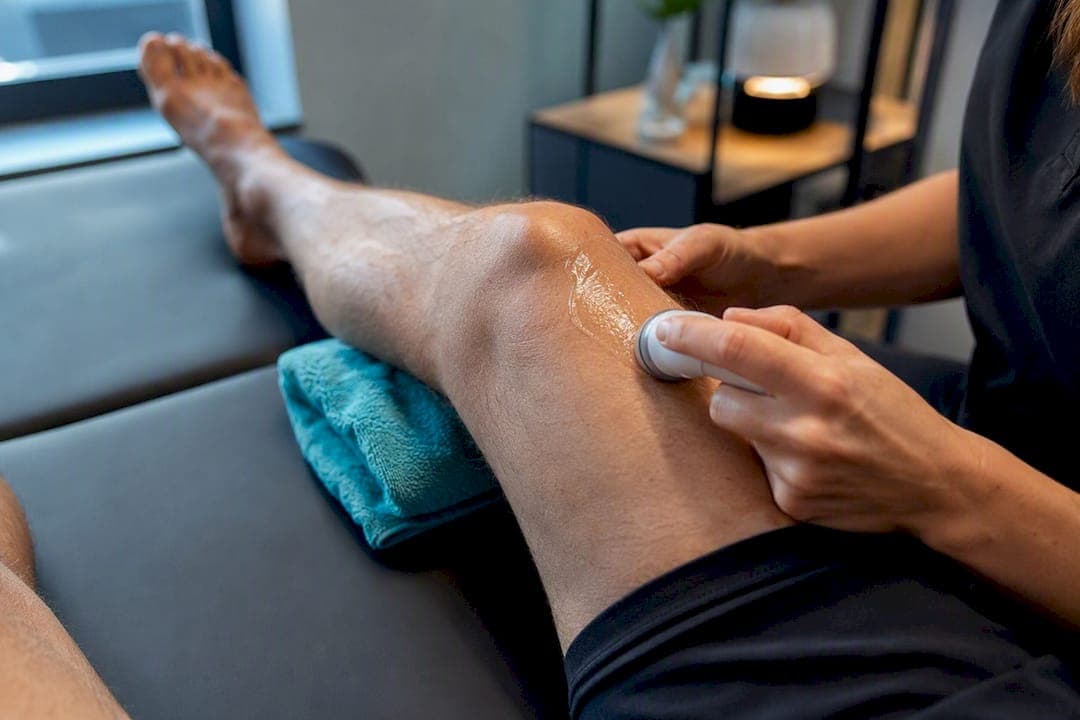
Ultrasound therapy works well for some injuries and barely moves the needle for others. A 2024 systematic review and meta-analysis found it significantly reduces pain from knee disorders, while shoulder pain and impingement showed no meaningful benefit. Low-intensity therapeutic ultrasound (LITUS) wearables show particular promise for myofascial pain and tissue healing. Used correctly by a trained provider, ultrasound is generally safe.
TL;DR:
- Ultrasound therapy is most effective for knee pain and myofascial pain syndrome, with significant benefits shown in clinical trials, especially when combined with other treatments.
- Proper technique, including continuous movement during application and the use of coupling gel, is crucial to avoid burns and enhance treatment safety.
- Low-intensity LITUS devices show promise for tissue healing but require daily use over weeks, not just a single session, to produce noticeable results.
- Ultrasound is contraindicated in cases of active infection, open wounds, pregnancy over the uterus, or nearby implants and metal hardware.
- It functions best as part of a broader rehab plan involving manual therapy, therapeutic exercise, and lifestyle modifications, not as a standalone cure.
Table of Contents
- How Ultrasound Therapy for Injuries Actually Works
- What the Research Says About Ultrasound Treatment for Pain
- Who Is a Good Candidate for Ultrasound Therapy
- What Happens During an Ultrasound Session
- Safety, Risks, and When Ultrasound Isn't the Right Call
- Cost, Timeline, and How Ultrasound Fits Into Recovery
- Getting the Most Out of Ultrasound Treatment Afterward
- Side Effects Beyond the Standard Warnings
- When to See a Professional Before Trying Ultrasound
- Our Clinical Perspective on Ultrasound Therapy
- How SparkMed Approaches Ultrasound-Assisted Recovery
- Sources
- FAQ
How Ultrasound Therapy for Injuries Actually Works
Ultrasound therapy pushes sound waves into tissue at frequencies too high for the human ear, and what happens next depends entirely on how the machine is set. Two distinct mechanisms are at play, and clinics often use both without patients realizing it.
Continuous mode produces a thermal effect backed by evidence. The wave energy is delivered steadily, tissue heats up, and blood vessels dilate. That increased circulation is what clinicians are after when treating stiff, chronically tight muscles, since warmer tissue stretches more easily and heals faster with better blood flow.
Pulsed mode works differently. The sound wave switches on and off rapidly, which limits heat buildup and instead triggers mechanical, non-thermal effects: microscopic bubble formation (cavitation) and a kind of cellular micro-massage that can increase membrane permeability. This is the mode favored for acute injuries where added heat could worsen swelling.
LITUS takes a third path entirely. Instead of a short burst of higher-intensity ultrasound in a clinic, LITUS delivers a much lower intensity over a far longer stretch of time, sometimes hours a day through a wearable device. It is a different dosing strategy, not just a weaker version of the same treatment.
A few settings determine what a session actually does:
- Frequency (measured in megahertz) controls depth. Lower frequencies (around 1 MHz) reach deeper tissue; higher frequencies (around 3 MHz) stay closer to the surface.
- Intensity determines how much energy reaches the tissue, measured in watts per square centimeter.
- Duty cycle is the ratio of "on" time to "off" time in pulsed mode, which shapes how much heat, if any, builds up.
Operator technique matters as much as the settings. The applicator has to keep moving in slow, overlapping strokes; the StatPearls clinical overview notes that letting the wand sit still can concentrate energy in one spot and cause a burn. Coupling gel is not optional either. Without it, air gaps reflect the sound waves before they ever reach the tissue.
Pro Tip: If a provider skips the gel or seems to hold the wand in one spot for more than a second or two, say something. That is the single most common technique error behind superficial ultrasound burns.
What the Research Says About Ultrasound Treatment for Pain
The evidence is stronger for some conditions than others, and the gap is wide enough that it should shape expectations.
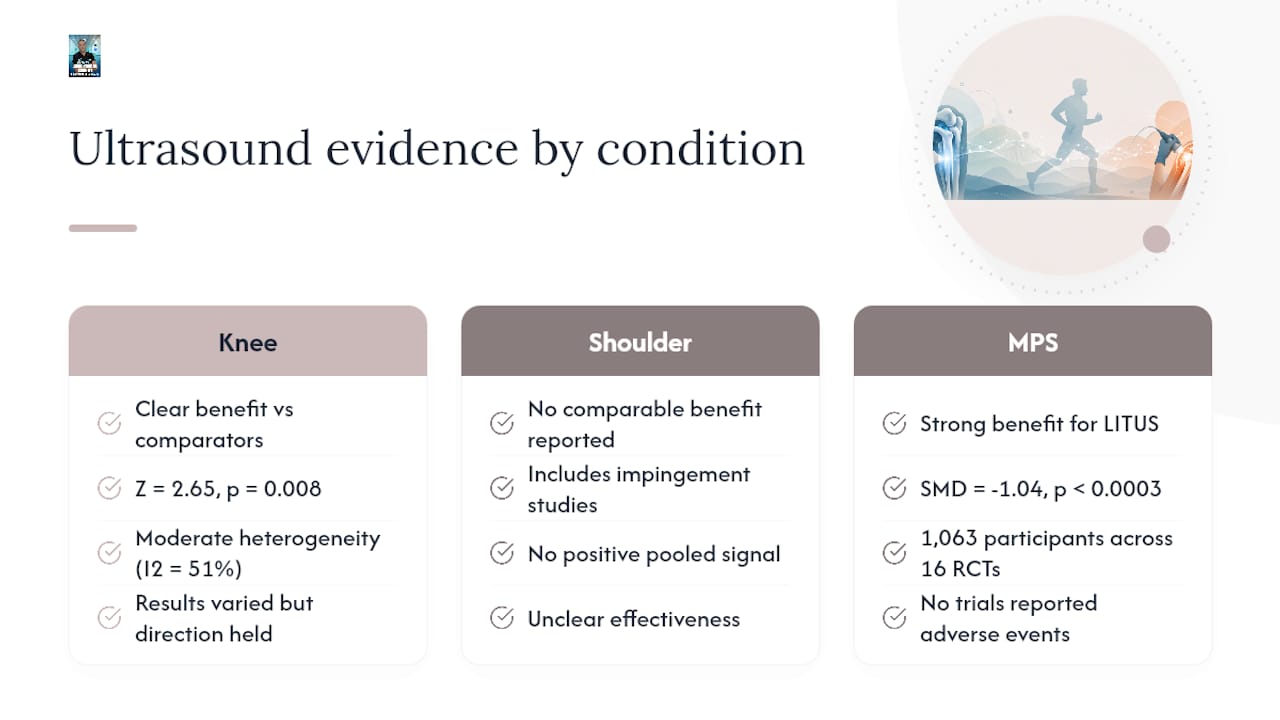
The clearest signal comes from knee disorders. The 2024 meta-analysis pooling multiple randomized trials found ultrasound significantly outperformed comparison interventions for knee pain, with a Z score of 2.65 and a p value of 0.008. That is a real statistical signal, not a borderline result.
The knee/shoulder split: The same meta-analysis found no comparable benefit for shoulder disorders, including impingement. Researchers reported moderate heterogeneity across knee studies (I2 = 51%), meaning results varied somewhat from trial to trial, but the overall direction held.
Myofascial pain syndrome (MPS) tells a similarly encouraging story for low-intensity ultrasound specifically. A 2024 systematic review covering 1,063 participants across 16 randomized controlled trials found LITUS reduced pain intensity with a standardized mean difference of negative 1.04, a large effect by conventional statistical standards, with a p value below 0.0003. Just as notable: none of the included trials reported adverse events.
Beyond pain scores, a broader 2024 clinical overview points to supportive mechanistic and animal-model data for LITUS in tendon, ligament, and bone healing, with some human trials showing measurable benefit. Multiple ultrasound devices carry FDA clearances for specific indications, though the overview is candid that debate continues over how much of the benefit comes from heating versus mechanical effects.
None of this adds up to a blanket endorsement. The same overview flags a recurring problem: studies mix ultrasound with other treatments, use inconsistent protocols, and rely on small sample sizes. That heterogeneity makes it hard to say exactly how much benefit comes from the ultrasound itself versus the exercise or manual therapy delivered alongside it. Combined with a myofascial release approach, results tend to be more consistent than ultrasound used in isolation.
Who Is a Good Candidate for Ultrasound Therapy
Knee disorders and myofascial pain syndrome sit on the stronger side of the evidence. Ultrasound also has a reasonable track record as an adjunct for tendon and ligament healing, particularly when paired with structured rehab. Shoulder impingement and general shoulder pain sit on weaker ground. If that is the primary complaint, a provider may lean more heavily on manual therapy or a shoulder-focused chiropractic approach instead.
Certain patient factors change the calculation entirely:
- Acute injuries with active swelling often call for pulsed, non-thermal settings rather than continuous heat.
- Open wounds, active infection, or unhealed skin near the treatment site rule out ultrasound at that location.
- Pregnancy contraindicates ultrasound directly over the uterus.
- Implants, pacemakers, and metal hardware require site-specific judgment from a qualified provider.
Before starting, tell the provider what you actually want out of treatment. Pain relief and tissue healing are different goals with different timelines, and ultrasound is rarely prescribed alone. It is typically layered into a broader plan that includes therapeutic exercise and manual work.
What Happens During an Ultrasound Session
In-clinic treatment and at-home LITUS look nothing alike, even though both fall under the same "ultrasound therapy" label.
- Prep. The provider applies a hypoallergenic coupling gel directly to the skin over the target area.
- Application. The applicator head is moved continuously in slow, overlapping circles or strokes. No anesthesia is needed, since therapeutic ultrasound is generally painless.
- Duration. A typical in-clinic session runs 5 to 10 minutes. Most patients feel mild warmth, and some feel nothing at all.
- Wrap-up. The gel is wiped off, and there is no recovery time needed before returning to normal activity.
LITUS wearables operate on a completely different schedule. These are prescription devices, worn against the skin and used daily, sometimes for multiple hours at a stretch, delivering a much lower intensity than a clinic unit over a far longer window. Providers select the frequency and intensity based on tissue depth and condition, then schedule follow-ups to track pain scores, range of motion, and function. If progress stalls or side effects appear, settings get adjusted, or the device gets pulled entirely.
Safety, Risks, and When Ultrasound Isn't the Right Call
Ultrasound therapy carries a low risk profile when a qualified provider handles it. The main danger is a superficial burn, and it almost always traces back to one mistake: a stationary applicator concentrating energy in a single spot.
Certain conditions rule ultrasound out entirely, or at least require a conversation with a provider first:
- Active infection or open wounds at the treatment site
- Uncontrolled bleeding disorders
- Pregnancy, when the target area is over the uterus
- Pacemakers or other implants, depending on proximity to the device
- Known malignancy near the treatment site
Pro Tip: Speak up the moment you feel unusual warmth or sharp discomfort during a session. A quick pause and skin check takes seconds and prevents nearly every superficial burn tied to ultrasound treatment.
Basic technique keeps the risk profile low: continuous applicator motion, adequate gel, and a provider who checks skin condition before and after treatment.
Cost, Timeline, and How Ultrasound Fits Into Recovery
Some patients feel looser or notice less pain immediately after a session, but that is not the same as tissue healing. The measurable clinical benefits documented in trials, the kind reflected in the knee and myofascial pain data above, usually build over several weeks of repeated sessions or consistent daily wearable use.
Insurance coverage varies by plan and diagnosis. Some indications for therapeutic ultrasound carry reimbursement codes, but coverage is inconsistent enough that confirming with your insurer before starting is worth the phone call.
Ultrasound rarely stands alone as treatment. It functions best as an adjunct layered into a broader rehab plan:
- Paired with manual therapy to address joint and soft-tissue restrictions
- Combined with a structured exercise program to build strength and range of motion
- Used short-term for pain control while longer-term tissue changes happen through movement and load
Think of it as a tool that makes the rest of rehab work better, not a replacement for it.
Getting the Most Out of Ultrasound Treatment Afterward
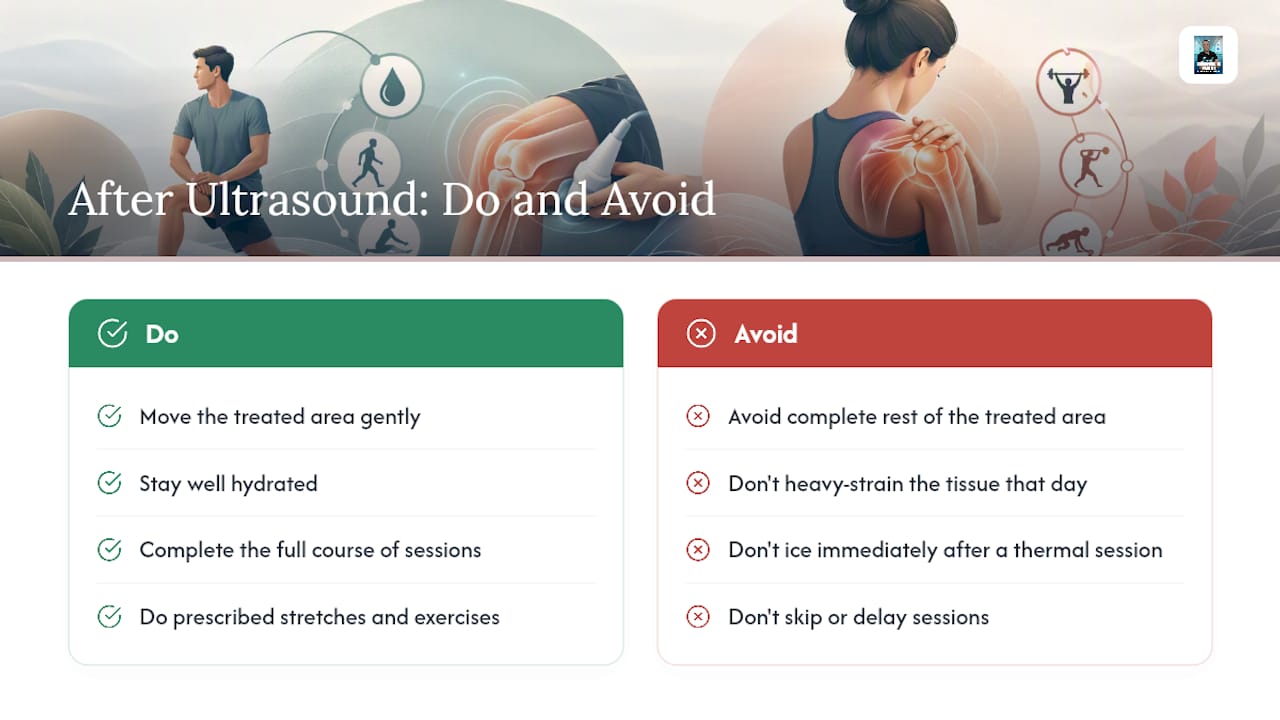
What you do in the hours after a session matters almost as much as the treatment itself. Gentle movement of the treated area, rather than complete rest, helps maintain the blood flow gains from a thermal session. Avoid heavy strain on the treated tissue for the rest of the day, especially if the goal was tissue healing rather than pure pain relief.
Hydration plays a supporting role too. Tissue repair depends on adequate circulation, and staying hydrated helps sustain the blood flow response that continuous-mode ultrasound is designed to trigger. Applying ice afterward is sometimes appropriate for acute injuries with swelling, but check with your provider first. Icing right after a thermal-mode session can work against the warming effect you just paid for.
Consistency drives the actual results seen in trials. A single session rarely changes much on its own. The knee and myofascial pain data cited earlier came from patients who completed a full course of treatment, not a one-off visit. Skipping sessions or stretching the schedule out too far dilutes the cumulative effect.
Pairing ultrasound with the rest of a rehab plan speeds things along. Providers often recommend specific stretches or therapeutic exercises to do between sessions, and skipping that homework is one of the more common reasons patients feel like ultrasound "didn't work" when the real issue was an incomplete plan. Watch the treated area over the following day for redness or unusual warmth that lingers, and mention it at the next visit even if it seems minor.
Side Effects Beyond the Standard Warnings
Superficial burns get most of the attention, but they are not the only possible reaction. Some patients report mild, temporary tenderness or redness at the treatment site that resolves within a few hours, similar to the after-effects of a deep tissue massage.
Rare adverse reactions do exist, though the myofascial pain research cited earlier found zero adverse events across 16 randomized trials and over a thousand participants, which speaks well to the overall safety margin of low-intensity applications specifically. Higher-intensity continuous settings carry a somewhat higher risk profile than pulsed or low-intensity modes, simply because more thermal energy is involved.
Occasionally, patients with sensitive skin react to the coupling gel itself rather than the ultrasound. Switching to a hypoallergenic formulation usually resolves this without needing to stop treatment. And for wearable LITUS devices used over multiple hours daily, skin irritation from prolonged adhesive contact is more common than any reaction to the ultrasound waves themselves, worth mentioning at a follow-up if it happens.
None of these represent a reason to avoid ultrasound therapy outright. They are the kind of manageable, low-severity issues that a trained provider catches early because they are watching for them.
When to See a Professional Before Trying Ultrasound
Ultrasound therapy is not something to self-administer with a consumer device based on internet research. Before starting any course of treatment, a qualified evaluation should confirm the diagnosis, rule out contraindications, and set the right settings for your specific tissue and injury stage.
See a provider first if you have any of the following:
- Pain that has lasted more than a few days without improvement, or that is getting worse
- Swelling, visible bruising, or a suspected fracture
- Numbness, tingling, or weakness anywhere near the injury
- Any of the contraindications covered above: pregnancy, implants, active infection, or a history of cancer near the treatment site
A proper evaluation also determines whether ultrasound is even the right tool. Given the mixed evidence for shoulder conditions, a provider might steer a shoulder complaint toward manual therapy or targeted exercise instead of leading with ultrasound. That kind of judgment call only happens with a hands-on assessment, not a symptom checklist read online.
Our Clinical Perspective on Ultrasound Therapy
Ultrasound gets treated online as either a cure-all or a gimmick, and both takes miss the point. We use therapeutic ultrasound as one tool inside a broader accident and soft-tissue recovery plan, not as a standalone fix.
The decision between in-clinic ultrasound and prescribing a LITUS wearable comes down to the injury stage and the patient's goal. Some patients benefit from short, in-clinic sessions paired with spinal adjustment. Others managing slower-healing tendon or ligament issues may be better fit for daily low-intensity dosing at home, with scheduled check-ins to track actual progress.
The evidence supports ultrasound for specific conditions, not every ache that walks through the door. Respecting that distinction is what separates a useful adjunct therapy from a treatment applied out of habit.
— Spark
How SparkMed Approaches Ultrasound-Assisted Recovery
SparkMed treats accident and injury recovery in North Miami the same way the research above suggests it should be treated: as a combination of hands-on chiropractic care and targeted adjunct therapies, not a single fix. Our chiropractic team uses therapeutic ultrasound alongside spinal adjustments and manual therapy when the evidence supports it for a specific injury, whether that's a knee strain from a slip-and-fall or a soft-tissue injury from a car accident.

Booking a first visit is straightforward. Bring any prior imaging or medical records related to your injury, a list of current medications, and details about how the injury happened, especially for car accident or workplace claims. A first appointment typically includes an assessment of the affected area, a discussion of your recovery goals, and a plan that may combine chiropractic adjustments with ultrasound, heat or cold therapy, or shockwave therapy depending on what the injury actually needs. If you're recovering from a recent injury and want a clinical evaluation before starting any treatment, schedule a visit with SparkMed to find out which approach fits your case.
This article is general information, not a substitute for advice from a qualified doctor. Consult a qualified healthcare professional about your own circumstances before acting on anything here.
Sources
- Ultrasound therapy for pain reduction in musculoskeletal disorders: a systematic review and meta-analysis
- Systematic review: low-intensity ultrasound for myofascial pain syndrome (MPS)
- Ultrasound therapy overview - StatPearls / NCBI Bookshelf
FAQ
Does Ultrasound Therapy Really Work for Pain?
Evidence supports meaningful pain relief for knee disorders and myofascial pain syndrome, but a 2024 meta-analysis found no significant benefit for shoulder pain, so effectiveness depends heavily on the condition being treated.
What Are the Negative Side Effects of Ultrasound Therapy?
The main risk is a superficial burn from a stationary applicator, though mild, temporary redness or tenderness at the treatment site can also occur; serious adverse events are rare, with one large review reporting none across 16 trials.
Is Ultrasound Therapy Covered by Insurance?
Coverage varies by insurer and diagnosis. Some indications carry reimbursement codes, but patients should confirm coverage directly with their insurance provider and clinic before starting treatment.
How Long Does It Take for Ultrasound Therapy to Work?
Some patients notice immediate, temporary relief after a session, but the measurable clinical benefits documented in trials typically build over several weeks of repeated in-clinic sessions or consistent daily LITUS wearable use.
Is Ultrasound Therapy Better Than TENS for Injury Pain?
They work through different mechanisms. Ultrasound targets tissue directly with thermal or mechanical effects, while TENS blocks pain signals through electrical stimulation, and many rehab plans use both rather than choosing one over the other.