
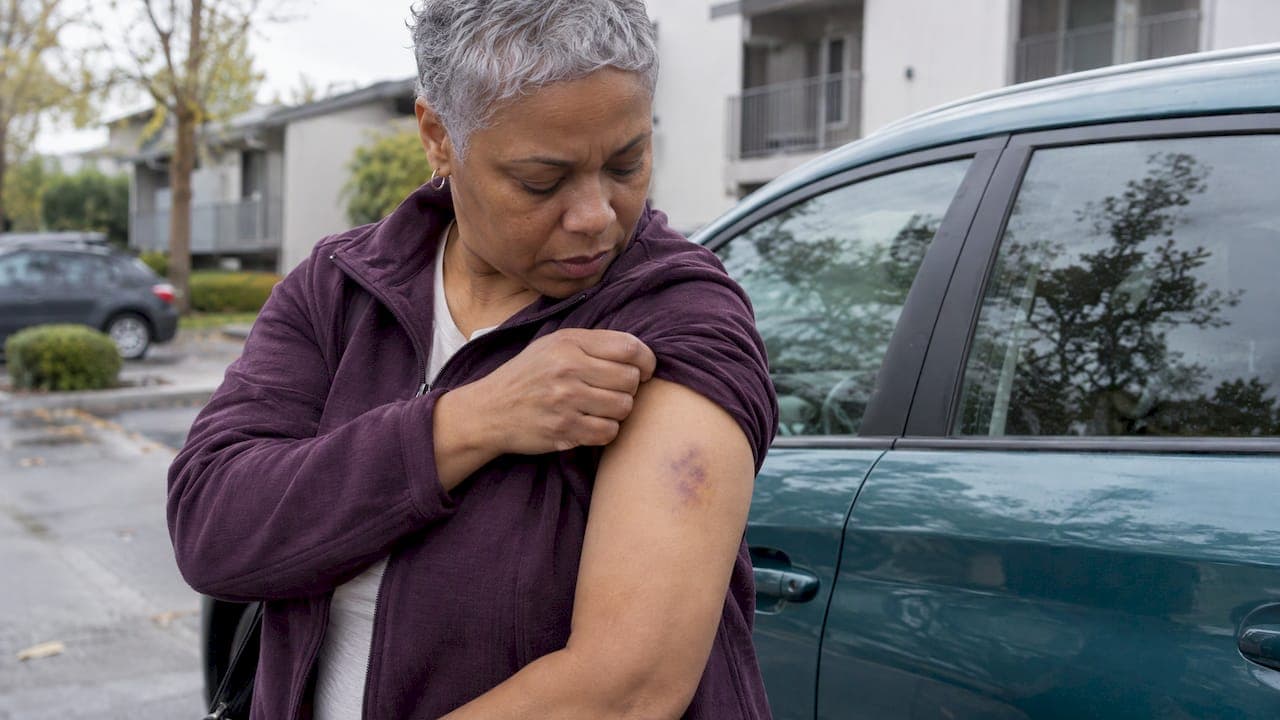
A bruise that appears a day or two after a crash is common, and it usually means blood slowly leaked under the skin and took time to reach the surface. Most of these bruises fade on their own. But a bruise that grows, hurts more each day, or sits over your belly or chest after a seat belt hit you deserves a prompt medical exam. This guide explains the usual timeline, the red flags, and what to do in the first days, especially if you were hurt in or around North Miami.
TL;DR
- Bruises often show up 12 to 36 hours after impact, and deeper ones can take longer to surface.
- A seat belt bruise across the chest or abdomen should be examined by a doctor, even if you feel fine.
- Go to the emergency room for trouble breathing, vomiting blood, blood in stool or urine, fainting, or extreme pressure in a bruised area.
- Photograph the bruise daily and write down your symptoms. These notes help your care and any insurance claim.
- Once serious injury is ruled out, a chiropractic exam can check the spine and soft tissue that took the force of the crash.
Table of Contents
- Why a bruise can show up late
- A realistic timeline
- Seat belt bruising deserves special attention
- Warning signs that mean act now
- Is a lump under the bruise normal?
- What to do in the first days
- Bruising is rarely the only thing that is delayed
- Our perspective: look past the bruise
- How chiropractic care fits after a crash
- See us in North Miami
- FAQ
- Sources
Why a bruise can show up late
A bruise is blood that has leaked from small vessels and pooled in the tissue around them. After a collision, vessels can tear under the skin without any mark at first. The blood needs time to collect and travel toward the surface, and the swelling that follows an impact can slow that process. That is why the shoulder that felt merely sore on Tuesday may be purple on Thursday.
Depth matters too. A bruise in the skin shows quickly. A bruise in the muscle or around a joint sits farther from the surface, so it may appear late or only as a dull, spreading discoloration. Adrenaline plays a role as well: in the minutes and hours after a crash, your body can blunt pain, so you may not notice the injury until the rush wears off.
The MedlinePlus encyclopedia entry on bruises is a good plain-language reference for what a bruise is and when it needs care.
A realistic timeline
Plan for a window, not a single day. One legal-industry guide reports that bruises usually appear within 12 to 36 hours, that bruises which do not break the skin typically fade in five to seven days, and that deep bruises can take two weeks to a month to clear. Treat those as general ranges. Your age, medications (blood thinners especially), and the force of the crash all change them.
Here is what the pattern often looks like:
| Time after the crash | What you may notice | What to do |
|---|---|---|
| First hours | Soreness, stiffness, maybe nothing visible | Get checked if you have any pain, even mild |
| Day 1 to 2 | Red or purple marks, swelling, tenderness | Photograph the area, note pain levels |
| Day 2 to 3 | Larger or darker bruising, new areas appear | Call a provider if it spreads or hurts more |
| Days 4 to 14 | Color shifts and fading, stiffness may linger | Keep tracking; lingering pain needs an exam |
| After two weeks | A bruise that is not fading, or a firm lump | Have it evaluated |
A bruise that follows a normal course gets lighter and less painful as days pass. One that gets bigger, harder, or more painful is behaving differently, and that is the signal to call.
Seat belt bruising deserves special attention
The seat belt saves lives, and it also leaves a mark. A band of bruising across the chest, shoulder, or lower abdomen is one of the most common crash findings, and it can hide injury underneath. Researchers reviewing seat belt injuries in a surgical journal article on PubMed Central found that a visible seat belt contusion is associated with a threefold higher incidence of intestinal perforation. They also note that some of these injuries become apparent days after the accident, which is why the authors suggest emergency departments consider CT scanning for patients with visible seat belt bruising.
In plain terms: do not wait for a seat belt bruise to "declare itself." If you have one, especially on the abdomen, tell a doctor about it and about how the crash happened. Mention it even if the pain is mild.
If you want a patient-level explanation, the ECU Health guide to seat belt contusions after a motor vehicle accident lists what to watch for afterward.

Warning signs that mean act now
Most bruises are harmless. These are not the ones to watch and wait on.
Go to the emergency room or call 911 for
- Extreme pressure in a bruised area, particularly if it is large or very painful. MedlinePlus lists this as a reason to seek emergency care right away.
- Trouble breathing, a changing heart rate, vomiting or coughing up blood, or loss of consciousness after a blow. The Cleveland Clinic page on blunt force trauma names these as signs that need emergency care.
- Bloody or black stool, bloody urine, or blood in vomit, which ECU Health describes as signs of severe internal bleeding.
Call a doctor promptly for
- Bruising that keeps getting worse, severe pain, or sudden numbness or weakness. UPMC's soft tissue injury guidance lists these as reasons to call.
- Dizziness, nausea, vomiting, or confusion after hitting your head. Tell your doctor right away, even if the bruise on your head is small.
- Signs of infection around the bruise: streaks of redness, pus or other drainage, or fever, per MedlinePlus.
The common thread is change. A bruise that is spreading, hardening, or paired with other symptoms is telling you something your skin alone cannot.
Is a lump under the bruise normal?
Sometimes. A lump over a bruise can be pooled blood, called a hematoma. The Mayo Clinic's first aid page on bruises says a lump over a bruise may be a sign of pooling blood. The Cleveland Clinic describes a hematoma as a larger collection of blood outside the vessels that is typically raised and painful to touch, and notes it may require medical attention.
A small, tender knot on the thigh or upper arm after a direct hit is common. A growing, hot, tense, or very painful lump is not something to massage or ignore. Have it looked at before you try any hands-on therapy on it. That includes massage, which we cover later.
What to do in the first days
You do not need to be a medical expert. You need a routine.
- Get evaluated. If you were in a crash and have any pain, bruising, or a seat belt mark, see a medical provider. Choose the emergency room if any red flag above applies.
- Photograph the bruise every day. Use the same lighting and distance, and put a coin or ruler in the frame for scale. Date each photo.
- Keep a symptom log. Write down pain levels, stiffness, headaches, and anything that limits work, driving, or sleep.
- Use ice early. The Cleveland Clinic notes that applying ice soon after an injury can minimize bruising. Wrap it in a cloth and keep sessions short.
- Do not skip follow-up visits. Delayed injuries often reveal themselves at the second or third visit, when your provider can compare how you look now with how you looked before.
- Keep the paperwork together. Medical bills, visit summaries, and photos all matter later.
Compression is one tool people reach for when swelling is part of the picture. If you want background on how it is used in medical settings, this overview of compression therapy medical uses covers four of them. Ask your provider before wrapping a fresh injury, since too much pressure on a large hematoma can cause problems.
If you are building a record for an insurance claim, our guides on documenting your injury step by step for claims and documenting accident injuries for chiropractic records explain what to capture and why. For the bigger picture of what can appear days later, see our list of 15 symptoms to watch for after car accidents.
Bruising is rarely the only thing that is delayed
The same forces that cause a late bruise also cause late pain. A bruise on the shoulder or neck often sits next to strained muscles, irritated ligaments, or joints that were pushed past their normal range. Those problems do not always show on the skin, and they tend to announce themselves as stiffness when you wake up, a headache at the end of the day, or a sore back after a few hours of driving.

That is why a bruise is a useful clue. It tells you where force landed. If the mark sits across your collarbone and shoulder, the neck and upper back took the same load. If it sits low across the hips, the lower back and pelvis deserve attention. Our article on why delayed pain after a car accident happens and what to do walks through the 24 to 72 hour window in more detail, and the post on acting within 24 to 72 hours covers the practical steps.
Our perspective: look past the bruise
We treat accident patients in North Miami every week, and the pattern is familiar. Someone walks in four days after a collision. They felt "mostly fine" at the scene, and now there is a purple band across the shoulder and a neck that will not turn. The bruise brought them in, but the bruise is rarely the whole story.
Our approach starts with a careful accident evaluation: how the crash happened, where the force went, and what the body is doing now. If anything suggests internal injury, we send you for emergency or imaging care first. That is not negotiable, and no spinal adjustment should ever come before it. Once serious injury is ruled out, we look at the spine, the joints, and the soft tissue around the bruised area.
From there, care can include gentle spinal adjustments, and for many patients modalities such as ultrasound therapy, electrical stimulation, traction or decompression, and shockwave therapy. We choose based on what the exam finds, not on a package. Our team has spent more than 20 years working with accident victims, we offer care in English, Spanish, and Creole, and we document injuries carefully so your records reflect what actually happened to you.
The earlier a delayed injury is found and written down, the easier it is to treat and to explain to an insurer. That is the main reason we encourage people to come in early, even when the pain feels small.
Spark
How chiropractic care fits after a crash
Chiropractic care is not a substitute for emergency medicine, and it should not be started over a fresh, expanding hematoma. Where it helps is the recovery phase: restoring motion in stiff joints, easing muscle tension, and monitoring how your body responds from visit to visit.
At our clinic, the starting point is an auto accident evaluation. From there, the options listed on our services page include massage therapy, electrical stimulation, ultrasound therapy, and traction or decompression. Not every patient needs every option, and some need only a few visits. For a deeper look at two of the most asked-about choices, read our guides to massage therapy after a car accident and shockwave therapy for car accident injuries in North Miami. If you want to understand how a longer plan unfolds, see our four-stage treatment plan after a car accident.
If your claim is still in progress, our walkthrough of the auto injury claim process shows where treatment records fit in.
See us in North Miami
If you have a bruise that surfaced days after a crash and no red flags, a visit with us is a practical next step. A chiropractic adjustment is $45, and a shockwave therapy session is $75. If you prefer a monthly structure, our plans are Essential at $149 per month, Performance at $249 per month, and Elite at $399 per month. You can see everything on our pricing page, and you can book through our main site. We offer transportation through Uber Health in North Miami for patients who need a ride.
Bring any photos you have taken, the name of anyone who treated you at the scene, and your insurance details if you have them. Tell us exactly where the bruise is and how your seat belt sat. That one detail changes how we examine you.
FAQ
How long after a car accident can a bruise appear?
Most bruises show within about 12 to 36 hours, though deeper ones can take a few days to reach the surface. If a mark appears later than you expected, that does not mean it is unrelated to the crash. Tell your provider the timeline so they can judge it properly.
Does delayed bruising mean internal bleeding?
Not usually, but it can, especially with seat belt marks on the chest or abdomen. Warning signs include severe or worsening pain, dizziness, vomiting, blood in stool or urine, and trouble breathing. If any of these appear, go to the emergency room rather than waiting to see how the bruise looks tomorrow.
Is a hematoma from a seat belt normal?
A small raised, tender lump over a bruise can be a hematoma, which is pooled blood. It is common after a direct impact, but a lump that grows, feels tense, or is very painful needs medical attention. Avoid massaging it until a provider has examined it.
Should I see a chiropractor or a medical doctor first?
If you have red-flag symptoms, a head injury, or a large seat belt bruise on the torso, start with emergency or medical care. Once serious injury is ruled out, a chiropractor can evaluate the spine and soft tissue and help with recovery. Many patients use both.
What can I do at home for a new bruise?
Apply a wrapped ice pack early, keep the area rested, and photograph it daily. Watch for changes in size, hardness, or pain. Check with a provider before using compression or heat on a large or growing bruise.
Sources
- Bruise: MedlinePlus Medical Encyclopedia
- Bruise: First aid, Mayo Clinic
- Bruises (Ecchymosis), Cleveland Clinic
- Blunt Force Trauma, Cleveland Clinic
- Soft Tissue Injuries: Sprains, Strains, Bumps, and Bruises, UPMC
- Seat belt-related injuries: A surgical perspective, PubMed Central
- Motor Vehicle Accident (MVA): Seat Belt Contusion, ECU Health
- Bruises From Car Accident, Chaikin & Sherman
- Compression Therapy: 4 Medical Uses Backed by Evidence