
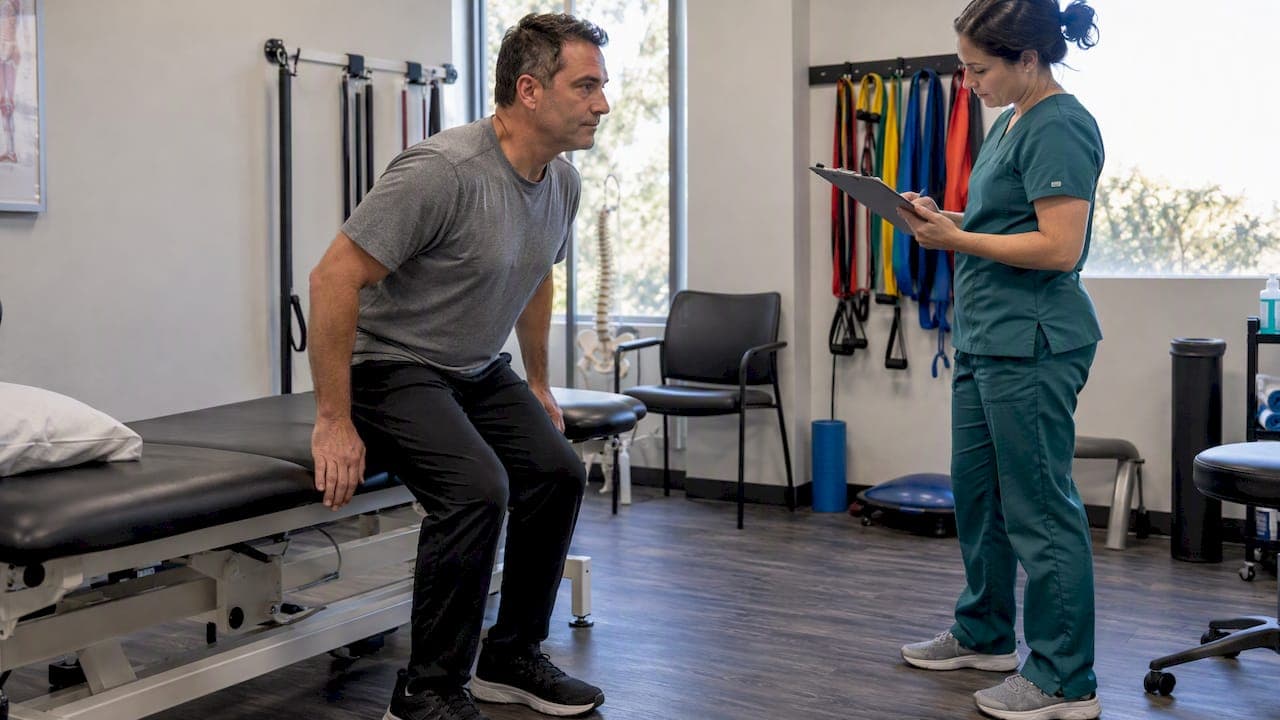
After a car accident, the most important next steps are a prompt medical evaluation, documented treatment, and an activation-based rehabilitation plan guided by a clinician. A typical plan moves from evaluation to pain control to graded activity and follow-up. Most people recover within weeks; some injuries take months, so early documentation and consistent care matter from day one.
TL;DR:
- Symptoms can emerge hours to days after a crash; worsening headache, repeated vomiting, seizures, slurred speech, confusion, or weakness require emergency care.
- Short rest, heat or cold, and nonprescription medication may help, but prolonged foam collar use delays normal motion; supervised exercise and manual therapy guide recovery.
- Clinicians use radiographs or CT scans when they suspect fracture or internal bleeding, reserving MRI for numbness, tingling, or weakness that persists into later weeks.
- If pain or restricted motion has not meaningfully improved by six weeks, revisit the plan; symptoms lasting beyond three months warrant discussing escalation.
- Keep dated symptom notes, visit records, imaging reports, and receipts; insurers may use gaps in early treatment to question whether injuries relate to the crash.
Table of Contents
- Recovery Timeline: What Happens From the ER Through Chronic Care
- The Core Pieces of a Post-Accident Treatment Plan
- How Often You'll Be Seen and What Signals a Problem
- Why Documentation Matters for Both Recovery and Claims
- What a Multimodal Recovery Pathway Looks Like in Practice
- Where Massage Therapy Fits Into Recovery
- Keeping Your Recovery on Track Between Visits
- Why Early, Consistent, Activation-Based Care Matters
- How We Support Your Recovery From the First Visit
- FAQ
- Sources
Recovery Timeline: What Happens From the ER Through Chronic Care
Recovery after a crash tends to follow four overlapping stages, and knowing what belongs in each one helps you recognize normal progress from a problem that needs attention.
- Emergency phase (first 24 to 72 hours): Emergency staff prioritize unstable vitals and neurologic signs, ordering imaging when there is suspected fracture, internal bleeding, or head trauma.
- Acute phase (0 to 2 weeks): Symptoms like neck stiffness, headaches, or soreness often emerge over this window rather than immediately, which is why Mayo Clinic notes that whiplash and mild TBI symptoms commonly appear hours to days after the collision rather than on impact.
- Subacute phase (2 to 12 weeks): This is where supervised exercise and manual therapy do the most work, with progress measured in range of motion and reduced pain rather than complete symptom absence.
- Chronic phase (beyond 3 months): When symptoms persist past this point, interdisciplinary care becomes more relevant.
The acute phase is where many people make a mistake: resting too long. Mayo Clinic's guidance on whiplash care states that short rest, heat or cold, and over-the-counter medication are reasonable first steps, but prolonged immobilization with a foam collar is discouraged because it delays the return of normal motion. A clinical practice guideline on neck pain and whiplash-associated disorders backs this up, recommending supervised graded exercise and manual therapy for recent-onset neck pain rather than extended rest.
By the subacute phase, most patients are working through structured rehab, often two to three visits a week, with milestones tied to function rather than the calendar. Chronic whiplash-associated disorder, defined as symptoms lasting longer than three months, is where a systematic review of noninvasive interventions found that exercise programs are the most effective option available, even though evidence quality varies across studies. If you are still dealing with significant pain or restricted motion at the three-month mark, that is the point to ask your provider about escalating or adjusting the plan rather than waiting it out. For a more detailed breakdown of exercises by phase, our step-by-step whiplash recovery guide walks through what a structured program looks like week by week.
The Core Pieces of a Post-Accident Treatment Plan
A treatment plan after a car accident usually has four building blocks, and knowing what each one is for helps you recognize whether your own care is on track.
- Medical evaluation and imaging: X-rays or CT scans are typically ordered when a fracture or internal bleed is suspected, while MRI is reserved for persistent neurologic symptoms like numbness, tingling, or weakness that don't resolve in the first weeks.
- Pain control: This usually starts with over-the-counter medication and heat or cold, moves to short-course prescription medication if needed, and only considers procedural options when conservative measures fail.
- Activation-based rehab: Supervised graded exercise, home range-of-motion work, and progressive strengthening form the backbone of recovery, a point the clinical practice guideline on neck pain and WAD makes explicitly in its recommendations for recent-onset cases.
- Manual therapy and modalities: Hands-on techniques, ultrasound, and electrical stimulation are generally used alongside exercise, not instead of it, as part of a multimodal approach.
Multimodal care means combining manual therapy with exercise rather than relying on just one tool, and the same guideline cited above supports this combination for both recent-onset and persistent neck pain. Modalities like heat, ultrasound, or electrical stimulation tend to work best when they reduce pain enough for you to tolerate the exercise portion of your plan, not as standalone treatment.
Psychological support deserves a place in this list too. Trauma recovery after a collision often carries an emotional component: anxiety about driving again, disrupted sleep, or symptoms resembling PTSD. Addressing these alongside physical rehab tends to improve overall outcomes, since fear of movement can slow physical progress just as much as the injury itself.
Pro Tip: Ask your provider for a written home exercise plan at your first rehab visit so you have something concrete to follow between appointments.
How Often You'll Be Seen and What Signals a Problem
Visit frequency and progress checkpoints follow a fairly predictable pattern in the first three months, and knowing what to expect helps you tell normal recovery from a plan that needs adjusting.
- Weeks 1 to 2: Visits focus on evaluation, short-term pain control, and starting gentle activation rather than full rehab.
- Weeks 2 to 6: Appointments shift toward supervised exercise progression, with providers tracking neck range of motion and pain scores at each visit.
- Weeks 6 to 12: This is typically when return-to-work or return-to-driving guidance gets finalized, based on functional improvement rather than a fixed date.
A substantial portion of patients with whiplash-associated disorders report persistent pain months or years after the initial injury, according to Mayo Clinic's update on whiplash-associated disorder management, which is part of why early, structured, consistent treatment matters so much in the first weeks.
If you aren't seeing meaningful improvement by the six-week mark, or if new neurologic symptoms appear, that's the signal to revisit the plan with your provider rather than continuing the same approach. Certain symptoms require immediate emergency care rather than a scheduled follow-up. The CDC's guidance on traumatic brain injury lists worsening headache, repeated vomiting, seizures, slurred speech, confusion, and weakness as danger signs that warrant an emergency room visit, not a wait-and-see approach.
Why Documentation Matters for Both Recovery and Claims
Consistent, well-documented care does double duty: it keeps your treatment on track and it protects you if you later need to support an insurance claim. Gaps in early treatment are commonly used by insurers to argue that an injury was unrelated to the crash, which is one more reason not to delay that first evaluation even if pain hasn't shown up yet.
Keep copies of everything connected to your care:
- ER reports and discharge instructions
- Imaging results and radiology reports
- Provider and therapy visit notes
- Receipts for medication, equipment, or treatment costs
- A simple symptom diary noting pain levels and what activities are affected
Before each visit, jot down how your symptoms have changed, what activities they're limiting, and any medications you've taken. This gives your provider a clearer timeline to work from and strengthens the written record of your recovery.
Pro Tip: Keep a dated symptom diary from day one, even brief notes help establish a consistent timeline if you need it later.

On the insurance side, notify your insurer promptly, keep copies of every document you send or receive, and ask directly what your policy covers for medical treatment. These are practical steps, not legal advice, so for anything specific to your claim, a legal professional is the right resource.
What a Multimodal Recovery Pathway Looks Like in Practice
A clinic-based pathway for accident injuries typically starts with a focused evaluation and builds from there based on what that evaluation finds.
- Auto accident evaluation: A focused exam identifies which structures are affected and establishes a baseline for tracking progress.
- Chiropractic care and activation-based rehab: Spinal adjustments paired with supervised graded exercise address both alignment and the strength and motion loss that follows a collision.
- Adjunct modalities: Shockwave therapy, ultrasound therapy, and electrical stimulation are layered in to support pain control and tissue recovery alongside the exercise program.
- Follow-up and milestones: Progress is tracked against function, range of motion, and pain reduction, with the plan adjusted as those markers improve.
We built this pathway around the idea that early, low-friction access to care changes outcomes. Multilingual support in English, Spanish, and Creole, transportation options, and an accessible first-visit offer all exist to remove barriers that otherwise delay that crucial first evaluation. Our chiropractic methods overview covers the specific techniques used in this kind of pathway in more depth.
Where Massage Therapy Fits Into Recovery
Massage therapy isn't a replacement for chiropractic adjustments or supervised exercise, but it plays a useful supporting role in a post-accident plan. Soft tissue work helps reduce muscle guarding and tension that often develops around the neck and shoulders after whiplash, which can make it easier to tolerate the range-of-motion exercises that drive actual recovery.
It's most useful in the acute and subacute phases, when muscle tightness is limiting how much activation-based rehab a patient can comfortably do. By easing that tension first, massage can make the exercise portion of a visit more productive rather than functioning as a standalone fix. It also tends to help with the sleep disruption and general tension that often accompany post-accident stress, which indirectly supports the psychological side of recovery.
The key is sequencing: massage works best as a complement to active rehab, not a substitute for it. A plan that relies on massage alone, without progressive exercise, tends to leave the underlying strength and motion deficits unaddressed. Within a multimodal plan, think of it as one tool among several, used strategically rather than as the main event. Our relief tips for whiplash pain touch on how soft tissue work pairs with home exercises during the early weeks.
Keeping Your Recovery on Track Between Visits
Follow-up visits exist to answer one question: is the plan working? That means tracking a few concrete markers over time rather than relying on how you feel on any given day.
Providers typically reassess range of motion, pain scores, and functional tasks like sitting tolerance or driving comfort at regular intervals, often every two to four weeks depending on severity. If those markers are improving, the plan continues as designed. If they've plateaued, that's the cue to adjust, whether that means adding a modality, changing exercise intensity, or reconsidering the diagnosis.
Between visits, your job is simpler: do the home exercises consistently, note any new or worsening symptoms, and flag anything unexpected rather than waiting for the next scheduled appointment. A plan only works if the home portion gets done, since supervised sessions alone aren't enough to rebuild strength and motion.
Our three-phase rehab plan for restoring range of motion lays out what these checkpoints look like in practice, phase by phase, so you know what progress should feel like at each stage rather than guessing.
Why Early, Consistent, Activation-Based Care Matters
I think the biggest mistake people make after a car accident isn't skipping treatment entirely, it's delaying it because they feel fine in the first few days. Adrenaline masks injury, and symptoms that show up a week later get harder to tie to the crash the longer that gap sits unexplained. The clinical evidence is consistent on this point: early activation beats prolonged rest, and documented, consistent care beats sporadic visits whenever symptoms flare.
If you're still dealing with pain, stiffness, or limited motion weeks after a collision, that's worth a real evaluation rather than another week of waiting it out.
— Spark
How We Support Your Recovery From the First Visit
We built our approach around removing the friction that keeps people from getting evaluated early. A focused auto accident evaluation at our North Miami clinic identifies what's actually affected, then builds a plan around chiropractic adjustments, activation-based rehab, and modalities like shockwave and ultrasound therapy where they fit.

What to expect on your first visit:
- A focused exam and discussion of your symptoms, with documentation handled as part of the process
- Multilingual support in English, Spanish, and Creole for patients who need it
- An accessible first-visit chiropractic adjustment at $45, no insurance required
Our pricing page outlines costs for shockwave therapy and our Essential, Performance, and Elite wellness plans, and our services page covers massage therapy, electrical stimulation, and ultrasound therapy in more detail. If you're dealing with pain after a recent crash, book an evaluation and let's get your plan started.
FAQ
How long does shock last after a fall or accident?
Shock-like symptoms such as racing heart, confusion, or numbness can mask injury for hours and sometimes days after a crash, which is part of why symptoms often don't show up immediately. Rather than waiting for a timeline, get evaluated promptly regardless of how you feel right after the collision.
How much is a good settlement for pain and suffering?
There's no single figure, since settlement value depends heavily on documented injury severity, treatment history, and your specific case details, which varies by jurisdiction and insurer. Consistent, well-documented treatment from early on is one of the main factors that supports a stronger claim, and a legal professional is best positioned to advise on your specific situation.
What is the typical hospital admission process after a car accident?
Emergency staff first prioritize unstable vitals and neurologic signs, ordering imaging like X-ray or CT when fracture or internal bleeding is suspected. Patients without those immediate red flags are often discharged with instructions to monitor for delayed symptoms and follow up with a provider.
What should I say to my insurer after an accident?
Notify your insurer promptly, keep copies of everything you send or receive, and ask directly what your policy covers for medical treatment. Stick to factual details about the accident and your documented injuries rather than speculating about fault or long-term outcomes, and consult a legal professional for anything specific to your claim.
What are the warning signs that require emergency care after a crash?
Worsening headache, repeated vomiting, seizures, slurred speech, confusion, or weakness are danger signs that the CDC lists as requiring immediate emergency care rather than a scheduled visit. These signs can appear hours or days after the initial accident, so monitoring symptoms in the days that follow matters as much as the initial evaluation.
Sources
- Symptoms of mild TBI and concussion | CDC
- The Treatment of Neck Pain–Associated Disorders and Whiplash-Associated Disorders: A Clinical Practice Guideline
- A research synthesis of therapeutic interventions for whiplash-associated disorder (WAD): Part 4 – noninvasive interventions for chronic WAD