
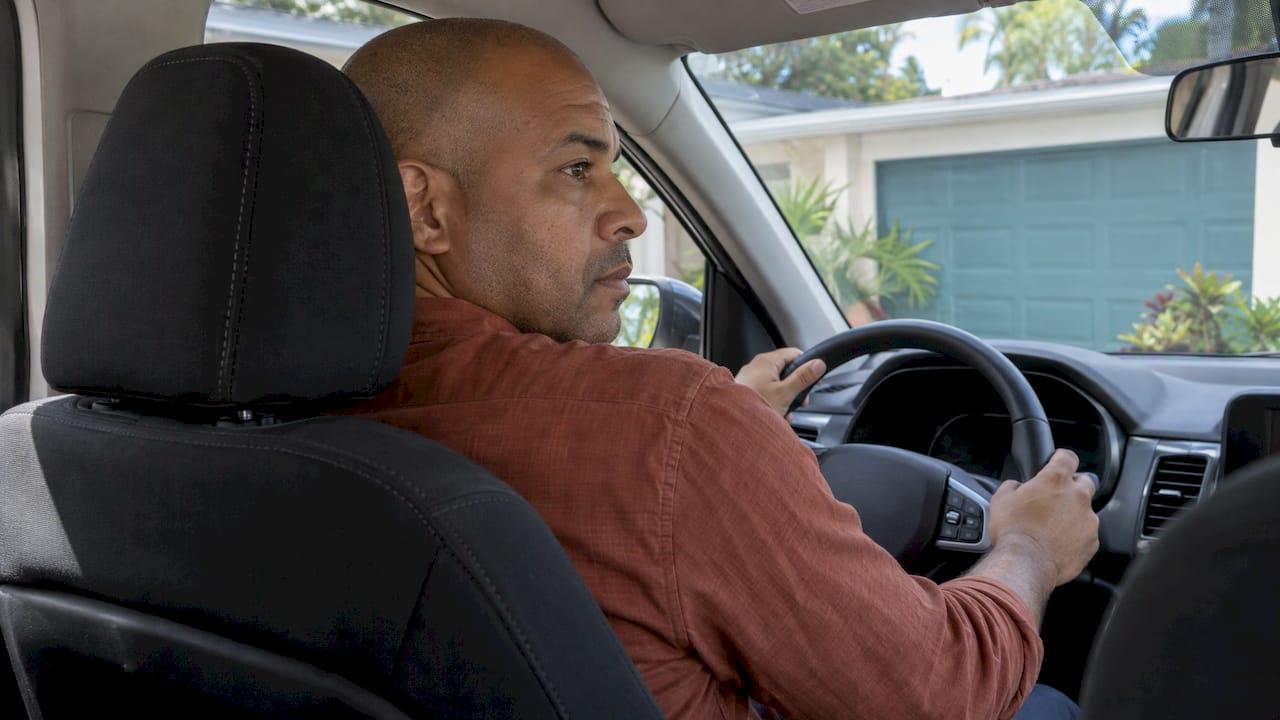
Neck pain while driving usually comes from holding your head still in one position for a long time, a seat and headrest that don't fit your body, or an older injury that the drive wakes up. Setup changes fix many cases. If the pain keeps coming back, travels into your arm, or started after a collision, it needs a hands-on examination. In North Miami, that is what we do at Sparkmed: chiropractic care for accident recovery and musculoskeletal pain, with adjustments at $45.
This guide covers why driving hurts your neck, how to set up your car, what to do during and after a drive, the warning signs, and when a chiropractic evaluation makes sense.
TL;DR
- Static posture, forward head position, vibration and a badly set headrest are the usual drivers of neck pain behind the wheel.
- Set the seat, headrest and wheel first. It costs nothing and takes five minutes.
- Numbness, tingling or weakness in the arm, trouble turning your head to check blind spots, or pain after a crash are signs to get examined, not to push through.
- Neck pain that began after a car accident, or that keeps returning, is what our North Miami clinic treats, starting with a $45 chiropractic adjustment.
Table of Contents
- Why driving makes your neck hurt
- Set up your car before anything else
- What to do during a drive
- What to do after a drive
- Can you drive with a stiff neck?
- Warning signs: when to stop self-care
- When the pain started with a crash
- How a chiropractor can help your neck
- What care costs at Sparkmed
- Ready to get your neck checked?
- Our perspective
- FAQ
- Sources
Why driving makes your neck hurt
Driving asks your neck to do something it handles poorly: stay still. Your head weighs roughly a bowling ball, and the muscles at the back of the neck and tops of the shoulders work continuously to hold it up while your eyes scan the road. Add a seat that tilts you forward and a wheel that sits too far away, and those muscles tire fast.
Research points the same way. A 2024 study of car drivers found that drivers with neck pain had lower cervical range of motion, a smaller craniovertebral angle (a measure of forward head posture, 6.3 degrees lower on average) and less accurate head position sense than drivers without pain. The study shows an association, not proof that driving causes these differences, but it describes what a stiff, forward-leaning driver looks like.
A three-year study of 537 professional drivers from the University of Trieste found neck pain in 31.9% of them. Cumulative whole-body vibration, driving with the trunk bent or twisted, and psychological distress were each linked to neck and shoulder pain. In other words, the causes stack: posture, road vibration and stress all add to the load.
The American Academy of Physical Medicine and Rehabilitation also lists driving among the risk factors for cervical radiculopathy, the medical name for a pinched nerve in the neck. That matters if your pain has a nerve component, which we cover below.
The common patterns
- Pain at the back of the neck and top of the shoulders after 30 minutes or more: usually sustained muscle tension and a forward head.
- Pain when you turn to check a blind spot: reduced rotation, often from stiff joints or muscle guarding.
- Pain that travels into the shoulder blade, arm or fingers: possible nerve irritation, which deserves an exam.
- Pain that began after a collision, even a minor one: treat it as an injury until it is checked.
Set up your car before anything else
Seat position is the cheapest fix, and official guidance agrees on the key numbers. The NY DMV's Car Fit guidance and AAA's vehicle-fit advice both say to:
- Sit with at least 3 inches of clear sight above the steering wheel.
- Keep at least 10 inches between your breastbone and the wheel or airbag cover.
- Place the center of the head restraint against the back of your head, not against your neck.
- Adjust the seat until you feel no discomfort or pain in your knees, back, hips, neck or shoulders.
Headrest height and distance
The headrest is not a pillow, and it matters for more than comfort. One automaker's owner's manual says the head restraint should sit 2 inches or less from the back of your head and never more than 4 inches away, with its top level with the top of your head. A headrest set too low or too far back is a common reason neck injuries happen in rear-end collisions. We explain the fix in how to set your headrest right.
Steering wheel and arms
If you reach for the wheel with straight arms, the muscles between your neck and shoulders do extra work all trip. Bring the seat or wheel closer so your elbows stay softly bent. Gripping the wheel hard has the same effect, so let your shoulders drop and keep a relaxed hold.
Mirrors
Set mirrors so you can see with a small eye movement rather than a big head turn. That cuts the number of rotations your neck makes in a long drive. A stiff neck is also a reason to move the mirrors, not to crank your head further.
What to do during a drive
Small habits help more than a big fix.
- Break up long drives. Stop every hour or so when you can, get out, and walk for a few minutes. Movement brings blood flow back to tired muscles.
- Sit tall, then relax. Bring your ears over your shoulders, not out in front of them. Slumping toward the wheel pushes the head forward.
- Support your lower back. If your seat lacks lumbar support, a rolled towel at the small of the back keeps your pelvis from tipping and your head from drifting forward.
- Keep your phone off the lap and out of your eyeline. Looking down is the quickest way to load the neck, and it is a safety problem anyway.
If you drive for work around Miami-Dade, with stop-and-go traffic on I-95 and Biscayne Boulevard, the constant braking and head checks add up. Treat your seat setup as part of the job.
What to do after a drive
MedlinePlus suggests this for minor neck pain: over-the-counter pain relievers such as ibuprofen or acetaminophen if they are safe for you, ice for the first 48 to 72 hours and heat after that, and slow range-of-motion movements: chin up and down, ear toward shoulder on each side, and turning side to side. Move within comfort and stop if pain sharpens.

Not sure whether ice or heat fits your pain? Our 3-step ice or heat protocol walks through it.
Bed rest does not help. MedlinePlus says to stay as active as you can without making the pain worse, and notes that a complete program includes stretching, strengthening and aerobic activity such as walking or stationary cycling, per your provider's guidance. UF Health adds that strengthening the upper back eases stress on the neck, and that starting exercises too soon after an injury can make pain worse. If you want a wider list of natural ways to ease pain, that is a place to browse, and our own guide on relieving neck pain naturally covers the neck specifically.
Can you drive with a stiff neck?
Sometimes, but your range of motion is the test. MedlinePlus says that if you can't move your head around very easily, you may need to avoid driving. The practical check: can you turn your head far enough to see your blind spot, and can you do it quickly? If not, you can't react to what is beside you, and the drive can wait or someone else can take the wheel.
If you are in North Miami and need to get to an appointment without driving, we offer Uber Health transport for patients.
Pinched nerve symptoms
A pinched nerve in the neck is a different problem from a tight muscle. The American Academy of Orthopaedic Surgeons describes burning or sharp pain from the neck down the arm, tingling in the fingers or hand, weakness and numbness, with pain that increases when you turn your head. Kaiser Permanente advises avoiding activities that make symptoms worse and asking your doctor when you can resume them. Driving with a weak or numb arm is a safety problem: you need full grip and quick steering.

AAPMR reports that up to 90% of patients with cervical radiculopathy may improve with rehabilitation, so getting evaluated early is worthwhile and not a reason to worry.
Warning signs: when to stop self-care
These signs come from MedlinePlus and its neck pain article. Contact a doctor if:
- Symptoms don't improve after one week of self-care.
- You have numbness, tingling or weakness in an arm or hand.
- The pain is so severe you can't get comfortable, gets worse lying down, or wakes you at night.
- You have trouble walking or balancing, or lose control of your bladder or bowels.
Call 911 if neck pain follows a fall, blow or injury and you can't move your arm or hand, or if you have a fever with a headache and a neck too stiff to touch your chin to your chest. Call 911 as well for heart attack symptoms. Kaiser Permanente also says to call 911 if you cannot move an arm or leg at all.
When the pain started with a crash
Neck pain that begins after a collision is a separate case from posture strain. It can show up hours or days later, and it often feels like the ordinary stiffness you get from driving. That is why the question "is this my seat or my accident?" is worth asking out loud.
We treat auto accident injuries in North Miami and have more than 20 years of experience with accident victims. Our auto accident evaluation is where we assess your range of motion and symptoms, and we work with direct insurance billing and document the injury thoroughly for claims. For what to expect, see our guide to spinal adjustments after a car accident and how many chiropractic visits follow a car accident.
It applies to work injuries and slip-and-falls too: a neck that hurts every time you drive after a fall at work deserves a proper exam. Our guides on neck injury causes, symptoms and recovery and why neck injuries need attention cover the signs in more detail, and the one on sleeping with whiplash helps with the nights.
How a chiropractor can help your neck
A chiropractic visit starts with a history and an exam of how your neck moves, then an adjustment where it fits. Our guide to why people choose a chiropractor for neck pain explains the approach. Beyond adjustments, we offer:
- Shockwave therapy for stubborn soft-tissue pain
- Electrical stimulation for muscle tension
- Ultrasound therapy and traction/decompression
- Massage therapy for tight shoulders and upper back
If your neck pain came with a long sitting habit, it can also help to read about text neck after an accident and your recovery step by step.
What care costs at Sparkmed
Our prices are published, so you can plan before you call.
| Service | Price |
|---|---|
| Chiropractic adjustment | $45 one-off |
| Shockwave therapy | $75 per session |
| Essential plan | $149 per month |
| Performance plan | $249 per month |
| Elite plan | $399 per month |
Massage, electrical stimulation, ultrasound, traction/decompression and auto accident evaluation are listed on our services page. Plans and shockwave pricing are on our pricing page.
Ready to get your neck checked?
If your neck hurts every time you drive, or the pain began with an accident, book a visit and we will examine how your neck moves, explain what we find and build a plan around it. Our team speaks English, Spanish and Creole.

Start with a $45 chiropractic adjustment or see all options on our pricing page.
Our perspective
Most drivers we meet have tried to fix a neck by adjusting the seat once and hoping. Seat setup is worth doing, and we encourage it, but a neck that hurts after every drive is telling you something about how it moves.
After more than 20 years of treating accident victims, we have learned that the first question is always the same: where does it hurt, when did it start, and how well does your head turn? Answering that properly takes a hands-on exam, not a guess from a list of tips.
That is why we keep our entry point simple: a chiropractic adjustment at $45, an evaluation after an accident, and modern therapies such as shockwave, ultrasound and electrical stimulation when your neck needs more than an adjustment. We bill insurance directly and document your injury thoroughly, so the clinical side and the paperwork move together.
Your neck should carry you through a drive without a price. If it doesn't, come in.
Spark
FAQ
What are red flags for severe neck pain?
Numbness, tingling or weakness in the arm or hand, trouble walking or balancing, loss of bladder or bowel control, and pain that wakes you at night are signs to contact a doctor, according to MedlinePlus. Neck pain after a fall or blow with an arm you can't move, or a fever with a stiff neck and headache, means calling 911.
Can you drive with a stiff neck?
Only if you can turn your head easily enough to check blind spots and react quickly. MedlinePlus says that if you can't move your head around very easily, you may need to avoid driving. Ask someone to drive you, or arrange transport, until your range of motion returns.
Can neck pain be caused by driving?
Yes, it can contribute. Static posture, forward head position, road vibration and twisting are all linked to neck pain in drivers in published studies, though driving is rarely the only factor. A poorly fitted seat and headrest add to it.
Can I drive with a pinched nerve in my neck?
It depends on your symptoms. If your arm is numb, tingling or weak, you can't steer or grip safely, so avoid driving and get examined. Kaiser Permanente advises asking your doctor when you can resume activities that worsen symptoms.
Sources
- Cervical Health Parameters in Car Drivers (2024 study)
- A prospective cohort study of neck and shoulder pain in professional drivers
- Cervical Radiculopathy, AAPMR
- Car Fit, NY DMV
- Control and Comfort Behind the Wheel, AAA
- Correct Head Restraint Position, owner's manual
- Neck pain: MedlinePlus Medical Encyclopedia
- Neck pain or spasms, self care: MedlinePlus
- Neck Pain or Spasms, Self Care: UF Health
- Cervical Radiculopathy (Pinched Nerve), OrthoInfo AAOS
- Pinched Nerve in the Neck: Care Instructions, Kaiser Permanente
- How to get rid of pain: natural and effective methods