
Deep buttock pain that starts after a car crash or a fall, sometimes with burning or tingling down the back of the leg, can be piriformis syndrome. The piriformis is a small muscle deep in the buttock, and when an impact irritates it, it can squeeze the sciatic nerve running beside it. At Sparkmed in North Miami, our team has more than 20 years of experience treating accident victims, and a chiropractic adjustment is $45. Documenting the injury early also protects any insurance claim that follows.
TL;DR
- Piriformis syndrome happens when the piriformis muscle spasms or swells and presses on the sciatic nerve. Car accidents and falls are recognized triggers.
- Typical signs: a deep ache or burning in one buttock, tingling or numbness down the back of the leg, and pain when sitting.
- Diagnosis is a hands-on exam. Scans mainly rule out other causes of sciatica, so a thorough accident evaluation matters.
- Sudden severe pain with weakness, foot-control problems, or loss of bowel or bladder control is an emergency. Go to the ER.
- Pain that lasts more than a few weeks, or that began after an accident, deserves a prompt evaluation.
Table of Contents
- What the piriformis is and why accidents hit it
- What it feels like: buttock pain and sciatica after an accident
- Warning signs that need urgent care
- How piriformis syndrome is diagnosed
- Recovery: what the medical guidance lists
- How care at Sparkmed fits
- Why the sooner the better after an accident
- Getting started in North Miami
- FAQ
- Sources
What the piriformis is and why accidents hit it
The piriformis is a flat, pear-shaped muscle that runs from the base of your spine to the top of your thigh bone. It helps rotate the hip. The sciatic nerve, the longest nerve in the body, passes right beneath it. In most people, the nerve exits the pelvis below the piriformis tendon. That leaves it exposed to anything that makes the muscle tight or swollen.
Accidents do exactly that. MedlinePlus, from the U.S. National Library of Medicine, lists car accidents, falls, sudden twisting of the hip and penetrating wounds as causes of piriformis irritation and damage. A 2021 literature review reports that trauma to the buttocks is the most common cause, leading to soft tissue inflammation, muscle spasm and compression of the sciatic nerve.
A few common crash and fall scenarios:
- Braking hard with one foot. Your leg and hip brace against the pedal at impact. A review of the clinical literature notes that piriformis trigger points have been documented after car accidents, particularly driver's-side impacts.
- A seated jolt. A rear-end collision drives force up through the seat and into the pelvis.
- Landing on the buttock. Slip-and-fall injuries at work, in a store or on a wet floor often land directly on the muscle.
- A sudden twist. Catching yourself mid-slip can wrench the hip into rotation.
MedlinePlus also notes the condition affects more women than men.
What it feels like: buttock pain and sciatica after an accident
People search for this as "buttock pain after a car accident" or "sciatica after a fall." Both can describe piriformis syndrome. MedlinePlus describes the main symptom as sciatica: buttock tenderness or a dull ache, tingling or numbness along the back of the leg, trouble sitting, and pain that worsens with activity, usually on one side.
The American Academy of Family Physicians' patient site adds that the condition can develop after a traumatic event such as a car accident or a fall. Its pain often begins as an intense burning deep in the buttock before running down the back of the leg.
Signs that point toward the piriformis rather than the low back:
- Pain centered deep in the middle of one buttock
- Worse after sitting in the car, at a desk, or on a hard seat
- Aggravated by climbing stairs, walking, or running
- Relief when you stand up and move around, for some people
These are patterns, not a diagnosis. A disc problem, a facet joint or a hip injury can feel similar. Accident injuries rarely come alone, so it helps to see the full picture, including numbness and tingling after a car accident and hip pain after a car accident.
Symptoms can show up late
Adrenaline and stiffness hide a lot in the first hours. Buttock pain may appear days or weeks after the crash as muscle guarding settles in. Our guide to symptoms after car accidents covers 15 signs worth watching.
Warning signs that need urgent care
Most buttock pain after an accident is not an emergency, but some signs are. MedlinePlus says to get immediate help for sudden severe low back or leg pain with weakness or numbness, problems controlling the foot, or loss of bowel or bladder control. Go to the nearest emergency room for any of these. Don't wait for an appointment.
The same page advises contacting your provider if the pain lasts longer than a few weeks or started after an accident injury. That second point applies to nearly everyone reading this page. The AAFP also warns that failing to treat piriformis syndrome can lead to permanent nerve damage, so a prompt evaluation is the safe course.
If you also have swelling around a possible broken bone, read about compression therapy for fracture swelling. Any suspected fracture needs imaging and medical evaluation first.
How piriformis syndrome is diagnosed
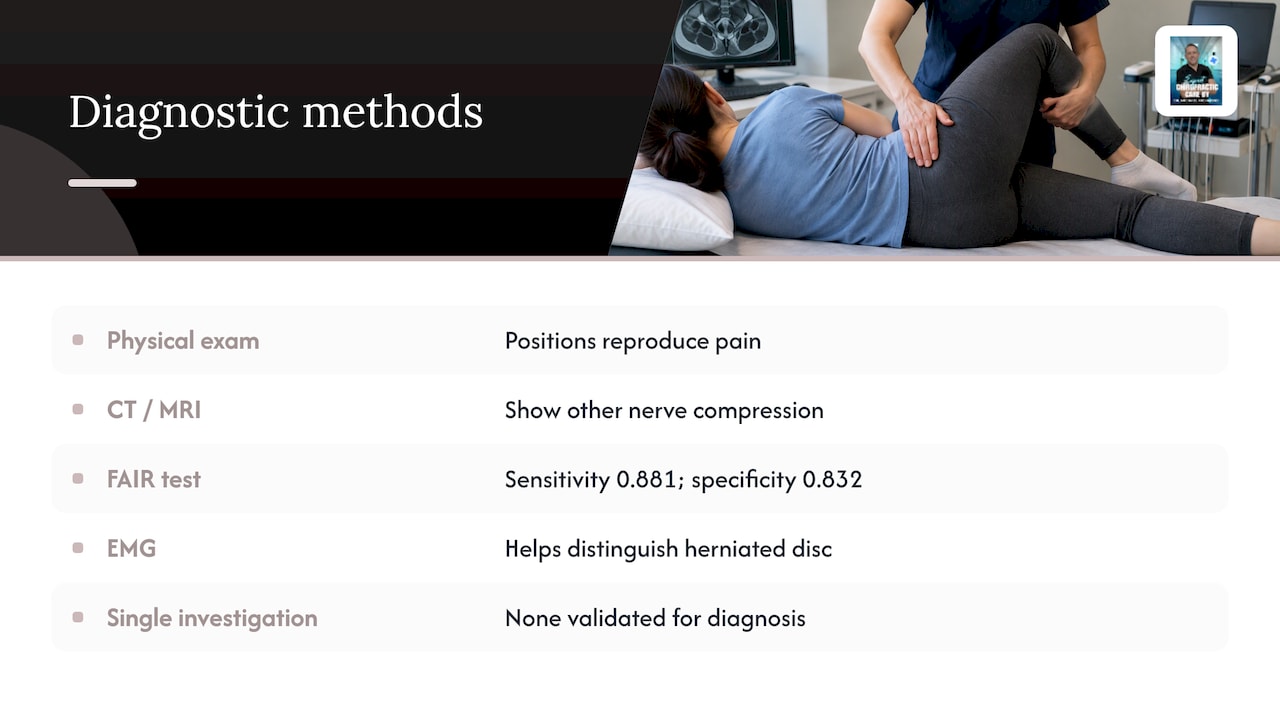
There is no single blood test or scan that confirms it. According to the AAFP, diagnosis rests on a physical exam in which the clinician moves your affected leg into several positions to see what provokes pain. CT and MRI can't diagnose the syndrome itself, but they can show whether something else is pressing on the sciatic nerve.
One of those positions is the FAIR test (flexion, adduction, internal rotation of the hip). In a review by Kansas City University osteopathic physicians, the FAIR test showed a sensitivity of 0.881 and specificity of 0.832 in one study. The same review notes that nerve testing (EMG) can help tell piriformis syndrome from a herniated disc.
Because no single test settles it, an evidence review from the University of East Anglia concludes that no one investigation has been validated for diagnosing piriformis syndrome. In practice, that means a careful history of the accident and a careful hands-on exam carry a lot of weight. The mechanism of injury, where it hurts, and which movements reproduce the pain all count.
What a good accident evaluation covers
When you come in after a collision or fall, expect questions about:
- How the accident happened: impact direction, where you were seated, whether you braced or landed
- When symptoms began and how they've changed
- Exactly where the pain and tingling run, and what makes them worse
- Prior back, hip or leg problems
- Movement and positional testing of the hip, pelvis and spine
Our Auto Accident Evaluation is listed on our services page. We bill insurance directly and document the injury thoroughly for claims, which matters when symptoms appear late and need a clear record.
Recovery: what the medical guidance lists
The encouraging news is that many cases settle with conservative care. In a study of 65 patients with suspected piriformis syndrome described in a 2021 review, 41 of the 42 whose MRI or CT was normal had complete resolution by 35 days, spontaneously or with conservative treatment. Results vary person to person, and none of this replaces an evaluation of your own injury.
The AAFP lists these steps for piriformis syndrome:
- Stop activities that cause pain, and take breaks from sitting
- Cold packs for about 15 minutes several times a day, then warm packs
- Over-the-counter pain relievers such as ibuprofen, aspirin, naproxen or acetaminophen
- Piriformis stretches
- Massage
- Physical therapy
- A steroid injection where the piriformis meets the sciatic nerve, for stubborn pain
- Surgery in severe cases
All of these are laid out on the AAFP's piriformis page. Medicines carry their own risks. If you take blood thinners, have kidney or stomach problems, or are pregnant, ask your doctor or pharmacist before using an anti-inflammatory.
Rest, but not too much
With accident injuries, the instinct is to stay still. Long sitting actually keeps the piriformis loaded. Short, frequent position changes beat one long rest. When to restart exercise is a common question, and our piece on letting symptoms, not a calendar, decide when to exercise walks through it.
How care at Sparkmed fits
Our team treats accident-related muscle and nerve pain in North Miami, and what we offer maps onto the steps above.
- Chiropractic adjustments to restore motion in the spine and pelvis. A session is $45. See what to expect from spinal adjustments after a car accident, and our explanation of why adjust after a car accident.
- Massage therapy for muscle tension. Here is how massage therapy helps after a car accident.
- Ultrasound, electrical stimulation, and traction or decompression, listed on our services page. Our overview of electrical stimulation for car accident injuries explains how it is used.
- Shockwave therapy at $75 per session. Read about shockwave therapy for car accident injuries in North Miami.
Timing matters too. Our guide on how soon to see a chiropractor after an accident explains why earlier evaluation helps. If numbness or tingling persists, ask for imaging at two weeks to rule out other causes.
Why the sooner the better after an accident
Piriformis syndrome is often secondary, meaning something else set it off. The 2021 review says primary piriformis syndrome, from anatomy such as a split sciatic nerve, accounts for fewer than 15% of cases. Secondary causes include trauma to the buttock or deep thigh and prolonged sitting. After a crash, you may have both: the impact itself and weeks of guarded, sitting-heavy living.
Practical reasons not to wait:
- Clear cause and effect. An exam soon after the accident links symptoms to the event, which matters for any claim.
- Overlap with other injuries. Back, hip and neck problems commonly travel together. One exam sorts out which is driving the pain.
- Less compensation. Favoring one side strains the other hip and your lower back.
- Nerve protection. Ongoing compression is the reason to act on persistent symptoms.
What we think
After an accident, buttock pain gets dismissed as a bruise. In our experience treating accident victims for over 20 years, the pain people describe as sciatica deserves a closer look at the hip, pelvis and spine together, not just the spot that hurts.
We believe the best first step is an accident evaluation and a plain explanation of what is going on. Care should be affordable enough that you actually start. That is why a chiropractic adjustment is $45, and why our wellness plans run $149, $249 and $399 per month depending on how much care you need.
We also want getting to the clinic to be easy. We offer bilingual care in English, Spanish and Creole, and transportation through Uber Health in North Miami. We bill insurance directly and document your injury carefully so your claim has the record it needs.
Spark
Getting started in North Miami
If you're dealing with buttock pain or sciatica after a crash, a work injury or a slip and fall, book an accident evaluation with us. We'll listen to how it happened, examine the hip, pelvis and spine, and talk you through a plan. Single sessions start with a $45 adjustment, shockwave therapy is $75 per session, and our monthly plans are on the pricing page. You can also start from our home page and book there.

Prefer to see everything we offer first? The services page lists massage, electrical stimulation, ultrasound, traction and the auto accident evaluation.
FAQ
Can a car accident really cause piriformis syndrome?
Yes. MedlinePlus lists car accidents and falls among the causes of piriformis muscle irritation. A 2021 review calls trauma to the buttocks the most common cause. Symptoms may start days or weeks after the crash.
Is buttock pain after a car accident always piriformis syndrome?
No. Disc injuries, facet joints, the sacroiliac joint and the hip can all cause buttock pain. The AAFP notes that CT and MRI can't diagnose piriformis syndrome but can show if something else is pressing on the nerve. A hands-on accident evaluation helps sort out which structure is responsible.
How long does recovery take?
It varies. In one study described in a 2021 review, 41 of 42 patients with normal imaging had complete resolution by 35 days with spontaneous or conservative care. Your timeline depends on the injury, your activity and how early you start care.
When is sciatica after a fall an emergency?
Go to the ER for sudden severe back or leg pain with weakness or numbness, trouble controlling your foot, or loss of bowel or bladder control, per MedlinePlus. For pain that simply lingers past a few weeks after an accident, get evaluated promptly.
How should I sleep with piriformis pain?
The sources reviewed here don't give a specific sleeping position. The AAFP's general advice is to avoid painful activities and take breaks from sitting. If pain wakes you at night, bring it up at your evaluation so the plan can address it.
Sources
- Piriformis syndrome: MedlinePlus Medical Encyclopedia
- Piriformis Syndrome | Family Doctor (AAFP)
- Surgical and Non-surgical Treatment Options for Piriformis Syndrome (PMC)
- Treatment options review, 2021 (Vij et al.)
- Piriformis Syndrome review (Cummings)
- Diagnosis and Management of Piriformis Syndrome (Kansas City University)
- Piriformis syndrome systematic review (University of East Anglia)