
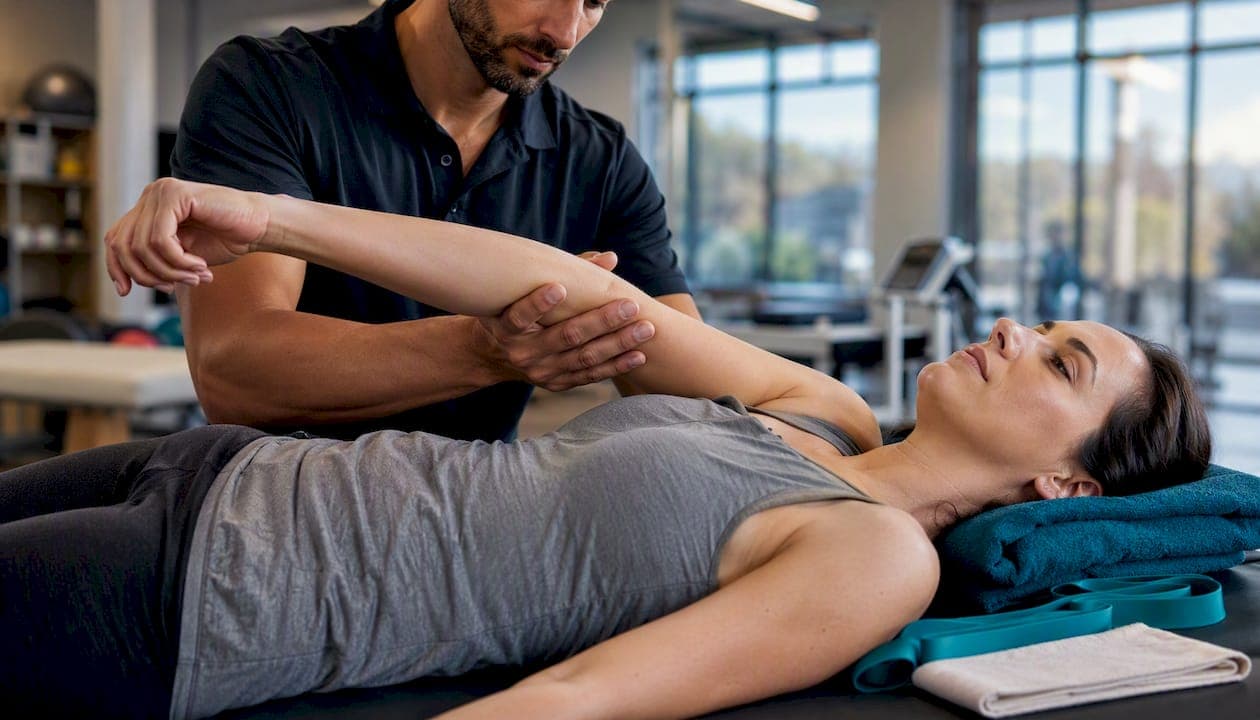
Yes. Most people recover useful range of motion after a car accident when they start guided rehabilitation early, combining pain control, graded mobility work, manual therapy, and progressive strengthening. Recovery typically unfolds over weeks to a few months, though severity, age, and how quickly treatment starts all shift that timeline. If stiffness or weakness lingers past the expected window, a specialist evaluation is worth pursuing sooner rather than later.
TL;DR:
- Most people recover functional range of motion after early guided rehabilitation that includes pain control, mobility exercises, manual therapy, and strengthening.
- Recovery duration varies from a few weeks for mild strains to several months for structural injuries, heavily influenced by age, pre-existing conditions, and how quickly rehab begins.
- Objective measurements of joint motion and symptoms are essential for tracking progress and deciding when to advance through rehab phases.
- Resistance exercises should follow passive and active-assisted movements, with manual therapy and modalities like chiropractic adjustments helping speed recovery.
- Seek specialist evaluation if movement stalls beyond a few weeks, pain worsens, or new neurological symptoms appear after a crash.
Table of Contents
- Why Range of Motion Drops After a Car Accident
- How Long Does It Take to Get Your Mobility Back?
- How Doctors Measure and Track Your Progress
- Exercises and Therapies That Rebuild Movement, Region by Region
- Managing Pain Without Blocking Your Own Progress
- A Practical Rehab Plan You Can Take to Your Clinician
- Sparkmed's Approach to Rebuilding Range of Motion
- Ready to Start Recovering? Here's What Your First Visit Looks Like
- Sources
- FAQ
Why Range of Motion Drops After a Car Accident
The body reacts to a collision the same way it reacts to any sudden trauma: it locks down. Muscles around an injured joint tighten reflexively, a protective response called guarding, and that tightening alone can cut your available range of motion long before any structural damage shows up on imaging.
Swelling adds a second layer of restriction. Fluid builds up around the joint capsule, the tissue thickens, and small adhesions can form between layers of soft tissue that are normally supposed to glide freely. That process is exactly why shoulders and necks often feel "frozen" a few days after a crash, even when nothing is broken.
Specific injury types drive specific losses:
- Whiplash stiffens the cervical spine and often limits neck rotation and side bending.
- Rotator cuff strains restrict overhead reach and internal rotation of the shoulder.
- Ligament sprains in the wrist, knee, or ankle reduce joint play and weight-bearing tolerance.
- Fractures mechanically block motion until healing allows controlled loading.
- Nerve irritation from disc or soft-tissue swelling can cause pain-limited movement even without direct joint damage.
There's also a psychological piece that's easy to underestimate. Fear of re-injury creates its own guarding pattern, and the stress and distress people carry after a crash can measurably slow physical recovery, not just complicate the emotional side of it.
How Long Does It Take to Get Your Mobility Back?
Recovery time depends almost entirely on what got hurt and how badly. A rough map looks like this:
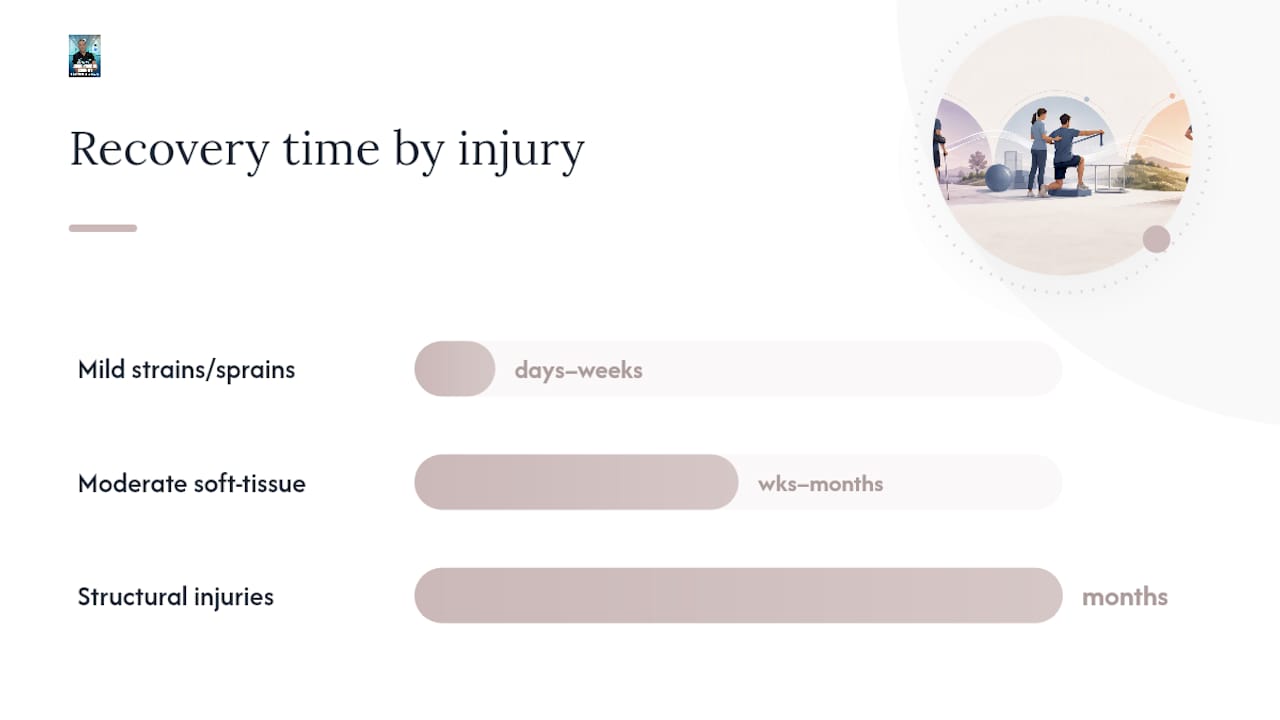
- Mild strains and sprains: days to a few weeks with basic movement and rest management.
- Moderate soft-tissue injuries (whiplash, rotator cuff strain, ligament sprains): several weeks to a few months of structured rehab.
- Structural injuries (fractures, disc involvement, significant ligament tears): months, sometimes with surgical input before rehab can fully progress.
Several factors push that timeline in either direction. Age matters. So does preexisting arthritis. Neck injuries in particular tend to leave chronic limitations when early symptoms don't settle or when the cervical spine already had wear and tear before the crash. The single biggest lever you actually control is how fast you get into supervised rehab. Early intervention is consistently tied to better long-term outcomes for neck range of motion specifically.
Watch for signs that recovery has stalled beyond what's expected for the injury type: motion that plateaus for more than two to three weeks without improvement, pain that spreads instead of easing, or new symptoms (tingling, weakness, instability) appearing after the acute phase. Any of those warrants a re-evaluation rather than waiting it out.
How Doctors Measure and Track Your Progress
Range of motion isn't judged by feel in a clinical setting. It's measured in degrees, tracked over time, and compared against normal benchmarks for your age and joint.
- Goniometer or inclinometer readings. A clinician places the device at the joint axis and records exact degrees of movement for flexion, extension, rotation, and side bending. This becomes your baseline and your progress marker at every follow-up.
- Validated outcome scores. Tools like the Neck Disability Index and standardized pain scales quantify how much your injury affects daily function, not just how far a joint bends.
- Full baseline exam. This covers pain mapping, strength testing, a neurological screen for nerve involvement, and joint-specific ROM measures across every affected area, not just the one that hurts most.
That documentation matters beyond the exam room. Precise, dated ROM numbers give your care team an objective way to decide when to progress your program, and they create the kind of clear injury record insurers and attorneys need when a claim depends on proving the extent of your injury.
Exercises and Therapies That Rebuild Movement, Region by Region
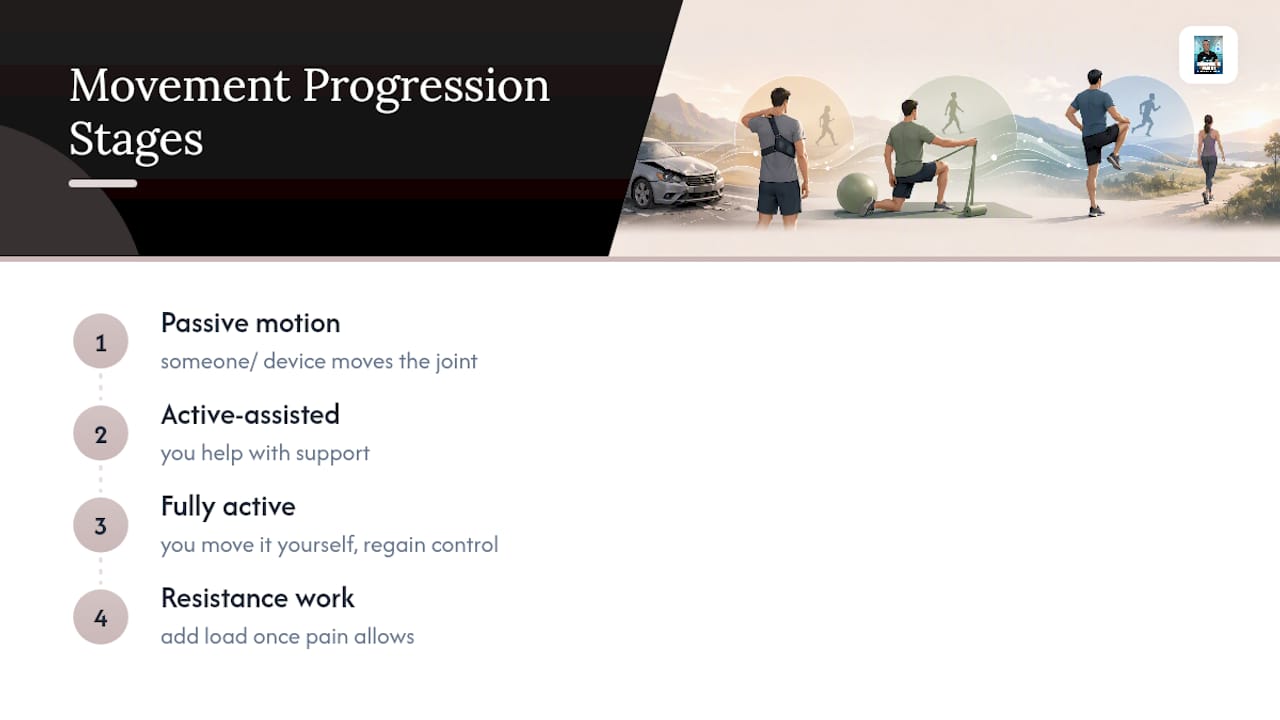
Rehab almost always follows the same progression regardless of the joint: passive motion first (someone or something else moves the joint through its range), then active-assisted (you help, with support), then fully active (you move it yourself), and finally resistance work once pain allows it. Rushing that order is the most common way people re-aggravate an injury.
Neck. Start with chin tucks and gentle rotation within a pain-free arc. Once that's comfortable, add isometric holds (pressing your head against your hand without moving) to rebuild stability before adding resistance bands.
Shoulder. Pendulum swings loosen the joint with minimal effort. Wall slides and doorway stretches restore overhead and external rotation. Rotator cuff strengthening comes last, once passive motion is close to full.
Spine and mid-back. Cat-cow stretches and thoracic rotations restore segmental movement that guarding tends to lock up. Extension exercises help counter the forward-hunched posture many people adopt after neck or back pain.
Lower limb. Heel slides and ankle pumps keep circulation moving and prevent stiffness in the knee and ankle. Straight-leg raises rebuild quad strength without stressing the knee joint itself, and progressive weight-bearing with gait re-education comes once pain allows standing tolerance.
Manual therapy, joint mobilization, and soft-tissue work from a clinician often speed this process along, especially when chiropractic adjustments and hands-on care help unlock a joint that's stuck at end range. Splints or orthoses come into play for specific hand or lower-limb injuries where extra protection is needed to preserve motion while healing continues.
The general rule for dosing: multiple short sessions spread across the day beat one long grinding session. Aim for pain that stays tolerable and lets you keep moving, not pain that forces you to stop.
Pro Tip: Hold each stretch at its end range for a few extra seconds before adding any resistance. Building control at full range first, then adding strength, prevents the compensations that cause new pain elsewhere.
Managing Pain Without Blocking Your Own Progress
The goal isn't zero pain. It's pain low enough that you can actually participate in therapy, because movement is what restores range of motion, and avoiding all discomfort usually means avoiding the exercises that work.
Non-drug strategies do a lot of the heavy lifting here:
- Ice for acute swelling, heat for lingering stiffness before movement sessions.
- Pacing activity across the day instead of pushing through one intense session.
- Prioritizing sleep, since poor sleep amplifies pain sensitivity.
- Relaxation techniques and gradual exposure to movements you've been avoiding out of fear.
On medication, acetaminophen and NSAIDs are the preferred first-line options for most soft-tissue injuries, with opioids reserved for short-term use and only under a prescriber's direct guidance. A tolerable-pain approach, rather than a zero-pain approach, is also linked to lower rates of pain becoming chronic.
Stop exercising and seek immediate care if you notice new numbness, progressively worsening weakness, sudden loss of bladder or bowel control, or any sign a fracture wasn't fully caught the first time. Those aren't stiffness symptoms. They're neurological or structural red flags that need same-day evaluation.
A Practical Rehab Plan You Can Take to Your Clinician
A good ROM recovery plan moves in phases, not a single fixed routine repeated for months.
- Phase 1: Assessment and protection. Baseline ROM measurement, pain control, and gentle protected motion. Education on what to expect matters here too, since anxiety about movement often makes guarding worse.
- Phase 2: Active mobility and early strength. Active-assisted exercises transition into fully active ROM, paired with light strengthening and neuromuscular control work to retrain how the joint moves under your own power.
- Phase 3: Loading and function. Progressive resistance, functional movement patterns, and simulation of real tasks, whether that's returning to a desk job, physical labor, or driving comfortably again.
Track progress against objective milestones, not how you feel on any given day: degrees of motion regained, pain scores trending down, and function returning (reaching overhead, turning your head to check a blind spot, standing tolerance). Comprehensive rehab pathways that combine these phases with coordinated care have been linked to faster and more complete return to work after road-traffic injuries.
Refer out for imaging or specialist input if motion plateaus despite consistent phase progression, or if new symptoms appear that weren't part of the original injury picture.
Pro Tip: Ask your clinician to re-measure your ROM in degrees at every follow-up, not just ask "how does it feel." Numbers catch small plateaus that subjective feel misses for weeks.
Sparkmed's Approach to Rebuilding Range of Motion
Rehab plans work best when someone is actually measuring progress, not guessing at it. The intake process ideally starts with objective range-of-motion measurement and a full baseline exam, as recommended by guideline bodies, so a treatment plan is built on numbers rather than assumptions about healing.
From there, care typically combines hands-on work, including chiropractic adjustments and manual therapy, guided therapeutic exercise progressions, and adjunct modalities like ultrasound or shockwave therapy when a specific injury calls for them. Multilingual support in English, Spanish, and Creole, and transport assistance can help remove common barriers to showing up for consistent rehab sessions, which is important for recovery.
— Spark
Ready to Start Recovering? Here's What Your First Visit Looks Like
There are other paths to rehab, a general physical therapist, a primary care referral, or simply toughing it out and hoping stiffness resolves on its own. None of those give you the same starting point: an objective measurement of exactly how limited your movement is on day one, compared against where it should be.
An initial visit ideally includes a full exam, goniometer-based ROM measurement of affected joints, and a clear treatment plan built around observed measurements rather than a generic exercise handout. Depending on exam findings, that plan might involve chiropractic adjustments, therapeutic exercises, or modalities like ultrasound and shockwave therapy when indicated for tissue not responding to movement alone. Multilingual staff and transport services can help reduce delays to the first appointment due to language or transportation issues.
If stiffness, pain, or restricted movement is holding you back weeks after a crash, the fastest way to get answers is a direct exam. Check Sparkmed's services and book a visit to get your baseline ROM measured this week.
Sources
This article draws on the FACS acute pain guidelines, NCBI Bookshelf rehabilitation guidance, and peer-reviewed whiplash and ROM outcome research supporting the timelines and methods described.
This article is general information, not a substitute for advice from a qualified doctor. Consult a qualified healthcare professional about your own circumstances before acting on anything here.
- Best practices guidelines for acute pain management in trauma patients (FACS)
FAQ
Can You Fully Regain Lost Range of Motion?
Most people regain functional, near-normal range of motion when they start guided rehab early and follow through on the full progression from passive to active movement. Cases involving preexisting arthritis or persistent unresolved symptoms are more likely to end up with some lasting limitation, which is exactly why early treatment matters so much.
What Are Delayed Symptoms After a Car Accident?
Delayed symptoms include stiffness, headaches, and pain that appear a day or more after a crash, often because adrenaline masks discomfort in the first few hours. Numbness, tingling, or worsening range of motion that shows up days later should be evaluated promptly rather than dismissed as normal soreness.
How Long Can Your Body Stay in Shock After a Car Accident?
Physiological shock from trauma typically resolves within hours as blood pressure and heart rate stabilize, but the psychological and pain-related stress response can linger for days to weeks. That extended stress response is part of why guarding and stiffness sometimes worsen before they improve.
How Much Is a Good Settlement for Pain and Suffering?
Settlement values vary widely based on jurisdiction, injury severity, and documented medical evidence, so there's no fixed figure that applies broadly. Thorough, dated documentation of your range-of-motion measurements and treatment history is one of the strongest factors in supporting any claim, which is part of why clinics like Sparkmed track ROM numbers at every visit.
When Should I See a Clinician for Limited Range of Motion?
See a clinician promptly if stiffness hasn't started improving within one to two weeks, or immediately if you notice numbness, spreading weakness, or loss of bladder or bowel control. Waiting past the expected recovery window for your injury type is the most common reason mild limitations turn into chronic ones.