
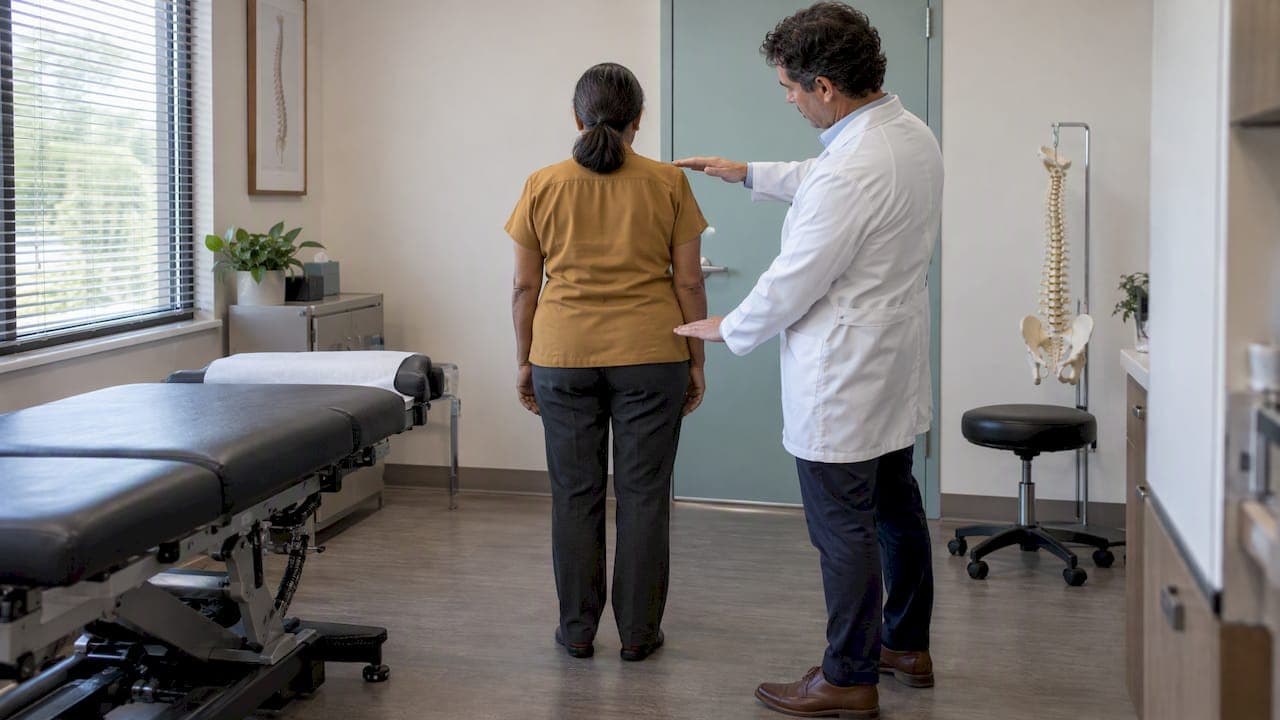
Chiropractic care can be a reasonable part of managing back pain that comes with scoliosis. The evidence does not show that it straightens a curve or stops one from progressing. The best plan treats the two questions separately: a spine specialist watches the curve, and a chiropractor helps with pain, stiffness and movement. This guide explains how the two fit together, what the studies found, what the risks are and how to choose a provider.
TL;DR
- Chiropractic care has not been shown to reduce scoliosis curvature or prevent progression, but it may help with the back pain that often goes with it.
- If you choose chiropractic care, also see an orthopaedic or neurosurgical spine specialist for monitoring.
- Side effects of spinal manipulation are usually mild and short-lived, and serious complications are very rare.
- Ask any chiropractor about licensure and specific experience with scoliosis before you start.
- In North Miami, we offer spinal adjustments at $45 per session, plus therapies such as traction, ultrasound and electrical stimulation.
Table of Contents
- What scoliosis is, and why the spine twists
- What the research says about chiropractic care and scoliosis
- What chiropractic care can realistically help with
- Techniques a chiropractor may use
- Risks and side effects
- When to see a spine specialist too
- How to choose a chiropractor for scoliosis
- Our perspective on scoliosis and chiropractic care
- Care in North Miami at a price you can see
- FAQ
- Sources
What scoliosis is, and why the spine twists
Scoliosis is a spinal curve of 10 degrees or more on an X-ray. It often looks like an S or a C, and the vertebrae usually rotate as well as bending sideways. That rotation is why the condition is sometimes described as a twisted spine. Visible signs can include uneven shoulders, hips or ribs.

The cause is unknown in most cases, which is what "idiopathic" means. One line of research proposes that idiopathic scoliosis is a mechanical, rotatory decompensation that starts in the transverse plane, meaning the twist comes first and the sideways curve follows. That is a hypothesis, not settled fact, but it explains why the rotation matters so much to specialists.
The curve is measured as a Cobb angle on a standing X-ray. That number is what spine specialists track over time to decide whether a curve is stable or changing.
How it shows up in adults
In adults, symptoms depend on where the curve sits. Lumbar scoliosis of degenerative origin often causes back pain. Thoracic curves tend to come to attention through restricted lung function, mostly when the curve reaches 80 degrees or more. Most adults who search for chiropractic help are in the first group: they want relief from an aching, stiff lower back.
Adults with scoliosis who have a bone density scan sometimes find the spine reading hard to interpret. This explainer on spine T-score artifacts walks through what can skew the number and what to do next.
What the research says about chiropractic care and scoliosis
The studies fall into two groups: those that ask whether chiropractic changes the curve, and those that ask whether it helps symptoms.
| Question | What the evidence shows |
|---|---|
| Does it reduce the curve? | A 2013 systematic review found a lack of evidence and noted that spinal manipulation does not influence progression of adolescent scoliosis. |
| Does full-spine adjusting work in children? | A 2001 cohort time-series trial of children aged 6 to 12 found adjustments with heel lifts and counseling were not effective at reducing curve severity. |
| Does manipulation help pain? | A systematic review of high-velocity manipulation found it does not seem to reduce deformity significantly but may reduce pain. |
| Do adults improve with a multimodal program? | A 2012 retrospective analysis reported better Cobb angle, pain and disability scores at 24 months. |
Read the last row with care. The author of that analysis noted that including only patients who came back for the 24-month follow-up may bias the findings. It is a promising signal for adults, not proof.
The broader picture is that chiropractic research on scoliosis is low quality, made up mostly of case reports and case series. Only two of the studies reviewed described outcomes in line with SOSORT and SRS recommendations. Those standards call for following immature patients through the end of growth and mature patients for at least five years, a bar most chiropractic studies have not met.
The practical reading: the strongest claim the evidence supports is symptom relief. The American Academy of Orthopaedic Surgeons says chiropractic care may be effective for back pain associated with scoliosis, and in the same breath says it has not been shown to change the curve. That is the honest frame, and it is a useful one if pain is what brings you in.
What chiropractic care can realistically help with
If your scoliosis is mild or stable and your problem is a sore, tight back, these are reasonable goals:
- Less pain. Manipulation may reduce pain even when it does not change the curve.
- Better joint movement. Stiff segments above and below a curve often get irritated.
- Easier daily function. Sitting, standing and walking tolerance often improve when pain settles.
- A movement plan. Exercises and posture habits you can keep up between visits.
What it should not be sold as is a way to straighten the spine. A clinic that promises a corrected curve is promising something the research has not shown.
Techniques a chiropractor may use
A review of chiropractic treatments for idiopathic scoliosis lists spinal manipulation, nutrition, exercises, traction, bracing and electrical stimulation among the tools chiropractors may use, and it calls for collaboration between professions. In a pain-focused plan, the common pieces look like this:
- Spinal adjustments. Applied to restricted joints, with technique adjusted for the curve and for your age and comfort.
- Traction or decompression. Gentle stretching of the spine to ease pressure and muscle guarding.
- Electrical stimulation. Used to calm muscle spasm around the curve.
- Ultrasound therapy. Deep warming of tight soft tissue.
- Massage and heat or cold. For the muscles that work overtime on the concave side.
- Home exercises. Stretching and strengthening to keep the trunk balanced.
We offer several of these therapies at our clinic, including traction and decompression, electrical stimulation, ultrasound and massage. How they are combined depends on your exam, not on a fixed script. For a closer look at how a course of care unfolds, see our step-by-step guide to chiropractic treatment.
Risks and side effects
According to the National Center for Complementary and Integrative Health, common side effects of spinal manipulation are mild and temporary, such as increased discomfort or stiffness. Serious complications are very rare, and underlying health problems can raise the risk. That last point is why you should tell your chiropractor about your scoliosis diagnosis, any prior spine surgery, bone density concerns, and any numbness, tingling or weakness.
Some practical guardrails:
- Report soreness that is getting worse rather than fading over a day or two.
- Tell your provider right away about new numbness, leg weakness or a change in bladder or bowel control, and seek urgent medical care if these appear.
- Do not skip scheduled imaging or specialist visits because you feel better.
Our article on what to expect after an adjustment and which red flags to watch covers the usual aftereffects in more detail.
When to see a spine specialist too
The AAOS advises that patients with scoliosis who choose chiropractic treatment should also see an orthopaedic or neurosurgical spine specialist for monitoring and treatment. The reason is simple. Only a specialist, with X-rays and Cobb angle measurements over time, can tell you whether a curve is changing. In a growing child or teen, bracing decisions depend on that tracking, and a missed window is hard to recover.
Book a specialist visit if:
- Your child has uneven shoulders, a prominent shoulder blade or a rib hump, especially during a growth spurt.
- You are an adult whose curve was known years ago and your pain or posture has changed.
- You have breathing difficulty, leg symptoms or pain that wakes you at night.
- You were in a car accident and have a known curve. Injury can aggravate an existing curve and mask new problems, so imaging matters.
A good chiropractor will welcome this and coordinate with your physician. The NCCIH encourages patients to discuss complementary approaches with their healthcare providers and make shared decisions, and that is the model that serves scoliosis patients best.
How to choose a chiropractor for scoliosis
The NCCIH suggests asking about a practitioner's education, licensure and any specialized training or experience with your condition. Turn that into a short checklist:
- Is the chiropractor licensed in Florida? You can verify this before booking.
- Do they ask for your scoliosis X-rays and specialist notes? They should.
- Do they explain goals in terms of pain and function rather than promising a straighter spine?
- Do they have a plan for re-evaluation? Care should have checkpoints, not an open-ended schedule.
- Will they refer you out if something looks wrong?
- Is pricing posted? Surprises in cost are a poor sign.
If you are older, our piece on how chiropractic care supports seniors' pain relief and mobility explains how technique is adapted with age.
Our perspective on scoliosis and chiropractic care
Most people with scoliosis who walk into a chiropractic clinic are not asking us to rebuild their spine. They want to get through a workday without a burning low back, sleep through the night and move without bracing for pain. We take that goal seriously.
We are also straightforward about what the research supports. Orthopaedic bodies say chiropractic care has not been shown to change a curve, so we do not promise that. What we do offer is hands-on care aimed at pain, stiffness and function, with a clear exam, a plan that is explained in plain language and re-checks along the way. Our approach is built around adjustments plus supportive therapies such as traction, electrical stimulation, ultrasound and massage, because pain around a curve usually involves joints and muscles together.
We encourage every scoliosis patient to keep a spine specialist in the loop. That is not a hand-off, it is how good care works: the specialist tracks the curve, and we work on how you feel and move. With more than 20 years of experience treating accident victims, we also know how a collision can stir up an old curve, and we document injuries carefully. Our team supports patients in English, Spanish and Creole, so nobody has to translate their pain.
Spark
Care in North Miami at a price you can see
If you are in North Miami and want help with scoliosis-related back pain, or with pain after a car accident, work injury or fall, we start with an exam and talk through your goals and your imaging. Our chiropractic adjustment is $45 per session, and shockwave therapy is $75 per session. Monthly wellness plans on the same page run $149 (Essential), $249 (Performance) and $399 (Elite). We also help with Uber Health transportation to the clinic.
If an accident is part of your story, our guide to chiropractic methods that aid healing after car accidents explains what recovery usually involves, and our accident evaluation is where we begin. You can book through our site.
FAQ
Can a chiropractor fix or straighten scoliosis?
No. The AAOS states that non-bracing treatments, including chiropractic care, have not been shown to reduce scoliosis curvature or prevent its progression. What chiropractic care may do is ease the back pain that goes with it. Pair it with a spine specialist who monitors the curve.
Is it normal to have neck pain three days after an adjustment?
Mild soreness or stiffness is the most common side effect, and it is usually temporary. If the pain is getting worse instead of fading, or comes with numbness, weakness or severe headache, contact your provider promptly or seek urgent care.
What are the downsides of chiropractic treatment?
Beyond short-term soreness, serious complications are very rare, though existing health problems can raise risk. Tell your chiropractor about your scoliosis, any surgeries and your medical history so technique can be adjusted. Our guide to adjustment side effects lists what to watch for.
What is a twisted spine called?
The medical term is scoliosis. It is a sideways curve of 10 degrees or more, usually with rotation of the vertebrae. The twist is part of what makes the rib cage or shoulders look uneven.
How much does a chiropractic visit cost at Sparkmed?
Our chiropractic adjustment is $45 per session, and shockwave therapy is $75 per session. Other therapies such as ultrasound, electrical stimulation and traction do not have a published price, so ask us for a quote when you book.
Sources
- Scoliosis, Johns Hopkins Medicine
- Idiopathic Scoliosis as a Rotatory Decompensation of the Spine, Journal of Bone and Mineral Research
- Idiopathic Scoliosis, PMC
- Nonsurgical Treatment Options for Scoliosis, OrthoInfo (AAOS)
- Chiropractic treatment of scoliosis: a systematic review, PMC
- Effect of chiropractic intervention on small scoliotic curves in younger subjects, PubMed
- Effects of High-Velocity Spinal Manipulation on Quality of Life in Scoliosis, PubMed
- Outcomes for adult scoliosis patients receiving chiropractic rehabilitation, PMC
- Chiropractic Treatments for Idiopathic Scoliosis, PMC
- Spinal Manipulation: What You Need To Know, NCCIH
- When Your Spine T-Score Is Misleading