
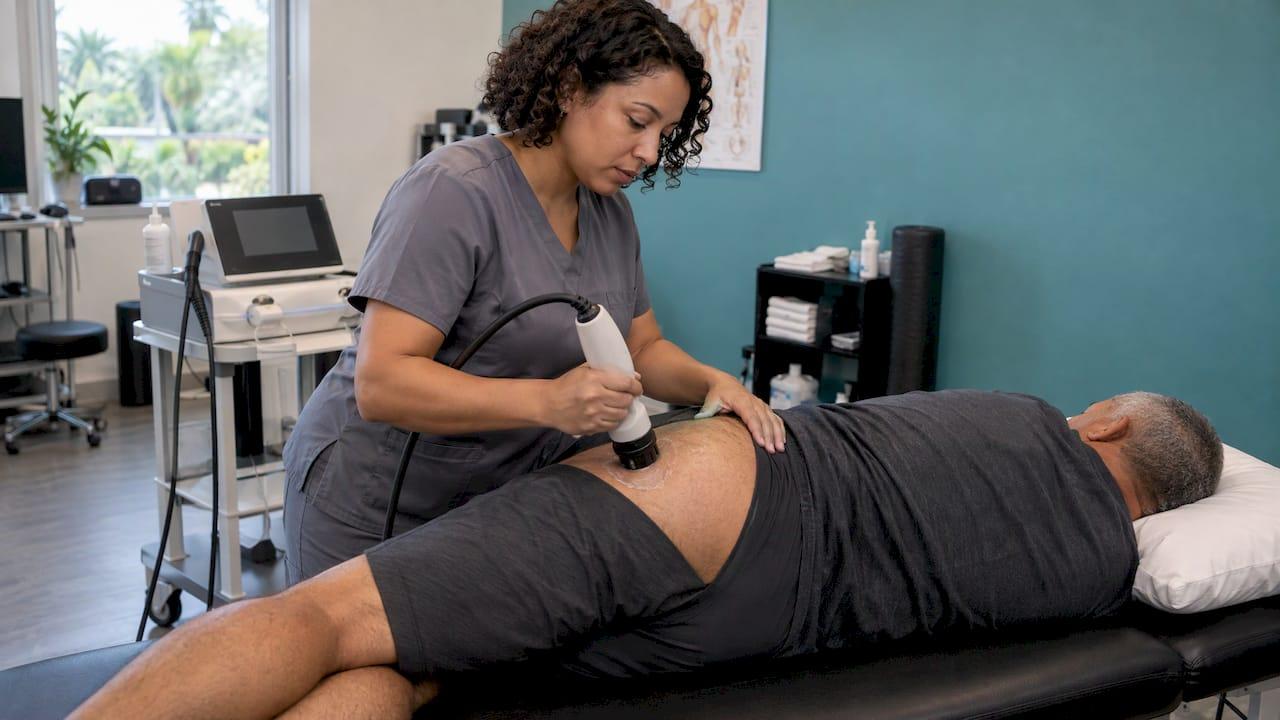
Shockwave therapy sends focused or radial acoustic pulses through the skin into the sore tendon around your hip. It is used mainly for pain on the outside of the hip (gluteal tendinopathy, often called hip bursitis), for calcific tendonitis and for hamstring tendon pain near the sit bone. A 2025 systematic review found significant pain and function improvement in 17 of 18 studies. At Sparkmed in North Miami, a shockwave session is $75, and the first step is an exam to confirm the hip pain is the kind this treatment is meant for.
TL;DR
- Shockwave therapy is a non-surgical treatment that sends acoustic pulses into painful hip tendons. Research reviews cover gluteal tendinopathy, calcific tendonitis and proximal hamstring tendinopathy.
- Most studied protocols used 3 to 4 weekly sessions of 2,000 to 3,000 pulses, so plan for a short series, not one visit.
- Side effects are usually mild: temporary soreness and skin irritation. Pregnancy, active infection and treatment near a known cancer are reasons to skip it.
- Hip pain after a car accident, a fall or a work injury should be examined first, because other problems can look like tendon pain.
- Sparkmed offers shockwave therapy at $75 per session in North Miami, with bilingual staff (English, Spanish, Creole) and direct insurance billing.
Table of Contents
- What shockwave therapy actually is
- Which hip conditions it is used for
- What a hip shockwave session looks like
- Side effects and who should not have it
- Is it hip tendon pain or something else?
- How shockwave fits with other care
- What it costs in North Miami
- Our perspective on hip shockwave therapy
- Getting treated at Sparkmed
- FAQ
- Sources
What shockwave therapy actually is
Extracorporeal shockwave therapy (ESWT) uses sound-based pressure pulses delivered by a handheld applicator. "Extracorporeal" just means the energy comes from outside the body. There are two main types. Focused shockwave reaches deeper and concentrates energy on a small target. Radial shockwave spreads energy over a wider, shallower area. The research on hip tendons includes both: in the 2025 review, 11 studies used radial and 7 used focused ESWT.

Researchers do not fully understand why it works. The authors of that review describe a process called mechanotransduction, where cells convert mechanical force into chemical signals. They suggest this may change pain signaling and support tissue repair through more collagen production and other cell responses. In plain terms, the pulses appear to give a stalled, chronically irritated tendon a reason to start healing again, while also turning down pain signals.
You can read more about how clinics use it for injury recovery in our guide to shockwave therapy uses.
Which hip conditions it is used for
Gluteal tendinopathy and "hip bursitis"
If your pain sits on the outside of the hip and hurts when you lie on that side, climb stairs or stand on one leg, the likely cause is greater trochanteric pain syndrome (GTPS). It used to be called trochanteric bursitis. According to American Family Physician (January 2021), it is the most common cause of lateral hip pain, most often affects women between 40 and 60, and gluteus medius tendinopathy or tears are now thought to be more common than bursitis itself.

That matters for you because "hip bursitis" is often really a tendon problem, and shockwave therapy is aimed at the tendon. Nine of the 18 studies in the 2025 review were about GTPS.
Here is what the research shows for this group:
- A 2024 meta-analysis of 12 articles covering 1,121 people found moderate effects favoring shockwave for pain, and the authors concluded it should be considered a viable GTPS option given its low side-effect rate.
- A 2021 systematic review reported good outcomes for gluteal tendinopathy, with pain significantly lower after one week and maintained in one study over 27 months.
- In a randomized trial of 50 patients, focused shockwave beat therapeutic ultrasound for pain at 2 months (pain score 2.08 vs 3.36) and 6 months (0.79 vs 2.03).
- A 2025 systematic review found focused shockwave superior to corticosteroid injection for long-term pain in gluteal tendinopathy.
Calcific tendonitis
Calcific tendonitis means calcium deposits have formed inside a tendon. It is best known in the shoulder, but it also occurs around the hip and pelvis. Seven of the 18 studies in the 2025 review examined calcific tendinopathy, and the review found significant pain and functional improvement across hip and pelvic tendon conditions overall. Calcific cases are diagnosed with imaging, so an X-ray or ultrasound comes before any treatment plan.
Proximal hamstring tendinopathy
Pain deep in the buttock where the hamstring attaches to the sit bone, worse when sitting on hard seats, is often grouped with hip pain. Five studies in the 2025 review covered it. It is a reason to describe your pain location precisely at your first visit.
What a hip shockwave session looks like
The practitioner applies gel to the skin over the most painful spot, then moves the applicator while delivering pulses. The 2022 best-practices paper says treatment is guided by clinical focusing over the areas of maximal pain, without anesthetics. That means you give live feedback on where it hurts, and that feedback steers the treatment. Expect a tapping or thumping sensation that can be intense over a tender tendon, but a session is brief.
Here are the typical numbers from the research:
| Detail | What studies used |
|---|---|
| Number of sessions | 3 to 4 weekly sessions in 72% of protocols |
| Pulses per session | 2,000 to 3,000 in 83% of protocols |
| Focused ESWT | Typically 3 weekly sessions of 600 to 2,500 pulses at 1 to 5 Hz |
| When pain relief was measured | From 0.5 to 27 months after treatment |
A 2024 Italian pilot study of gluteus medius tendon pain combined both types over 3 to 5 weekly sessions, with no side effects reported. Protocols vary by device and condition, so your clinician sets the plan after examining you.
Side effects and who should not have it
Shockwave therapy has a low rate of problems. Across the 2025 review, the adverse-event rate was 12% (65 of 557 patients), mostly temporary increased pain and skin irritation. For a deeper look at what to expect afterward, see our guide on shockwave therapy side effects.
Safe use includes a few rules:
- Skip it with: active infection in the bone (osteomyelitis), pregnancy, or treatment next to a known cancer, according to the ISMST contraindication list cited in a 2022 best-practices paper.
- Keep high-energy waves away from: lung tissue, the brain or spinal nerves, growth plates in children and teens, and in people with severe clotting disorders.
- Pain relief afterward: the same paper advises avoiding NSAIDs (ibuprofen, naproxen) for post-treatment pain and using acetaminophen or topical analgesia instead. Tell your clinician about any blood thinners or other medications before treatment.
If you are pregnant, have cancer, or take blood thinners, speak with your physician before booking.
Recovery habits help too. Light walking, gentle movement your clinician approves and rest from the activity that aggravated the tendon are sensible after sessions. If you use other recovery tools alongside treatment, such as vibration or magnetic field devices, read up on PEMF therapy side effects and tell your clinician what you are using.
Is it hip tendon pain or something else?
Not all hip pain is a tendon or bursa problem. American Family Physician recommends MRI when a doctor suspects a labral tear, a femoral neck stress fracture or early avascular necrosis (loss of blood supply to the bone). It also advises evaluating for a gluteus medius tendon tear when GTPS does not respond to anti-inflammatories and physical therapy, using MRI or musculoskeletal ultrasound.
See a clinician promptly, and do not self-diagnose, if you have:
- Hip pain after a car crash, fall or work injury
- Pain that wakes you at night or keeps getting worse
- Groin pain, a catching or locking feeling, or pain with weight-bearing that makes you limp
- Redness, swelling or fever around the hip
This is why the order matters: exam first, treatment second. A hip that hurts after a collision can involve the joint, the pelvis, the lower back or all three, and the treatment plan depends on which. Our article on hip pain after a car accident explains what to document for your injury claim.
How shockwave fits with other care
Shockwave is rarely the only tool. A 2022 network meta-analysis of 13 randomized trials and 1,034 patients found that PRP and shockwave both beat no treatment for pain at 1 to 3 months, and that structured exercise was the only option to significantly improve function in that window. Bremer and colleagues recommend exercise and education as the foundation for gluteal tendinopathy, with focused shockwave as a possible addition.
A good plan pairs the pulses with work on the muscles and joints around the hip. At Sparkmed, the services available alongside shockwave include chiropractic adjustments, massage therapy, electrical stimulation, ultrasound therapy and traction or decompression. Our overview of tendonitis shockwave therapy covers what it treats and costs in more detail.
What it costs in North Miami
At Sparkmed, shockwave therapy is $75 per session, as published on our pricing page. A typical series in the research runs 3 to 4 weekly sessions, so you can estimate your total by multiplying the per-session price by the number of sessions your clinician recommends after your exam. Monthly plans are also available: Essential is $149 per month, Performance is $249 per month and Elite is $399 per month. Chiropractic adjustments are $45.
If your hip pain came from a car accident, direct insurance billing and thorough injury documentation are part of how we work. For more on pricing across the country, see our guide to shockwave therapy cost.
Our perspective on hip shockwave therapy
We have spent more than 20 years treating people hurt in accidents, and hip pain is one of the complaints that most often keeps them from sleeping, walking and working. A hip that hurts after a collision or a fall deserves a proper exam before any treatment plan.
That is why we start with an evaluation. Shockwave therapy is a strong option for stubborn tendon pain on the outside of the hip, and the research reviews point to meaningful improvement in pain and function. But the best results come from matching the right treatment to the right tissue, then supporting it with adjustments, soft-tissue work and the therapies we offer in the same clinic.
We also believe cost should not be the barrier. We publish our prices, $75 for a shockwave session and $45 for a chiropractic adjustment, and we help with transportation through Uber Health so getting to your appointments is one less worry. We speak English, Spanish and Creole, so you can describe exactly where it hurts in the language you think in.
Spark
Getting treated at Sparkmed
If your hip pain is stopping you from sitting, sleeping or walking comfortably, the next step is an exam. Our North Miami team offers shockwave therapy alongside chiropractic care, and we handle direct insurance billing for accident-related visits. See our services or read about shockwave therapy for car accident injuries in North Miami, then book your visit.
You can also start with a chiropractic adjustment while we assess whether shockwave belongs in your plan.
FAQ
How many shockwave sessions does hip pain usually need?
Most studied protocols used 3 to 4 weekly sessions with 2,000 to 3,000 pulses each. Your clinician sets the exact number after examining the hip and the condition behind the pain.
Does shockwave therapy help hip bursitis?
Much of what is called hip bursitis is gluteal tendinopathy, and shockwave targets the tendon. Studies of greater trochanteric pain syndrome report improved pain and function, and one trial found focused shockwave gave lower pain scores than therapeutic ultrasound at 2 and 6 months.
Is shockwave therapy for hip pain painful?
You feel strong tapping, and it can be uncomfortable over a tender spot, because treatment is guided by where you feel the most pain. The most common side effects are temporary soreness and skin irritation. Tell your clinician if the intensity is too much.
Can shockwave therapy treat calcific tendonitis in the hip?
Seven studies in the 2025 review looked at calcific tendinopathy around the hip and pelvis, and the review reported significant improvement in pain and function overall. Imaging first confirms the diagnosis.
Who should avoid shockwave therapy?
People who are pregnant, have an active bone infection or have a known cancer near the treatment area should avoid it, as should anyone with a severe clotting disorder. Growth plates and the lungs, brain and spinal nerves should not receive high-energy waves, per the 2022 best-practices paper.
Sources
- Extracorporeal Shockwave Therapy for Tendinopathies Around the Hip and Pelvis (PMC, 2025)
- Hip Pain in Adults: Evaluation and Differential Diagnosis (American Family Physician, 2021)
- Is shockwave therapy effective in the management of greater trochanteric pain syndrome? (PubMed, 2024)
- Treatment of Gluteal Tendinopathy: A Systematic Review (PMC, 2021)
- Focused extracorporeal shock wave therapy for greater trochanteric pain syndrome (PubMed, 2019)
- The efficacy of gluteal tendinopathy treatments (PMC, 2025)
- Best practices for extracorporeal shockwave therapy (PMC, 2022)
- Long-Term Efficacy of Combined Focused and Radial Shockwave Therapy (PMC, 2024)
- Comparative Efficacy of Nonoperative Treatments for Greater Trochanteric Pain Syndrome (PubMed, 2022)
- PEMF Therapy Side Effects: What You Need to Know