
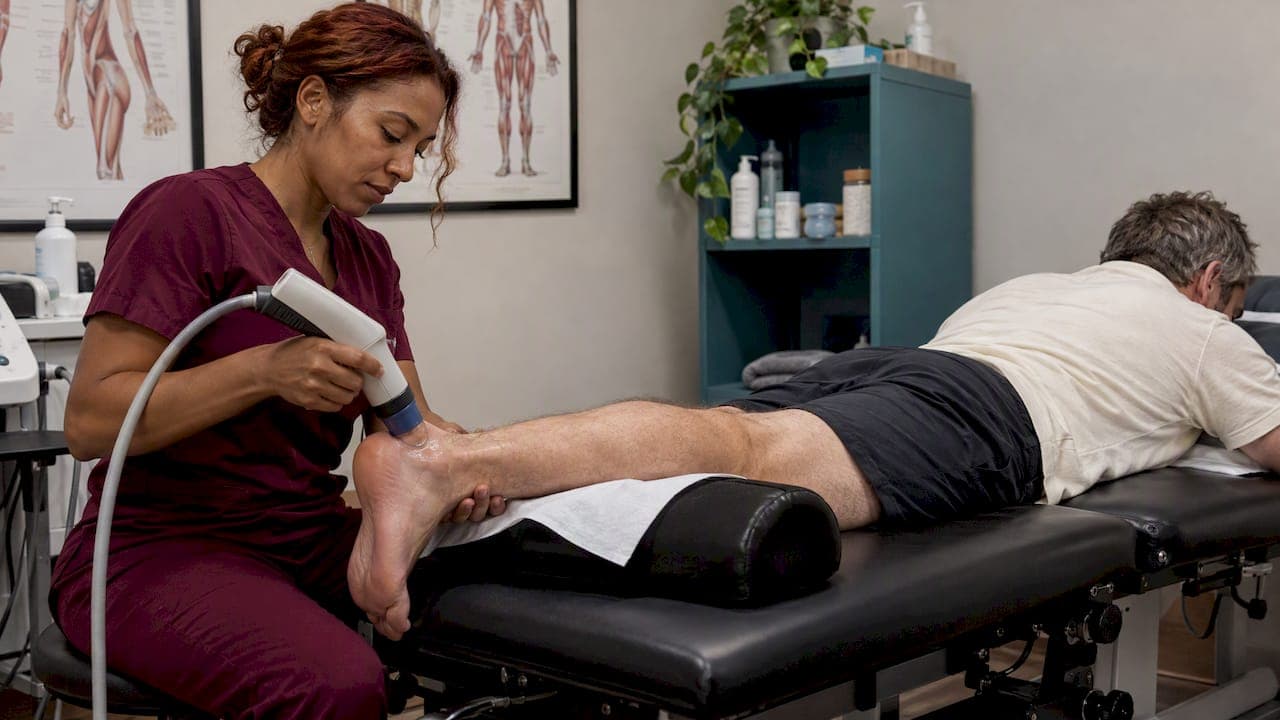
Shockwave therapy can reduce pain in many chronic tendon problems, but results vary from person to person and the research is still mixed. It works best on stubborn tendonitis that has not improved with rest, stretching and basic care. A typical course is several short sessions spaced about a week apart. Insurance often does not pay for it. At our North Miami clinic, a shockwave session is $75.
Below, we explain which tendons respond, what happens in the treatment room, how many visits to plan for, the real side effects, and how to decide whether it fits your injury.
TL;DR
- Shockwave therapy sends pulses into an injured tendon to relieve pain and support healing. Mayo Clinic lists it among tendinopathy treatments.
- Studies show pain reduction, but findings conflict and the best protocol for each tendon is not settled.
- Plan on a course, not a single visit. Sessions run 10 to 30 minutes and are often weekly.
- Side effects are usually mild (soreness, bruising, tingling), but pregnancy, active infection and some other situations rule it out.
- Our shockwave sessions are $75 each. Our pricing page lists the details.
Table of Contents
- Does shockwave therapy heal tendonitis?
- Which tendons respond best
- What happens during a session
- How many sessions and how far apart
- Side effects and who should skip it
- Cost and insurance
- Our perspective
- Is shockwave the right next step for you?
- Start with an exam in North Miami
- FAQ
- Sources
Does shockwave therapy heal tendonitis?
It can reduce pain and improve function, and for many people with long-lasting tendon pain that is enough to get back to normal activity. A review of studies on shockwave and tendinopathy pain found reduced pain overall. It also noted that individual trials contradicted each other and that more high-quality research is needed to define the best treatment for each type.
That honesty matters, because the reasons for the mixed results are practical. Researchers at Penn State point out that tendinopathy therapies produce mixed outcomes partly because treatment settings and reporting are not standardized. Two clinics can both say "shockwave" and deliver very different energy levels, session counts and targeting. The result depends heavily on who is applying it and how well the diagnosis is matched to the tendon.
A word on terms. "Tendonitis" usually means a tendon that is irritated and inflamed in the short term. "Tendinopathy" describes the longer-standing condition where the tendon structure itself has changed. Shockwave is mostly used for the second kind: pain that has lasted weeks to months. If your pain started a few days ago, rest, activity changes and an exam come first.
How it is thought to work
The device delivers acoustic pulses through the skin into the sore tissue. The Mayo Clinic describes the aim as relieving pain and helping the tissue heal. Clinics commonly explain this as stimulating blood flow and the body's repair response in tissue that has stalled. Treat those mechanisms as the working explanation, not a guarantee for any one patient.
Which tendons respond best
Not every tendon has the same level of backing. The list below separates conditions with formal approval from those where use is common but off-label.
| Condition | Where it stands |
|---|---|
| Plantar fasciitis (heel) | FDA-approved indication |
| Lateral epicondylitis (tennis elbow) | FDA-approved indication |
| Achilles tendinopathy | Studied, off-label use |
| Patellar tendinopathy (jumper's knee) | Studied, off-label use |
| Calcific shoulder tendinitis | Studied, off-label use |
The VA's own guidance agrees on the approved pair: high-energy ESWT is FDA-approved for chronic plantar fasciitis and tennis elbow. The International Society for Medical Shockwave Treatment also lists calcifying shoulder tendinopathy, greater trochanteric pain syndrome, patellar and Achilles tendinopathy among treated conditions, as summarized by Mayo Clinic.
For Achilles problems, the evidence has been gathered in a systematic review of randomized trials that separates mid-portion from insertional cases, which is a reminder that the exact spot on the tendon changes the plan.
If your tendon pain came from a crash, a fall at work or a slip, the picture is different: the injury may involve several tissues at once. Our guide on shockwave therapy for car accident injuries in North Miami covers how we think about that.
What happens during a session
Expect a short, hands-on visit. A provider may apply gel to your skin, then pass a wand-like device over the sore area to deliver pulses. The Cleveland Clinic puts a session at 10 to 30 minutes.
Here is how a visit typically flows:
- Exam and history. We locate the painful tendon, check movement and strength, and ask what aggravates it.
- Positioning. You sit or lie so the tendon is accessible and relaxed.
- Gel and device. Gel goes on the skin, and the applicator is moved over the target area.
- Feedback. The treatment can feel uncomfortable over a tender spot. Tell the provider and the intensity can be adjusted.
- Aftercare. You walk out the same day. We usually advise easing back into hard loading rather than testing the tendon right away.
Focused versus radial
Focused shockwave concentrates energy into a smaller zone and reaches deeper. Radial waves spread over a wider, shallower area. One Florida performance clinic notes that focused treatment may need fewer sessions for deep, stubborn tissue. Which is right depends on how deep and how broad your problem is, so ask any provider which type they use and why.

Some wellness spaces round out recovery with gentler options, for example red light therapy sessions that run 10 to 20 minutes. These are a separate category from shockwave, and your provider should explain how any combination fits your plan.
How many sessions and how far apart
Plan for a series. The Cleveland Clinic says most conditions are treated about once a week for six to 12 weeks, each visit lasting 10 to 30 minutes. A Tampa performance clinic describes a typical course as 5 to 6 sessions, spaced 5 to 10 days apart. Those are ranges, not promises: a recent flare may settle faster, and a long-standing Achilles problem may take longer.
A realistic timeline looks like this:
- Weeks 1 to 2: first sessions. Some people feel relief right away, others feel nothing yet. Soreness can appear.
- Weeks 3 to 6: the stretch where most people judge whether it is working. Your provider should re-test pain and function, not just ask how you feel.
- After the course: tendons keep remodeling for a while. Gradual strengthening is what helps results last.
The effects are not always permanent. The Cleveland Clinic notes some patients need repeat treatment a year or two later. That is why a rehab plan, not just the device, decides how well you do over time.
Side effects and who should skip it
Shockwave is generally safe when done by a trained provider, and the side effects are usually minor. A clinical practice review lists pain, redness, bruising, hematoma, numbness or tingling, swelling and headache as possible effects, and Achilles tendon rupture has been reported. The same review lists the situations where it should not be used: active infection and pregnancy, and treatment aimed at a malignant tumor. High-energy treatment should also avoid the brain or nerves, lung or pleura, and growth plates in children.
In plain terms, tell your provider before treatment if you are pregnant or might be, have an infection near the area, have a known tumor, or have had steroid injections into that tendon recently. Ask about blood thinners and bleeding disorders too. If you have any of these, your medical doctor should weigh in before you start.
Proper technique matters as well. A Mayo Clinic physician notes there is less consensus on complications and stresses understanding the treatment's limits and giving it properly. For a deeper walk through, see our article on shockwave therapy side effects.
See a doctor promptly, rather than waiting for the next session, if you feel a sudden pop or sharp loss of strength in a tendon, severe swelling, or numbness that does not fade.
Cost and insurance
Most people pay out of pocket. Mayo Clinic notes that focused shockwave and radial pressure wave therapies are not covered by most insurance plans. On the Medicare side, one regional contractor's local coverage determination treats high-energy ESWT for musculoskeletal conditions as not reasonable and necessary, so it is not covered there.
Prices vary widely by provider, device type and region, so ask for the per-session price and the expected number of visits before you start, and multiply the two. Our own price is published: a shockwave session is $75 on our pricing page. For a broader breakdown of what drives price, read our shockwave therapy cost guide.
If your injury came from a car accident, ask us how documentation and billing work for your case. We bill insurance directly for accident care and document injuries thoroughly for claims.
Our perspective
Tendon pain is rarely just a tendon problem. After a collision, a fall or years of repetitive work, the joint above and below, the muscles around it and the way you move all changed. That is why we do not treat shockwave as a stand-alone gadget.
We have more than 20 years of experience treating accident victims, and our approach is to combine targeted shockwave with the other tools in our clinic: spinal adjustments, ultrasound, electrical stimulation, massage and traction or decompression. The device calms a stubborn tendon. The rest of the plan helps you load it again.
We publish our prices because cost is often the first barrier. A $75 session lets you try a course without guessing, and our wellness plans are there if you want ongoing care. We also work in English, Spanish and Creole, and offer transportation help, so language and getting to the clinic do not get in the way of recovery.
If shockwave is not right for you, we will say so at the exam and point you to the approach that fits your injury.
Spark
Is shockwave the right next step for you?
Use these questions as a quick filter:
- Has the pain lasted more than a few weeks? Longer-standing pain is where shockwave is most often used.
- Have rest, stretching and activity changes plateaued? If so, a course may be reasonable.
- Do you have a diagnosis? Tennis elbow and plantar fasciitis have approved indications. For other tendons, expect your provider to explain the evidence honestly.
- Are you in a screening group? Pregnancy, infection near the area, or a tumor means talk to your doctor first.
- Can you commit to a series? One session rarely tells you much.
For related options, our guides on non-invasive therapy for pain recovery, ultrasound for injuries and soft tissue therapy explain how each tool fits alongside shockwave. If you have scar tissue from a past injury, read three questions to ask before shockwave for scar tissue. A full overview of uses is in our ISMST uses article.
Start with an exam in North Miami
If tendon pain from an accident, work injury or a slip is holding you back, we can examine it and tell you whether shockwave belongs in your plan. Shockwave sessions are $75 each, and our chiropractic adjustments are $45. Our monthly plans are Essential at $149, Performance at $249 and Elite at $399. Details are on our pricing page, and our other treatments are listed on the services page.
Book an appointment through sparkmed.net and we will start with an exam, not a sales pitch.
FAQ
Is there a downside to shockwave therapy?
The common downsides are temporary soreness, redness, bruising and tingling. Rarer problems, including Achilles tendon rupture, have been reported, and pregnancy and active infection are contraindications. Results are also not always permanent, so some people repeat a course later.
Why isn't shockwave therapy covered by insurance?
Coverage bodies have not accepted the evidence as strong enough for routine musculoskeletal use. One Medicare contractor's coverage determination calls high-energy ESWT not reasonable and necessary for these conditions. Most private plans follow a similar line, so many clinics, including ours, price it per session.
How many shockwave sessions will my tendonitis need?
Usually a series. The Cleveland Clinic describes weekly visits for six to 12 weeks for most conditions. Your provider should re-check your pain and function partway through and adjust the plan.
Does shockwave therapy hurt?
It can feel uncomfortable, especially over an irritated tendon, but sessions are short, at 10 to 30 minutes according to the Cleveland Clinic. Tell your provider if it is too intense and the setting can be lowered. Mild soreness afterward is common.
Sources
- Mayo Clinic: Tendinopathy diagnosis and treatment
- Effect of extracorporeal shock-wave therapy on pain in tendinopathy (PMC)
- Therapeutic ultrasound and shockwave therapy for tendinopathy (PMC)
- Extracorporeal shockwave therapy in musculoskeletal disorders (PMC)
- VA: Extracorporeal Shock Wave Therapy for Musculoskeletal Conditions
- Mayo Clinic: Shockwave treatment, a new wave for musculoskeletal care
- Systematic review of ESWT for Achilles tendinopathy
- Cleveland Clinic: Acoustic wave therapy
- Best practices for extracorporeal shockwave therapy (PMC)
- Focused shockwave therapy overview
- CMS: LCD for Extracorporeal Shock Wave Therapy (L38775)