

Therapeutic exercise is prescribed physical movement designed to correct impairments, restore musculoskeletal and neuromuscular function, and maintain overall well-being. Unlike a general gym workout, it is clinically directed, meaning a licensed professional matches the type, intensity, and progression of movement to a specific pathology and the patient's current healing stage. The American Academy of Physical Medicine and Rehabilitation recognizes it as a foundational intervention, and StatPearls research confirms it is indicated for virtually all non-acutely ill adults and children up to their level of ability.
What sets therapeutic exercise apart is clinical precision. A patient recovering from a rotator cuff repair and a patient managing knee osteoarthritis may both perform shoulder or leg movements, but the mode, load, and timing are entirely different. The goal is always functional: get the person back to doing what they need to do, with less pain and more capacity.
Key characteristics and objectives of therapeutic exercise:
- Prescribed by a licensed clinician based on individual assessment
- Targets specific impairments rather than general fitness
- Progresses systematically through healing stages
- Aims to remediate pain, restore range of motion, rebuild strength, and improve coordination
- Applies to musculoskeletal, neurological, cardiopulmonary, and metabolic conditions
- Supported by evidence across chronic disease management, post-surgical recovery, and fall prevention
Table of Contents
- How the body responds to therapeutic exercise
- What are the main types of therapeutic exercise?
- When is therapeutic exercise indicated?
- Contraindications and safety considerations
- Equipment, personnel, and preparation
- Why therapeutic exercise matters more than most people realize
- How to design a therapeutic exercise program
- Common conditions treated with therapeutic exercise
- How to monitor and adjust a therapeutic exercise program
- What results can you expect, and how long does it take?
- Sparkmed supports your recovery with therapeutic care in North Miami
- Key Takeaways
How the body responds to therapeutic exercise
Therapeutic exercise works because the body adapts to physical stress in predictable, measurable ways. Understanding which structures are being targeted, and why, is what separates a clinically sound program from a generic one.
The musculoskeletal system is the primary target. Muscles generate force and absorb load; tendons transfer that force to bone; ligaments stabilize joints; and cartilage cushions the surfaces where bones meet. When any of these structures are injured or deconditioned, the whole chain is affected. Therapeutic exercise rebuilds each link deliberately.

Neuromuscular control is equally important and often overlooked. Proprioception, the body's sense of joint position and movement, degrades after injury. A sprained ankle, for example, doesn't just damage ligament fibers; it disrupts the sensory receptors embedded in those fibers. Balance and coordination exercises specifically retrain this system, reducing re-injury risk.
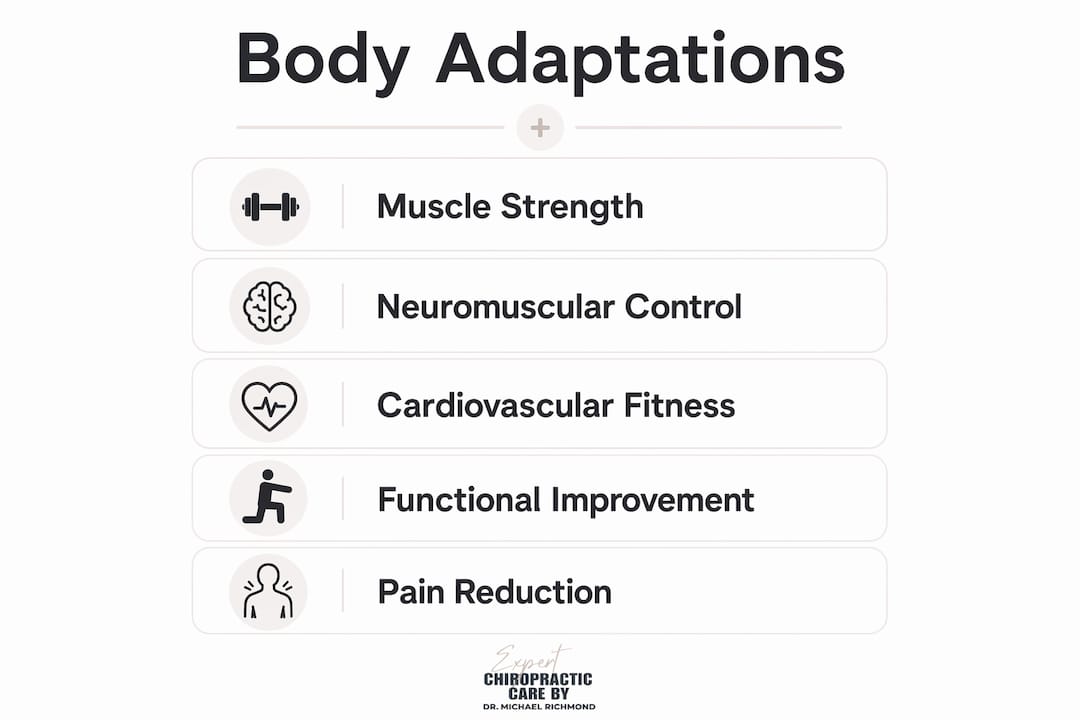
| Physiological system | What therapeutic exercise targets | Measurable adaptation |
|---|---|---|
| Skeletal muscle | Fiber recruitment and hypertrophy | Increased strength and endurance |
| Connective tissue | Collagen remodeling in tendons and ligaments | Greater tensile strength and flexibility |
| Cardiovascular system | Cardiac output and oxygen delivery | Improved aerobic capacity |
| Nervous system | Motor unit activation and proprioception | Better coordination and balance |
| Bone | Mechanical loading stimulus | Increased bone mineral density |
Cardiovascular adaptations matter too, especially for patients with chronic disease. Aerobic exercise improves cardiac output, lowers resting heart rate, and enhances the muscles' ability to extract oxygen. These changes don't happen overnight, but they are durable when exercise is sustained.

What are the main types of therapeutic exercise?
The spectrum of therapeutic exercise runs from completely passive movement, where the therapist moves the limb with no muscle effort from the patient, all the way to resisted exercise performed against significant external load. Where a patient starts on that spectrum depends entirely on tissue healing stage and current capacity.
The four primary categories:
- Aerobic exercise: Sustained, rhythmic activity (walking, cycling, swimming) that improves cardiovascular and pulmonary function. Used for cardiac rehab, chronic obstructive pulmonary disease management, and general deconditioning.
- Resistance (strengthening) exercise: Progressive loading of muscles through isotonic, isometric, or isokinetic contractions. High-resistance, low-repetition work builds strength; lower resistance with higher repetitions builds endurance. Research from Johns Hopkins confirms that isotonic exercises are generally preferable to isometric ones for functional strength gains.
- Flexibility exercise: Static, dynamic, or proprioceptive neuromuscular facilitation (PNF) stretching to restore or maintain range of motion. Passive range-of-motion exercises prevent contractures but do not build strength on their own.
- Neuromotor exercise: Balance, coordination, agility, and proprioceptive training. Particularly critical after lower-extremity injuries and for older adults at risk of falls.
Sub-classifications by effort mode:
- Passive: No voluntary muscle contraction; therapist or machine moves the limb
- Active-assisted: Patient initiates movement; therapist or device provides partial support
- Active: Patient moves through full range without assistance or resistance
- Resisted: Patient works against external force (weights, bands, body weight)
Pro Tip: Patients often assume therapeutic exercise means lifting weights. Passive and active-assisted movements are just as clinically purposeful, especially in the acute phase of healing when loading tissue too early can set recovery back.
General fitness programs aim for broad health improvement. Therapeutic exercise, by contrast, targets a defined deficit. The SAID principle (Specific Adaptation to Imposed Demands) is the scientific basis: the body adapts specifically to the demands placed on it, so the exercise must match the functional goal.
When is therapeutic exercise indicated?
Therapeutic exercise is appropriate across a wide range of medical and functional conditions. The common thread is a gap between what a patient can currently do and what they need to do.
Common indications include:
- Musculoskeletal disorders: osteoarthritis, tendinopathy, low back pain, post-fracture rehabilitation, rotator cuff injuries
- Post-surgical recovery: joint replacement, spinal surgery, ligament reconstruction
- Neurological conditions: stroke, Parkinson's disease, multiple sclerosis, traumatic brain injury
- Cardiopulmonary conditions: heart failure, chronic obstructive pulmonary disease, post-myocardial infarction
- Metabolic conditions: type 2 diabetes, obesity-related deconditioning
- Preventive applications: fall prevention in older adults, injury prevention in athletes
Consider knee osteoarthritis as a concrete example. The joint cartilage has degraded, causing pain and stiffness that reduce activity. Less activity leads to muscle weakness around the knee, which increases joint loading and accelerates cartilage breakdown. Therapeutic exercise interrupts that cycle. Meta-analyses confirm that supervised programs for knee and hip osteoarthritis produce measurable improvements in self-reported pain and physical function. The exercise doesn't regenerate cartilage, but it rebuilds the muscular support that protects what remains.
The goal across all indications is the same: increase function, reduce disability, and improve quality of life. For older adults especially, maintaining independence through exercise is one of the most clinically significant outcomes a rehabilitation program can deliver.
Contraindications and safety considerations
Therapeutic exercise is not appropriate for every patient at every moment. Recognizing when to hold off, or when to modify significantly, is as important as knowing how to prescribe.
Absolute contraindications (exercise should not proceed):
- Acute myocardial infarction or unstable angina
- Uncontrolled cardiac arrhythmia with hemodynamic compromise
- Severe aortic stenosis
- Acute systemic infection with fever
- Acute deep vein thrombosis or pulmonary embolism
- Uncontrolled hypertension at rest
Relative contraindications (proceed with caution and monitoring):
- Moderate valvular heart disease
- Electrolyte abnormalities
- Uncontrolled metabolic conditions (e.g., poorly managed diabetes)
- Significant musculoskeletal pain that worsens with movement
- Recent fracture not yet cleared for loading
Safety during exercise depends heavily on matching the load to the tissue's current healing capacity. Applying resistance to a tendon in the acute inflammatory phase, for example, can disrupt the repair process rather than support it. This is why tissue healing stage is a non-negotiable part of the initial assessment.
Severe complications during supervised programs are rare. The more common problem is inadequate adherence to prescribed intensity and frequency, which prevents the physiological adaptations the program is designed to create. Professional guidance isn't just about safety; it's about making sure the exercise actually works.
Safety tips for patients and clinicians:
- Monitor heart rate, blood pressure, and perceived exertion during sessions
- Stop immediately if chest pain, dizziness, or severe shortness of breath occurs
- Progress load gradually; avoid large jumps in intensity or volume
- Communicate pain levels honestly; a 3/10 ache during exercise is often acceptable, but 7/10 is a signal to back off
- Re-evaluate the program after any significant change in patient status
Equipment, personnel, and preparation
A therapeutic exercise program requires the right tools, the right people, and a clear picture of where the patient is starting from.
Common equipment used in therapeutic exercise:
- Free weights and dumbbells for progressive resistance
- Resistance bands for variable-load strengthening
- Treadmills and stationary bikes for aerobic conditioning
- Balance boards, wobble cushions, and BOSU balls for neuromotor training
- Parallel bars and gait trainers for ambulation rehabilitation
- Pulleys and cable systems for range-of-motion and strengthening
- Therapeutic pools for aquatic exercise (reduces joint load while maintaining resistance)
Personnel involved:
- Physical therapists (PTs): Primary prescribers and supervisors of therapeutic exercise programs; licensed to evaluate, diagnose movement dysfunction, and design individualized plans
- Physical therapist assistants (PTAs): Implement programs under PT supervision
- Physiatrists (Physical Medicine and Rehabilitation physicians): Medical doctors who prescribe and oversee rehabilitation programs, particularly for complex or neurological cases
- Certified athletic trainers and rehabilitation specialists: Support program delivery in sports and occupational settings
Preparation and assessment before starting:
- Comprehensive intake: medical history, current medications, prior injuries, surgical history
- Functional movement screening to identify compensatory patterns
- Baseline measurements: range of motion, muscle strength, balance, cardiovascular fitness
- Pain assessment and identification of aggravating and relieving factors
- Goal setting: short-term (reduce pain, restore range of motion) and long-term (return to work, sport, or daily activities)
A personalized wellness plan built from this assessment is what separates effective rehabilitation from generic exercise advice. The assessment isn't a formality; it's the data that drives every decision about what exercises to prescribe, at what intensity, and in what sequence.
Why therapeutic exercise matters more than most people realize
Therapeutic exercise is one of the most underutilized treatments in modern healthcare, consistently overshadowed by medication and procedures despite strong evidence for its effectiveness. The American Academy of Physical Medicine and Rehabilitation recommends multi-modal exercise programs combining aerobic, resistance, flexibility, and neuromotor training for adults managing chronic conditions.
The benefits are well-documented. Supervised therapeutic exercise improves strength, aerobic capacity, and physical function while reducing pain, and it does so without worsening disease progression in patients with chronic conditions. For aging populations, the stakes are particularly high. Maintaining muscle mass, balance, and cardiovascular fitness through exercise directly reduces fall risk and preserves independence, two outcomes that no pill replicates.
Long-term adherence is where many programs fall short. Benefits can persist 2–6 months after formal therapy ends, but only when patients continue exercising. For chronic conditions like osteoarthritis, joint lubrication and anti-inflammatory effects depend on ongoing movement, not a completed course of treatment. The clinical work is getting patients to internalize exercise as a permanent habit, not a temporary fix.
Dosing matters as much as the exercise itself. Too little load produces no adaptation; too much causes injury or flare-up. The art of therapeutic exercise prescription, as the ASHT describes it, lies in balancing the science of physiological adaptation with the reality of each patient's context, tolerance, and goals. Complementary approaches like therapeutic massage can support recovery between sessions by reducing muscle tension and improving tissue circulation.
How to design a therapeutic exercise program
Program design follows a set of principles that prevent both under-dosing and overloading. The SAID principle is the foundation: the body adapts specifically to the demands imposed on it, so every exercise choice must map back to a functional goal.
Core design principles:
- Specificity: Match the exercise to the movement pattern, muscle group, and energy system the patient needs to recover. A patient returning to stair climbing needs loaded knee extension and hip extension work, not just general leg strengthening.
- Progressive overload: Gradually increase the challenge (load, volume, complexity, or speed) as the patient adapts. Stagnant programs produce stagnant results.
- Reversibility: Gains disappear when exercise stops. Program design must account for long-term maintenance, not just the acute rehabilitation phase.
- Individuality: Two patients with the same diagnosis may need very different programs based on age, fitness baseline, comorbidities, and functional goals.
Dosage parameters to specify:
- Mode (type of exercise)
- Frequency (sessions per week)
- Intensity (load, heart rate zone, or perceived exertion target)
- Volume (sets, repetitions, or duration)
- Progression criteria (when and how to advance)
Progression is where clinical judgment is most visible. A physical therapist advancing a patient from active-assisted to fully resisted exercise is making a decision based on tissue healing timeline, pain response, and movement quality, not just a calendar. Rushing progression is one of the most common causes of setbacks in rehabilitation. Customizing chiropractic and rehabilitation plans around these principles is what drives consistent, measurable recovery.
Common conditions treated with therapeutic exercise
Therapeutic exercise has a documented role across a broad range of diagnoses. The conditions below represent the most frequently treated in outpatient and inpatient rehabilitation settings.
Musculoskeletal conditions: Low back pain is among the most common reasons patients are referred for therapeutic exercise. Core stabilization, hip strengthening, and mobility work address the muscular deficits that drive most mechanical low back pain. Rotator cuff injuries, knee ligament tears, and hip replacement recovery all follow structured progressive loading protocols tailored to the specific tissue and surgical approach.
Neurological conditions: Stroke rehabilitation relies heavily on task-specific therapeutic exercise to retrain motor pathways through neuroplasticity. Repetitive, goal-directed movement, such as reaching for objects or practicing gait patterns, drives cortical reorganization. Parkinson's disease management uses resistance and balance training to slow the functional decline associated with the condition.
Cardiopulmonary conditions: Cardiac rehabilitation programs are structured therapeutic exercise protocols for patients post-myocardial infarction or heart surgery. Supervised aerobic exercise improves cardiac output and reduces re-hospitalization rates. Pulmonary rehabilitation for chronic obstructive pulmonary disease uses breathing exercises and aerobic conditioning to improve exercise tolerance and reduce breathlessness.
Chronic disease and metabolic conditions: Type 2 diabetes management benefits from both aerobic and resistance exercise, which improve insulin sensitivity and glycemic control. Obesity-related deconditioning responds well to low-impact aerobic exercise combined with progressive strengthening. For older adults, spinal therapies and therapeutic exercise together address the compounding effects of age-related spinal degeneration and muscle loss.
How to monitor and adjust a therapeutic exercise program
A program that isn't being tracked isn't being managed. Monitoring is what allows a clinician to know whether the exercise is working, whether the patient is tolerating it, and whether the dose needs to change.
Key monitoring parameters:
- Pain levels before, during, and after exercise (using a 0–10 numeric scale)
- Range of motion measurements at regular intervals
- Strength testing (manual muscle testing or dynamometry)
- Functional outcome measures (e.g., Timed Up and Go test, 6-Minute Walk Test)
- Patient-reported outcomes (e.g., PROMIS, KOOS, DASH questionnaires)
- Cardiovascular response during aerobic exercise (heart rate, blood pressure, perceived exertion)
Adjustments are triggered by specific signals. If pain consistently spikes above acceptable levels after sessions, the load or volume is too high. If the patient plateaus on strength or function measures for two or more consecutive sessions, the program needs a progression. If a patient reports fatigue or soreness that doesn't resolve within 24–48 hours, recovery time or exercise volume needs recalibration.
Manual therapy integrated alongside therapeutic exercise can accelerate recovery by improving joint mobility and reducing pain that limits exercise participation. The role of manual therapy in musculoskeletal recovery is well-established as a complement to active exercise, not a replacement for it.
Documentation matters too. Tracking outcomes over time creates a record that justifies continued treatment, guides discharge planning, and gives the patient visible evidence of their own progress.
What results can you expect, and how long does it take?
Realistic expectations are one of the most important things a clinician can set at the start of a therapeutic exercise program. Recovery timelines vary widely by condition, severity, and patient factors, but general patterns hold.
Acute musculoskeletal injuries (sprains, strains, post-surgical): Meaningful functional improvement typically occurs within 4–8 weeks of consistent supervised exercise. Full recovery for complex surgical cases (ACL reconstruction, total knee replacement) often takes 3–6 months or longer.
Chronic conditions (osteoarthritis, low back pain, chronic pain syndromes): Noticeable pain reduction and functional gains usually emerge within 6–12 weeks of a structured program. The evidence base shows benefits can persist 2–6 months after formal therapy ends, provided the patient continues exercising independently.
Neurological rehabilitation: Progress is slower and less linear. Stroke recovery, for example, can continue for years with consistent neuromotor exercise, though the most rapid gains occur in the first 3–6 months post-event.
Cardiopulmonary rehabilitation: Aerobic capacity improvements are often measurable within 4–6 weeks of a supervised cardiac or pulmonary rehab program.
The single biggest predictor of outcome is adherence. Patients who complete their prescribed sessions and continue home exercise programs consistently outperform those who don't, regardless of the condition being treated. Setting small, achievable milestones early in the program builds the habit and the confidence that sustains long-term participation.
Sparkmed supports your recovery with therapeutic care in North Miami
Recovering from a car accident or a musculoskeletal injury is not a straight line. Pain, stiffness, and limited function can persist long after the initial injury if the underlying impairments aren't addressed with structured, clinically directed care.
Sparkmed, based in North Miami, specializes in exactly this kind of recovery. The clinic combines chiropractic adjustments with individualized rehabilitation approaches for patients dealing with post-accident injuries, spinal conditions, and musculoskeletal pain. Experienced practitioners assess each patient's specific deficits and build a care plan around them, not a generic protocol. Sparkmed offers chiropractic adjustments at an accessible price requiring no insurance, removing one of the most common barriers to getting started. If you're ready to move from managing pain to actually recovering from it, book your appointment at Sparkmed and get a clear plan for what comes next.
Key Takeaways
Therapeutic exercise is most effective when it is clinically prescribed, systematically progressed, and sustained beyond the formal treatment period.
| Point | Details |
|---|---|
| Definition and scope | Therapeutic exercise is prescribed movement targeting specific impairments, not general fitness. |
| Types span a full spectrum | Programs range from passive range-of-motion work to resisted strengthening, matched to healing stage. |
| Benefits persist post-therapy | Evidence shows gains can last 2–6 months after formal therapy ends with continued independent exercise. |
| Safety is well-established | Severe complications in supervised programs are rare; the main risk is poor adherence to prescribed intensity. |
| Sparkmed for post-injury recovery | Sparkmed in North Miami delivers individualized chiropractic and rehabilitation care for accident and musculoskeletal injuries. |