
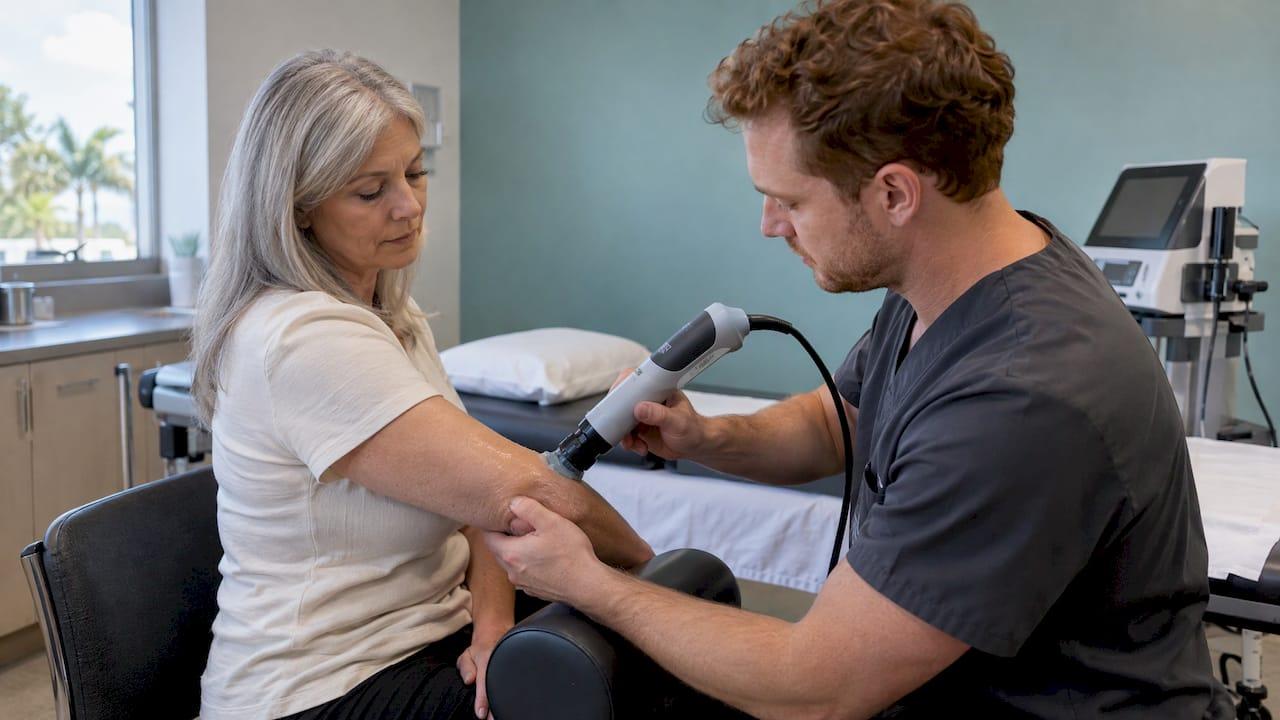
Shockwave therapy is a non-invasive option for stubborn tennis elbow, the pain on the outer side of the elbow that makes gripping, lifting and even shaking hands hurt. Several meta-analyses report better pain scores and stronger grip after treatment, and the usual course is a short series of weekly sessions. At Sparkmed in North Miami, a single shockwave session is $75, and our team can tell you whether your elbow is a good candidate.
This guide explains what the studies found, how a course of treatment runs, who is considered for it, what side effects to expect and what to do if your pain is not coming from the tendon at all.
TL;DR
- Tennis elbow (lateral epicondylitis) is pain where the forearm tendons attach on the outer elbow. Shockwave therapy sends acoustic pulses into that spot to treat it without surgery or injections.
- A 2020 meta-analysis of 13 trials and 1,035 patients found lower pain scores and higher grip strength in the shockwave group.
- A typical course is 3 to 5 sessions about a week apart, with the energy raised gradually as you tolerate it, alongside physical therapy.
- Soreness at the treatment site is the most common side effect. Pregnancy, a pacemaker, active infection, cancer near the treated area and blood-thinning medication change the plan.
- At Sparkmed, shockwave is $75 per session. Book an evaluation to find out if it fits your elbow.
Table of Contents
- What tennis elbow is, and why it lingers
- What the studies show about pain and grip strength
- How a shockwave course works
- Who is considered for shockwave therapy
- Safety: side effects and who should not be treated
- What about calcific tendonitis?
- What else supports a tennis elbow recovery
- What shockwave costs
- Our perspective
- Book an evaluation in North Miami
- FAQ
- Sources
What tennis elbow is, and why it lingers
Tennis elbow is the common name for lateral epicondylitis. The forearm muscles that lift your wrist attach to a bony bump on the outside of the elbow through a tendon, and that attachment becomes painful and sensitive. You do not need to play tennis to get it. Repetitive gripping at work, tool use, keyboard and mouse work, and carrying heavy items can all load the same tendon.
Tendons heal slowly because they receive less blood than muscle does. That is why many people feel better for a few weeks, return to normal activity, and feel the pain return. It is also why treatments that aim to stimulate the tendon's repair response, rather than just cover up the pain, get so much attention.
A review of common tendinopathies published in 2025 says shockwave may help tennis elbow by increasing cellular permeability and blood flow near the tendon, which can accelerate healing. That is the idea behind the treatment: a mechanical signal that wakes up a stalled healing process.

What the studies show about pain and grip strength
The research on shockwave for tennis elbow is large, and the better-known reviews point in an encouraging direction. Here are the main findings, in plain terms.
| Study | What it pooled | What it found |
|---|---|---|
| Yao et al., 2020 | 13 articles, 1,035 patients | Pain scores significantly lower and grip strength significantly higher with shockwave. The authors concluded it can relieve pain and functional impairment with better overall safety than several other methods. |
| Zheng et al., 2020 | 9 randomized trials | More patients reached a 50% pain reduction, and grip strength was significantly better at 12 weeks to 3 months. |
| Karanasios et al., 2021 | 27 studies, 1,871 patients | Pain reduced at mid-term follow-up and grip strength improved at very short and short-term follow-up compared with sham treatment. Shockwave also outperformed laser for grip strength and ultrasound for pain. |
| Verbeke and Vanwalleghem, 2026 | 11 randomized trials | Some trials showed significant benefits in pain, strength and function. The authors suggest shockwave may be a valuable adjunct to physical therapy. |
Two points matter for you as a patient.
Grip strength is the most consistent gain. Both the Yao and Zheng analyses found grip strength improved, by about 3.4 and 3.5 units respectively. If your elbow pain shows up when you grip a steering wheel, a tool or a coffee pot, that is the outcome that counts most.

Shockwave works best as part of a plan. The 2026 review points to shockwave as a useful addition to physical therapy, and the best-practices guidance covered below says the same. Shockwave is the stimulus, and the loading exercises that follow are what rebuild the tendon. We treat it that way: a session is one part of recovery, not the whole of it.
How a shockwave course works
A 2022 best-practices review in a peer-reviewed journal describes the standard approach. The clinician focuses the treatment over the areas of maximal pain, generally without anesthetics. A course typically involves 3 to 5 treatments about a week apart. Energy starts low and is raised as you tolerate it, and treatment should be paired with physical therapy.
What that looks like in practice:
- Finding the spot. Your provider palpates the outer elbow to locate the tender area. The gel goes on, and the applicator is held over that point.
- Building up. The first pulses feel like rhythmic tapping. The energy rises through the session as you adjust.
- Short sessions. The treatment itself is brief. One 2018 study of 50 patients used 2,000 shocks per session over five sessions with five-day breaks and described the therapy as non-invasive, safe and cumulative, with many patients reporting relief after the first session.
- No downtime. You can usually go back to normal daily activity, though the guidance below on the first days afterward is worth following.
A 2019 retrospective study of 330 patients whose tennis elbow had not responded to conservative care compared two radial shockwave settings. Both significantly reduced pain and disability scores. The setting with 2,000 impulses at 2 bars showed better functional improvement and no complications. Your own settings depend on your exam and how you tolerate the treatment, which is why a hands-on evaluation comes first.
The first days after a session
The same best-practices review advises avoiding NSAIDs, ice, fluoroquinolone antibiotics and corticosteroids after treatment, and says acetaminophen is acceptable for pain. Tell your provider about every medication you take before the first session so the plan fits you. If you take over-the-counter anti-inflammatories regularly, ask what to use instead on treatment days.
Who is considered for shockwave therapy
Shockwave is aimed at tennis elbow that has hung on. The FDA clearance summary for one shockwave system describes it as a non-surgical alternative for chronic lateral epicondylitis in patients with symptoms for 6 months or more and a history of unsuccessful conservative treatment.
The U.S. Department of Veterans Affairs uses a similar yardstick in its clinical determination. It considers high-energy shockwave for chronic lateral epicondylitis when the diagnosis is confirmed, the elbow has hurt for 6 months, and the patient has failed at least two conventional options: 4 or more weeks of physical or occupational therapy, a 4-week or longer course of NSAIDs, or local steroid injections.
In plain terms, you are a good candidate to ask about if:
- your outer-elbow pain has lasted months, not days;
- rest, a brace, stretching or anti-inflammatories have not settled it;
- gripping and lifting are the movements that hurt;
- you want to avoid surgery or repeated injections.
If your elbow pain started recently, perhaps after a collision, a fall or a work incident, an evaluation comes first. Elbow pain after trauma can come from joints, nerves or ligaments as well as the tendon, and the right treatment depends on which structure is involved. Our auto accident evaluation is where that sorting happens.
Safety: side effects and who should not be treated
In the clinical study behind the FDA clearance of a shockwave system, 114 patients were treated. The most common adverse event was pain at or around the treatment site in more than 20% of patients. Less common events (under 20%) included nausea, tingling or numbness, headache, dizziness and skin reactions at the application site. A Cochrane review also described the side effects as usually transient, including pain, skin reddening and some nausea, and most patients did not need to stop treatment.
The same FDA summary advises patients on anticoagulants or daily aspirin to consult their prescriber about temporarily stopping to prevent bruising. Do not stop a prescribed blood thinner on your own: raise it with the prescribing doctor before your first session.
The International Society for Medical Shockwave Treatment (ISMST) guidelines list who should not receive treatment. For radial and low-energy focused devices, the exclusions are a malignant tumor in the shockwave field, a fetus, or a pacemaker or defibrillator in the field. High-energy focused treatment also excludes lung tissue and significant coagulation disorders. The guidelines list common side effects as pain, skin reddening or blistering, bruising and swelling. They also note that reported tendon ruptures after shockwave followed repeated cortisone injections, and they call for telling patients about rupture risk when there is prior tendon damage and about avoiding premature sports stress after treatment.
Before your first session, make sure your provider knows if you:
- are pregnant or could be;
- have a pacemaker or defibrillator;
- have an active infection or have had cancer near the elbow;
- take blood thinners or daily aspirin, or have a clotting disorder;
- have had cortisone injections in the elbow.
For a deeper look at what to expect afterward, see our guide to shockwave therapy side effects.
What about calcific tendonitis?
Calcific tendonitis is a different problem: calcium deposits form inside a tendon, most often in the shoulder. It is not tennis elbow, and the evidence differs by body site. A 2025 review of common tendinopathies says calcific tendinitis improves with both non-operative care, including shockwave and ultrasound-guided needling, and surgery. Surgery shows superior results, but non-operative treatments are recommended first given their favorable results and lower cost and risk. If you have been told you have calcium deposits in a shoulder or another tendon, our overview of shockwave for tendonitis explains what it treats and what it costs.
What else supports a tennis elbow recovery
Shockwave is rarely the only tool. Most recovery plans combine several things, and the best-practices guidance says shockwave should be coupled with physical therapy. Depending on your exam, a plan might include:
- Progressive loading exercises that gradually rebuild the tendon's tolerance for gripping and lifting.
- Ultrasound therapy, a different form of sound-based treatment. A 2021 meta-analysis found shockwave outperformed ultrasound for pain, and our page on ultrasound for injuries explains where it fits.
- Massage therapy and electrical stimulation to ease the surrounding forearm muscles and calm pain. For a look at how different non-invasive modalities compare for rehab pain, see this piece on PEMF and EMS for rehab.
- Traction or decompression and spinal adjustments when the neck or upper back is contributing to arm symptoms.
- Activity changes, such as adjusting your grip, tool handles or desk setup so the tendon is not reloaded all day.
We offer massage therapy, electrical stimulation, ultrasound, traction and decompression in the same clinic, so your plan can be adjusted without sending you across town.
What shockwave costs
Shockwave therapy at Sparkmed is $75 per session. If your course follows the typical 3 to 5 sessions described in the research, session fees would come to $225 to $375 in total. Our monthly plans are Essential at $149 per month, Performance at $249 per month and Elite at $399 per month, listed on the same pricing page. A chiropractic adjustment is $45. For a wider view of what shockwave costs, see our guide to shockwave therapy cost.
Our perspective
We see tennis elbow as a problem of load: a tendon that has been asked to do more than it can recover from. Shockwave therapy is one of the ways we help the tendon respond, and the research on grip strength and pain is a big reason we offer it.
What matters most is the match between the treatment and the person. That means an exam first, a clear plan for the number of sessions, and exercises you can do at home or at work so the gains hold. We have more than 20 years of experience treating accident victims, and that background helps us sort out whether your elbow pain comes from the tendon, the neck or something else.
We keep access simple. Our team speaks English, Spanish and Creole, we offer Uber Health transport in North Miami, and we bill insurance directly with thorough injury documentation for claims. Our prices are posted, so you know the cost of a shockwave session before you come in.
Spark
Book an evaluation in North Miami
If your elbow has hurt for months, or the pain started after an accident or a work injury, the first step is an exam. We will check the elbow, ask what makes it worse and tell you whether shockwave belongs in your plan. Shockwave therapy is $75 per session, and you can see all current prices on our pricing page. Injured in a crash? Read about shockwave therapy for car accident injuries in North Miami.
Sparkmed is a chiropractic clinic in North Miami. Call or book online to schedule your visit.
FAQ
Does shockwave therapy work for tennis elbow?
Meta-analyses report that patients treated with shockwave had lower pain scores and stronger grip than comparison groups. One 2020 analysis of 13 trials found both improvements, and a 2026 review suggests shockwave may add value alongside physical therapy. Results vary from person to person, so an exam is the best way to judge whether it suits your elbow.
How many sessions will I need?
The best-practices guidance describes a typical course of 3 to 5 sessions about a week apart, starting at low energy and increasing as you tolerate it. Your provider adjusts that to your exam and how your elbow responds. Many patients also do exercises between visits.
Does shockwave therapy hurt?
Treatment can be uncomfortable over the tender spot, and soreness at the treatment site is the most commonly reported side effect. The energy is raised gradually so you can tolerate it, and you can tell your provider if it is too strong. Skin reddening, bruising and mild swelling can also occur and are usually short-lived.
Who should not have shockwave therapy?
The ISMST guidelines exclude treatment over a malignant tumor, during pregnancy, and with a pacemaker or defibrillator in the shockwave field. Active infection and significant clotting disorders also matter. Tell your provider about blood thinners, aspirin and past cortisone injections before treatment.
Can shockwave treat calcific tendonitis too?
A 2025 review lists shockwave among the non-operative options for calcific tendinitis and recommends non-operative care first. The evidence depends on which tendon is affected, so the shoulder, elbow and other sites are assessed individually.
Sources
- Efficacy of Extracorporeal Shock Wave Therapy for Lateral Epicondylitis (Yao et al., 2020)
- Effectiveness of extracorporeal shock wave therapy in lateral epicondylitis (Zheng et al., 2020)
- Clinical effectiveness of shockwave therapy in lateral epicondylitis (Karanasios et al., 2021)
- Extracorporeal Shock Wave Therapy in Chronic Lateral Elbow Tendinopathy (2026)
- Best practices for extracorporeal shockwave therapy (Tenforde et al., 2022)
- The Effectiveness of Shockwave Therapy in Patients with Lateral Epicondylitis (2018)
- Dose-related Effect of Radial Extracorporeal Shockwave Therapy
- VA clinical determination on extracorporeal shock wave therapy
- FDA Summary of Safety and Effectiveness, P010039
- Shock wave therapy for elbow pain, Cochrane
- ISMST Guidelines for ESWT, 2023
- Diagnosis and Management of Common Tendinopathies, 2025
- PEMF and EMS for rehab pain