

A family chiropractic practice is a single clinic that provides age-appropriate, nervous-system-focused musculoskeletal care for every member of your household, from newborns through seniors, under one roof. Rather than treating only acute pain, these practices emphasize long-term wellness and adapt their techniques to each patient's developmental stage.
Here is what you can expect from a family chiropractic practice:
- DC-licensed clinicians (Doctor of Chiropractic) trained in pediatric, prenatal, and adult care
- Age-adapted techniques: fingertip-pressure inputs for infants, instrument-assisted or manual adjustments for adults
- Nervous-system focus: assessing sleep, feeding, posture, and stress adaptation, not only pain
- Preventive wellness plans alongside injury and symptom care
- Family-friendly operations: coordinated scheduling, shared health records, multilingual staff
The American Chiropractic Association (ACA) recognizes chiropractic as a non-surgical, non-pharmaceutical approach to musculoskeletal and nervous-system health. Sparkmed, based in North Miami, applies this same whole-family model with multilingual support and transparent per-visit pricing.
Table of Contents
- What makes a family chiropractic practice different from a regular clinic?
- How do treatment techniques change across different ages?
- What are the main benefits of family chiropractic care?
- What happens at your first visit, and what does it cost?
- What conditions do families commonly bring to a chiropractor?
- Is chiropractic care safe for your whole family, and when should you see a doctor instead?
- How do you choose the right family chiropractor?
- Common myths about family chiropractic care, corrected
- What does the research say about family chiropractic approaches?
- Key Takeaways
- A practitioner's perspective on whole-family care
- Sparkmed serves families in North Miami with transparent, age-adapted care
- Useful sources and further reading
What makes a family chiropractic practice different from a regular clinic?
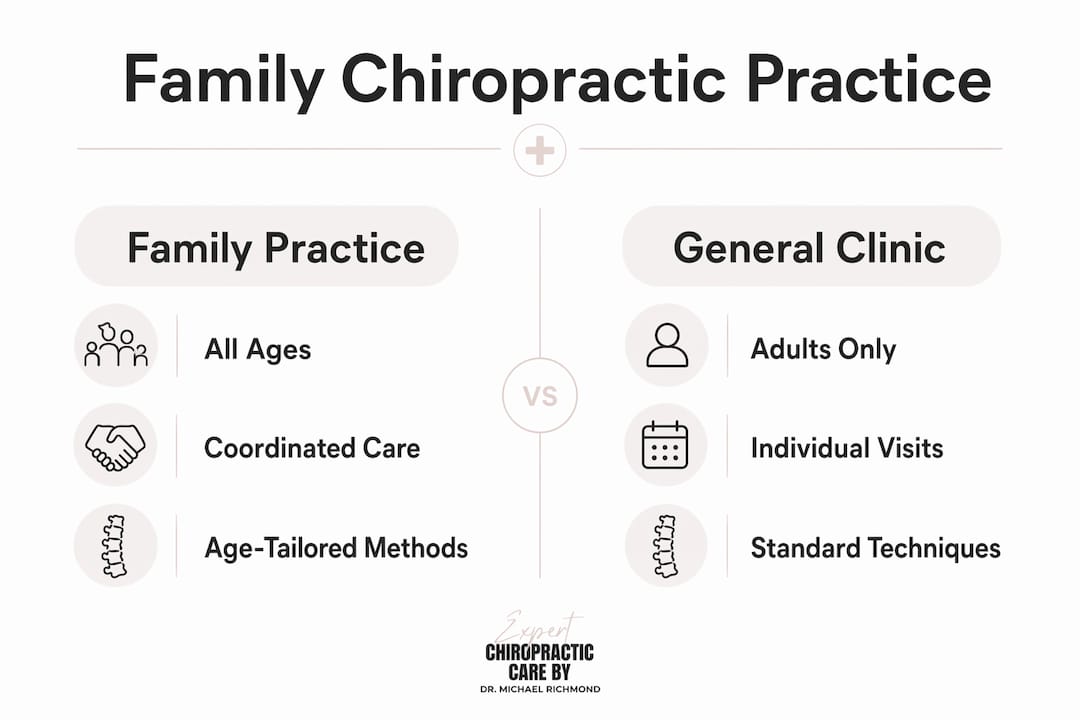
Most chiropractic clinics focus on working-age adults with back or neck pain. A family practice deliberately expands that scope to serve every generation, which changes the physical environment, the clinical reasoning, and the day-to-day operations in concrete ways.

Philosophy and scope

A family chiropractic care model addresses pediatric development, prenatal pelvic balance, adult work-related strain, and senior joint mobility within the same practice. The clinical reasoning shifts from "what hurts?" to "how is this person functioning at their stage of life?" That means assessing an infant's feeding mechanics, a teenager's posture under a heavy backpack, and a grandparent's balance risk, all with different tools and goals.
Operational differences
A true family practice is also built differently. Coordinated family scheduling and shared health-history records let multiple household members be seen back-to-back on the same day, cutting down on separate trips and administrative friction. Kid-friendly reception areas, educational materials for parents, and multilingual staff are observable signals that a clinic genuinely serves families rather than simply tolerating younger patients.
| Feature | Family Chiropractic Practice | General Adult Clinic |
|---|---|---|
| Patient age range | Newborns through seniors | Primarily working-age adults |
| Technique range | Low-force, instrument-assisted, manual | Mostly manual/high-velocity |
| Clinical assessment | Sleep, feeding, posture, function | Pain location, range of motion |
| Scheduling model | Coordinated family appointments | Individual appointments |
| Environment | Kid-friendly, educational materials | Standard clinical setup |
| Care orientation | Preventive wellness + symptom care | Primarily symptom relief |
The non-invasive, age-tailored methods used in family settings also require practitioners to pursue continuing education in pediatric and prenatal care beyond their base DC degree. That additional training is one of the clearest markers separating a genuine family practice from a general clinic that occasionally sees children.
How do treatment techniques change across different ages?
The short answer: significantly. The pressure, tools, goals, and exam items all shift depending on whether the patient is three weeks old or seventy-three years old.
Infants
Infant adjustments use very low-force inputs, typically fingertip pressure or instrument-assisted impulses, never high-velocity thrusts. The goal is neurological regulation and comfort, not structural correction. Common reasons parents bring newborns include postnatal tension from delivery, latch difficulties, and sleep dysregulation. The exam focuses on cranial symmetry, neck range of motion, and feeding mechanics.
Children and teens
As children grow, adjustments become slightly more firm but remain well below adult force levels. Practitioners watch for developmental milestones, screen for postural changes from heavy backpacks or screen time, and address sports injuries. Sleep quality, attention, and behavior are often part of the clinical conversation at this stage. Technique selection from chiropractic technique specialization options expands as the child's musculoskeletal system matures.
Adults
Adults typically receive manual high-velocity adjustments, instrument-assisted techniques such as Activator, or a combination depending on their condition and preference. Rehabilitation exercises, soft-tissue work, and workplace ergonomics guidance are common additions. Accident recovery, repetitive-strain injuries, and chronic low-back or neck pain drive most adult visits.
Seniors
Older patients benefit most from lower-force approaches that respect reduced bone density and existing joint conditions. The clinical priorities shift toward preserving mobility, reducing fall risk, and managing comorbidities. Senior chiropractic care focuses on joint mobility and balance rather than aggressive structural correction. A good family chiropractor will also coordinate with the patient's primary care physician when managing conditions like osteoporosis.
What are the main benefits of family chiropractic care?
The benefits families report span well beyond back pain, and they tend to compound when the whole household participates together.
- Reduced pain and improved mobility across all ages, from infant tension to adult work strain to senior joint stiffness
- Better sleep and nervous-system regulation, particularly noted in infants and children
- Enhanced spinal alignment and nervous-system function, supporting the body's ability to self-regulate
- Preventive care culture: when families pursue wellness adjustments together, healthy habits tend to reinforce across generations
- Practical scheduling efficiency: one trip, multiple family members seen, shared records updated
Family practices frame care as long-term wellness, not only symptom relief. Reported benefits include improved spinal alignment, enhanced nervous-system function, better sleep quality, and immune support. That preventive orientation is what separates a family practice from a walk-in pain clinic.
A note on evidence: Research supports manual therapy for several musculoskeletal complaints, particularly adult low-back and neck pain. Evidence for pediatric chiropractic is growing but less extensive. Families should ask their chiropractor which specific claims are supported by clinical research and which are based on clinical experience.
What happens at your first visit, and what does it cost?
First-visit sequence
A typical initial consultation lasts about 30 minutes and usually follows this order:
- Health history intake — medical history, current complaints, medications, prior injuries
- Physical and postural exam — range of motion, orthopedic tests, neurological screening
- X-rays if clinically indicated — not always required on the first visit
- Care plan discussion — the chiropractor explains findings and recommends a treatment approach
- Same-day adjustment — many practices offer an initial treatment at the first visit if appropriate
For a more detailed breakdown of what to expect, the chiropractic consultation guide covers the exam steps and first-visit protocols in depth.
Typical follow-up patterns
| Care Phase | Typical Frequency | Goal |
|---|---|---|
| Initial (acute/corrective) | 2–3 visits per week | Reduce symptoms, restore function |
| Rehabilitative | 1–2 visits per week | Stabilize and strengthen |
| Maintenance/wellness | Monthly or as needed | Prevent recurrence, support health |
Cost and insurance
Many family practices, especially cash-pay models, offer transparent per-visit pricing rather than long-term contracts. Insurance coverage varies widely by plan; always call ahead to confirm. First-time patient deals are common at family-focused clinics and can significantly reduce the barrier to a first visit.
What to bring to your first appointment
- Photo ID and insurance card (if using insurance)
- List of current medications and supplements
- Any relevant imaging (X-rays, MRI reports)
- Notes on symptom history, onset, and what makes it better or worse
- Questions about techniques used, experience with your family's specific needs, and pricing
What conditions do families commonly bring to a chiropractor?
Family practices see a wide range of presentations, and the conditions vary considerably by age group.
Infants and toddlers
- Feeding and latch difficulties linked to birth-related tension
- Colic and sleep dysregulation
- Torticollis (neck muscle tightness causing head tilt)
- Plagiocephaly (positional head flattening)
Children and teens
- Postural problems from prolonged screen time or heavy backpacks
- Sports injuries: ankle sprains, shoulder strain, knee pain
- Growing pains and scoliosis screening
- Headaches and tension
Adults
- Low-back and neck pain, including disc-related issues
- Headaches and migraines
- Workplace repetitive-strain injuries
- Car accident recovery and whiplash
Pregnancy
- Pelvic girdle pain and sacroiliac joint discomfort
- Round ligament tension
- Prenatal positioning support (Webster Technique for optimal fetal positioning)
Expectant parents seeking complementary prenatal support often find that holistic prenatal care resources, including doula services, pair well with chiropractic care during pregnancy.
Seniors
- Chronic joint stiffness and arthritis-related mobility loss
- Balance problems and fall-risk reduction
- Post-surgical rehabilitation support
Chiropractic is often an appropriate primary option for musculoskeletal complaints without neurological deficits. When symptoms suggest something beyond the musculoskeletal system, a responsible chiropractor refers out promptly. For conditions involving pain relief across the lifespan, non-invasive chiropractic care is frequently the first line before considering medication or surgery.
Is chiropractic care safe for your whole family, and when should you see a doctor instead?
Licensure and scope
Every practicing chiropractor holds a DC (Doctor of Chiropractic) degree, which requires a minimum of four years of graduate-level education after undergraduate prerequisites. DCs are licensed by their state board and operate within a defined scope: musculoskeletal and nervous-system-focused, non-surgical, non-pharmaceutical care. They do not prescribe medication or perform surgery.
Red flags that require immediate medical attention
A responsible family chiropractor screens for these before any treatment and refers out when they appear:
- Neurological deficits: numbness, tingling, or weakness in limbs that is progressive
- Fever combined with spine pain (possible infection or inflammatory condition)
- Unexplained weight loss alongside musculoskeletal symptoms
- Bladder or bowel dysfunction with back pain (possible cauda equina syndrome)
- Suspected fracture from trauma or significant osteoporosis
- Severe headache of sudden onset ("thunderclap" headache)
How a good chiropractor handles referrals
Documentation matters. A quality family practice keeps clear records of red-flag screenings, communicates findings to the patient's primary care physician or pediatrician when appropriate, and does not delay referral to manage a case beyond its scope. Co-management with OB/GYNs for prenatal patients and with pediatricians for infants is standard practice at well-run family clinics.
Pro Tip: Ask any prospective chiropractor directly: "What would make you refer me to another provider?" A confident, specific answer is a strong sign of clinical integrity. Vague or dismissive responses are a warning sign.
How do you choose the right family chiropractor?
Credentials to verify before booking:
- Active DC license in your state (verify through your state chiropractic board)
- Pediatric or prenatal continuing education — look for ICPA (International Chiropractic Pediatric Association) training or equivalent
- Experience with multi-age caseloads — ask directly how many infants or pregnant patients they currently see
- Clear communication style — do they explain findings in plain language without pressure?
- Transparent pricing — per-visit rates, family rates, and what is included in an initial exam
Questions to ask at intake
- What techniques do you use for infants and toddlers?
- Do you co-manage with pediatricians or OB/GYNs?
- Can multiple family members be seen on the same day?
- What does a first visit cost, and what does it include?
- How do you handle a case that falls outside your scope?
Observable signals of a quality family practice
- Kid-friendly clinic environment: calm reception, child-sized tables, educational materials for parents
- Streamlined family scheduling with back-to-back appointments and shared records
- Multilingual staff where the community warrants it
- No pressure to commit to long-term prepaid packages before you have seen results
Common myths about family chiropractic care, corrected
Myth: Chiropractic is only for back pain. Family practices assess and support nervous-system function, sleep, feeding, posture, and stress adaptation. Back pain is one reason to visit; it is far from the only one.
Myth: Adjustments are always forceful and loud. The "crack" associated with chiropractic is a cavitation of gas in the joint and does not indicate force level. Low-force pediatric contacts use fingertip pressure or instrument-assisted impulses, with no high-velocity thrust involved. Many adults also prefer instrument-assisted techniques.
Myth: Chiropractic is not safe for babies or during pregnancy. When performed by a clinician trained in pediatric and prenatal protocols, chiropractic care uses techniques specifically adapted for those populations. The clinical protocols prioritize restraint and specificity, not force. Prenatal care, including the Webster Technique, is widely practiced and generally considered safe when red-flag screening is applied.
Myth: One-size-fits-all care. The defining feature of a family practice is the opposite: individualized goals and broader functional assessments tailored to each patient's developmental stage, health history, and presenting concerns.
What does the research say about family chiropractic approaches?
The evidence base for chiropractic care is strongest for adult musculoskeletal conditions and continues to develop for pediatric and prenatal applications.
What research supports:
- Manual therapy for adult low-back pain has a solid evidence base, with multiple systematic reviews supporting its effectiveness for short-term pain reduction and functional improvement
- Spinal manipulation for adult neck pain and headaches is supported by clinical guidelines in the United States
- Low-force techniques for infants are considered safe when applied by trained clinicians, though large-scale randomized trials remain limited
- Holistic injury care combining manual therapy with lifestyle guidance and exercise shows better outcomes than manual therapy alone in several adult populations
Where evidence is still developing:
- Long-term outcomes for pediatric chiropractic care need more large-scale research
- Immune-function claims require more rigorous study before being stated as established fact
- Colic and infant sleep outcomes from chiropractic show promising pilot data but not yet definitive trial evidence
Practical takeaways for families
| Research Area | Evidence Level | Practical Implication |
|---|---|---|
| Adult low-back pain | Strong | Reasonable first-line option before medication |
| Adult neck pain and headaches | Moderate–strong | Supported by US clinical guidelines |
| Prenatal pelvic pain | Moderate | Widely practiced; ask about clinician training |
| Pediatric musculoskeletal | Emerging | Seek ICPA-trained practitioners |
| Infant colic/sleep | Preliminary | Discuss realistic expectations with your chiropractor |
For a deeper look at the evidence behind spinal adjustments, the spinal adjustment evidence guide covers current research in accessible detail.
Key Takeaways
A family chiropractic practice provides age-appropriate, nervous-system-focused care for every household member, adapting techniques and clinical goals from infants through seniors within a single, preventive-wellness-oriented model.
| Point | Details |
|---|---|
| All-ages scope | One practice serves newborns through seniors using techniques adapted to each developmental stage. |
| Technique varies by age | Infants receive fingertip or instrument-assisted inputs; adults and seniors receive manual or low-force adjustments based on their condition. |
| First visit is about 30 minutes | Expect a health history, physical exam, care plan discussion, and often a same-day adjustment. |
| Red flags require medical referral | Progressive neurological deficits, fever with spine pain, or suspected fracture need medical evaluation before chiropractic treatment. |
| Sparkmed in North Miami | Sparkmed offers affordable per-visit chiropractic care, multilingual support, and age-adapted treatment for families and accident recovery patients. |
A practitioner's perspective on whole-family care
The most underrated aspect of family chiropractic is not the technique variety. It is the shift in clinical reasoning that comes with seeing a household across generations. When you treat a parent and their infant in the same week, you start to understand health patterns that a single-patient model never surfaces: the postural habits passed down, the stress load a family carries together, the way a child's sleep affects a parent's recovery.
Most chiropractic marketing focuses on pain. That framing is understandable, because pain is what drives people through the door. But the practices that genuinely serve families well are the ones that treat the visit after the pain resolves as just as important as the first one. Preventive scheduling, posture checks for kids, and mobility work for seniors are not upsells. They are the actual model.
There is also a practical argument that rarely gets made plainly: a family that schedules together is far more likely to keep showing up. Shared appointments reduce the friction of healthcare. When a parent does not have to make four separate trips for four family members, they actually come back. That consistency is what produces the long-term outcomes that make chiropractic worth recommending.
The evidence for pediatric chiropractic is still developing, and any honest practitioner will say so. What is not in question is that low-force techniques are safe when applied by trained clinicians, and that the nervous-system-focused assessment model catches things that a pain-only intake misses. Families deserve that level of attention.
Sparkmed serves families in North Miami with transparent, age-adapted care
If you are looking for a family chiropractor in North Miami who handles everything from infant tension to adult accident recovery, Sparkmed offers exactly that: per-visit pricing starting at $25 for a chiropractic adjustment, no insurance required, and multilingual support in English, Spanish, and Creole.
The clinic's team provides spinal adjustments, wellness plans, and advanced therapies including ultrasound and shockwave treatment, all adapted to the patient's age and condition. Uber Health transport is available for patients who need it. Whether you are booking a first visit for yourself after a car accident or bringing in a family member for a wellness check, the intake process is straightforward and same-day treatment is often available.
To book or ask about family visit options, visit Sparkmed's clinic page or call the North Miami office directly. Mention that you are interested in a family appointment and ask about current new-patient pricing.
Useful sources and further reading
Families who want to verify claims or dig deeper into the evidence behind chiropractic care can start with these resources:
- American Chiropractic Association (ACA) — acatoday.org: the primary US professional body for chiropractors, with patient education resources and a practitioner directory
- Creating a Family-Based Practice — chiro.org: a practitioner-facing overview of what distinguishes a family-oriented chiropractic model from a standard adult clinic
- Spinal adjustment evidence guide — Sparkmed blog: accessible summary of current research on adjustment outcomes
- Regular chiropractic checkups — Sparkmed blog: explains the case for preventive and maintenance scheduling
- Serenity Doula community resources — a directory of perinatal and family wellness resources for expectant parents seeking complementary care alongside prenatal chiropractic
- ICPA (International Chiropractic Pediatric Association) — icpa4kids.com: the leading US organization for pediatric and prenatal chiropractic training and research
When evaluating any chiropractic resource, check that the author holds an active DC license, that clinical claims reference peer-reviewed research, and that the practice discloses its scope and referral protocols clearly.
This article is general health information, not medical or chiropractic advice. Confirm current guidelines and your family's specific needs with a licensed DC or your primary care provider.