
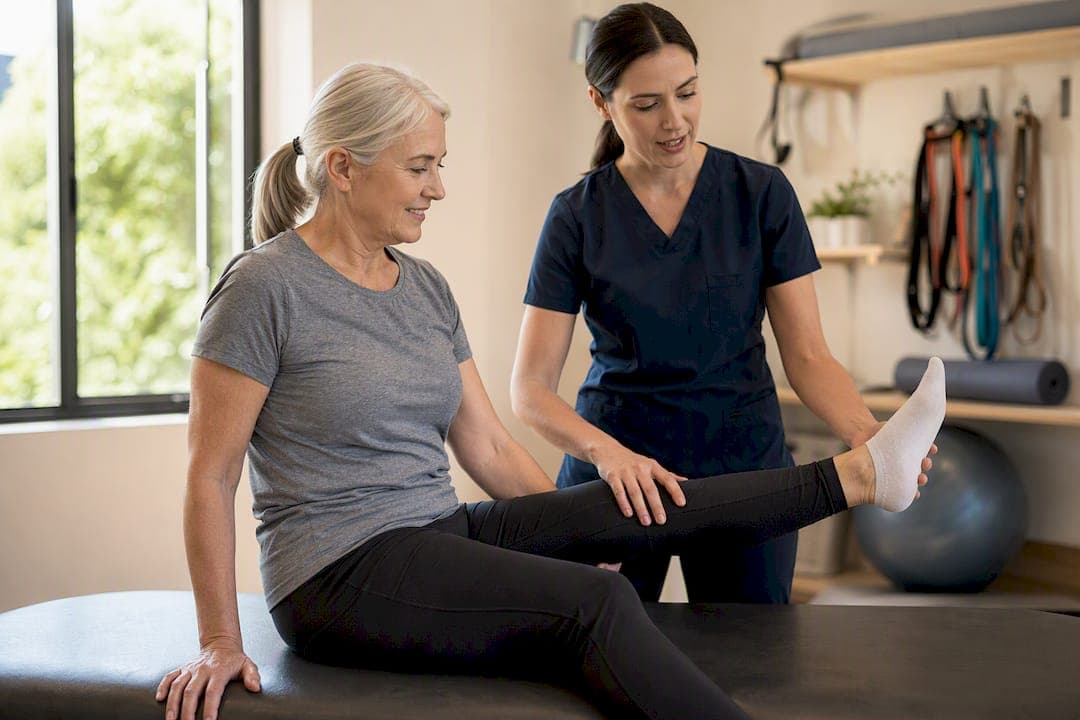
Post-traumatic rehabilitation is structured, multidisciplinary care designed to restore, maintain, or help you compensate for physical, cognitive, and emotional abilities lost after a major injury, according to MedlinePlus. It applies after traumatic brain injury, spinal cord damage, amputation, or polytrauma from a car accident, fall, or workplace incident. Guidelines from the NIH's NCBI Bookshelf and the VA/DoD Clinical Practice Guideline for PTSD both frame this care as team-based and time-sensitive. At Sparkmed, that framework shapes how outpatient recovery is approached once a patient leaves the hospital or urgent care setting.
You don't need to wait for a formal diagnosis to start asking questions. Certain signs mean you should seek an assessment now, not next month:
- New or worsening physical disability (can't walk, grip, or bear weight the way you could before)
- Loss of a basic self-care skill (dressing, bathing, feeding yourself)
- Persistent confusion, memory gaps, or trouble concentrating after a head injury
- Early symptoms of post-traumatic stress: flashbacks, avoidance, hypervigilance, or sleep disruption
- Pain that isn't improving after two to three weeks of standard care
Key Takeaways
Post-traumatic rehabilitation works because it combines early, coordinated, multidisciplinary care with measurable goals that shift from survival to independence to full life reintegration.
| Point | Details |
|---|---|
| Rehab is multidisciplinary by design | Physical, cognitive, speech, and psychological care must run together, not in sequence, for the best outcomes. |
| Three phases guide the pathway | Acute, post-acute, and long-term care each carry different settings, intensity, and goals. |
| Early mobilization prevents complications | Starting rehab as soon as medically safe cuts risk of DVT, contractures, and pulmonary problems. |
| Progress needs measurable goals | SMART goals and standardized tools like the FIM track whether therapy is actually working. |
| Sparkmed fits the outpatient stage | Its $25 adjustment, advanced modalities, and multilingual support serve musculoskeletal recovery once acute care is complete. |
Table of Contents
- What Is Post-Traumatic Rehabilitation Meant to Accomplish?
- Who Needs Post-Traumatic Rehabilitation? Indications and Red Flags
- The Three Phases of Recovery: Acute, Post-Acute, and Long-Term
- Who Makes Up the Rehabilitation Team?
- What Treatments Are Used in Post-Traumatic Rehabilitation?
- How Rehabilitation Differs by Injury Type
- How Progress Gets Measured
- Getting Home: Discharge Planning and Reintegration
- Complications That Rehabilitation Aims to Prevent
- How to Choose a Rehabilitation Program
- Sparkmed's Role in Outpatient Post-Injury Recovery
- A Publisher's Perspective on Recovery After Trauma
- Get Outpatient Care Started With Sparkmed
- Frequently Asked Questions
- Sources
What Is Post-Traumatic Rehabilitation Meant to Accomplish?
Rehabilitation after trauma covers far more ground than a set of stretching exercises. It spans physical recovery, cognitive retraining, speech and swallowing therapy, psychological treatment, and eventually social and vocational reintegration. The goal isn't just healing tissue; it's rebuilding a life that works.
A patient with a shattered femur needs to walk again, sure, but she also needs to climb her own stairs, drive to work, and sit through a full shift without her hip locking up. A construction worker with a mild TBI needs to relearn how to sequence multi-step tasks safely, not just pass a memory quiz. A driver injured in a rear-end collision needs her neck pain managed well enough that turning to check a blind spot doesn't become a daily ordeal. Each of those outcomes touches a different discipline, and none of them get solved by a single specialist working alone.
The NCBI's clinical overview of rehabilitation after traumatic injury recommends that assessment and treatment planning account for a patient's pre-existing conditions and aim to restore optimum function and independence as quickly as it's safely achievable. That "as quickly as possible" clause matters. Delayed rehab tends to produce worse long-term outcomes, largely because muscles, joints, and even cognitive pathways lose ground fast when they sit idle.
Coordination across disciplines is the part patients underestimate most. The NCBI guideline calls specifically for input from at least two allied health disciplines working from a shared plan, not two separate providers giving contradictory advice. A multi-author European review of trauma rehabilitation goes further, stating that recovery must begin early in the acute phase and include physical, psychological, and social supports simultaneously, not sequentially.
That's the throughline across every credible framework on this topic:
- Rehab starts as early as medical stability allows
- It runs on a team model, not a solo-provider model
- It addresses body, brain, and mental health together
- It extends into social and work life, not just clinical milestones
Skip any one of those elements and recovery tends to stall, plateau, or reverse.
Who Needs Post-Traumatic Rehabilitation? Indications and Red Flags
If you were hospitalized after a traumatic event, rehabilitation almost certainly belongs somewhere in your discharge plan. The clearest indications include a limb, nerve, or spinal cord injury; a diagnosed traumatic brain injury of any severity; amputation; or polytrauma, meaning multiple significant injuries from a single event like a car crash. Persistent functional loss, meaning you can't do something today that you could do easily before the injury, is itself a valid reason for referral even without a dramatic diagnosis attached.
Some referral triggers are less obvious. A patient discharged from the ER after a "minor" concussion who still can't concentrate at work three weeks later needs a cognitive rehabilitation evaluation, not just reassurance that concussions "take time." A worker who returns to light duty after a back injury but keeps guarding his movements out of fear of re-injury often needs both physical therapy and a conversation about pain psychology.
Certain symptoms cross the line from "monitor at home" to "seek care today":
- Sudden loss of a self-care ability you had yesterday
- Progressive weakness or numbness spreading beyond the original injury site
- New confusion, disorientation, or personality change after a head injury
- Thoughts of self-harm or suicidal ideation
- Signs of infection at a surgical or amputation site (fever, spreading redness, foul drainage)
None of those belong on a wait-and-see list. They warrant same-day medical attention, and a rehabilitation team should be looped in as soon as the acute issue is stabilized.
The Three Phases of Recovery: Acute, Post-Acute, and Long-Term
Rehabilitation after major trauma typically unfolds in three distinct phases, each with its own setting, intensity, and goals. Research on polytrauma recovery published via PubMed describes this progression clearly: acute inpatient care focused on medical stabilization, post-acute rehabilitation in a specialized facility aimed at physical function and early reintegration, and long-term outpatient care built around maintenance and independence.
Acute rehabilitation starts inside the hospital, often within 24 to 48 hours of injury if vital signs allow. Therapy here looks modest from the outside, things like sitting upright, basic range-of-motion work, and swallow safety checks, but it's doing critical work preventing complications before they start. A systematic review of polytrauma staging in International Orthopaedics notes that rehab intensity during this phase must be matched to the patient's physiologic tolerance and adjusted as surgical reconstruction proceeds.
Post-acute rehabilitation picks up once a patient is medically stable but not yet independent. This phase happens in specialized inpatient rehab facilities or intensive outpatient programs, often with intensive daily therapy sessions. Goals shift from "don't get worse" to "get functional." This is where gait training, cognitive retraining, and structured speech therapy do their heaviest lifting.
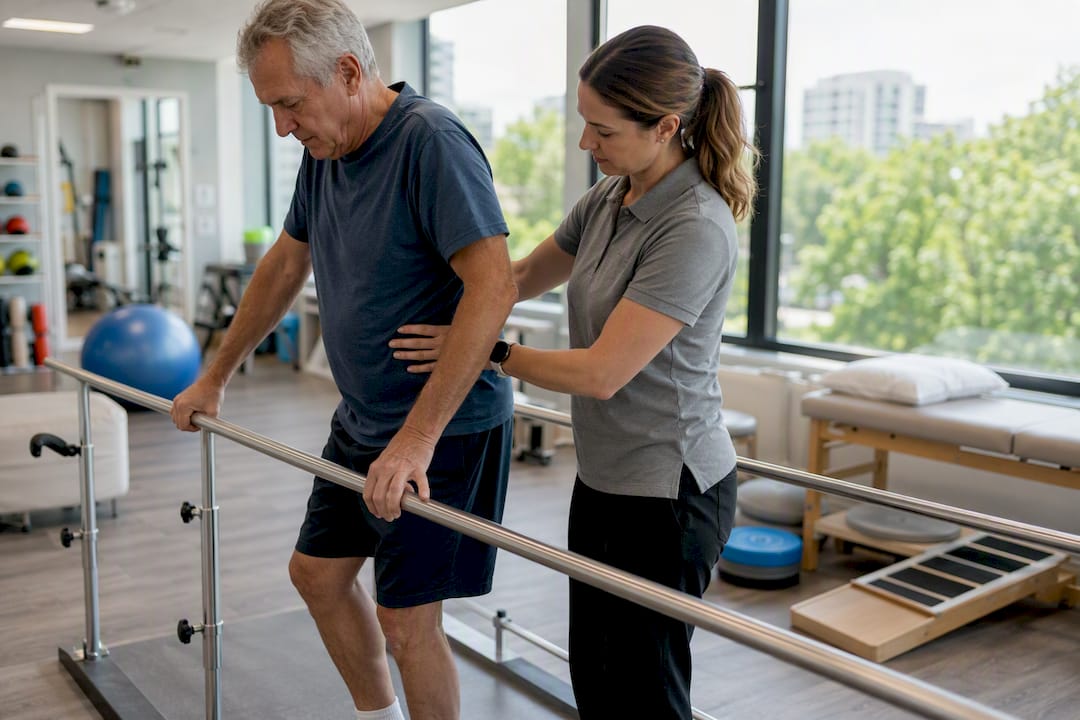
Long-term or community-based rehabilitation is where most patients spend the majority of their recovery timeline. Sessions taper to a few visits per week, then eventually to maintenance care. Success at this stage depends heavily on patient motivation and consistency, since the clinical team's contact time drops sharply.
| Phase | Typical setting | Primary goal | Who coordinates care |
|---|---|---|---|
| Acute | Hospital, ICU, or trauma ward | Medical stabilization, complication prevention | Trauma physician, nursing team |
| Post-acute | Inpatient rehab facility, intensive outpatient | Restore function, begin reintegration | Physiatrist, rehab team lead |
| Long-term/community | Outpatient clinic, home health, community programs | Maintain gains, vocational/social reentry | Primary rehab provider, patient, family |
The transition between phases is where recovery often breaks down. A patient discharged from post-acute rehab without a clear outpatient plan can lose ground fast, which is exactly why acute injury care and the follow-up plan that comes after it need to be connected from day one, not treated as separate episodes of care.
Who Makes Up the Rehabilitation Team?
Recovery after major trauma is rarely the work of one provider. It runs through a coordinated team, and knowing who does what helps you understand whose name should be on your treatment plan.
- Physiatrist (rehabilitation physician): Oversees the overall medical plan, manages pain and spasticity, and sets the pace for how aggressively therapy can progress.
- Physical therapist: Rebuilds strength, balance, and mobility through targeted exercise and gait training.
- Occupational therapist: Focuses on the tasks of daily living, dressing, cooking, driving, and adapts them when full restoration isn't realistic.
- Speech-language pathologist: Treats communication deficits and swallowing disorders, common after TBI and stroke-like injuries.
- Neuropsychologist or psychologist: Assesses cognitive deficits and treats trauma-related mental health conditions, including PTSD.
- Social worker or vocational rehab specialist: Manages logistics, benefits navigation, and the return-to-work process.
- Nursing staff and case managers: Track daily medical needs and keep every discipline working from the same plan.
Pro Tip: Ask your care team who your single point of contact is. In a well-run rehab program, one person, usually a case manager or the physiatrist, owns the overall plan so you're not stuck relaying updates between five separate providers yourself.
Goal ownership typically splits along predictable lines. A physical therapist owns your mobility milestones. An occupational therapist owns your independence in daily tasks. A vocational specialist owns the return-to-work timeline. When those goals conflict, say your PT wants you resting a joint while your vocational counselor is pushing a return date, that's exactly the kind of gap a good case manager should catch before it becomes your problem.
What Treatments Are Used in Post-Traumatic Rehabilitation?
Treatment in post-traumatic rehabilitation breaks down by the system it targets, and most patients end up touching several categories at once.
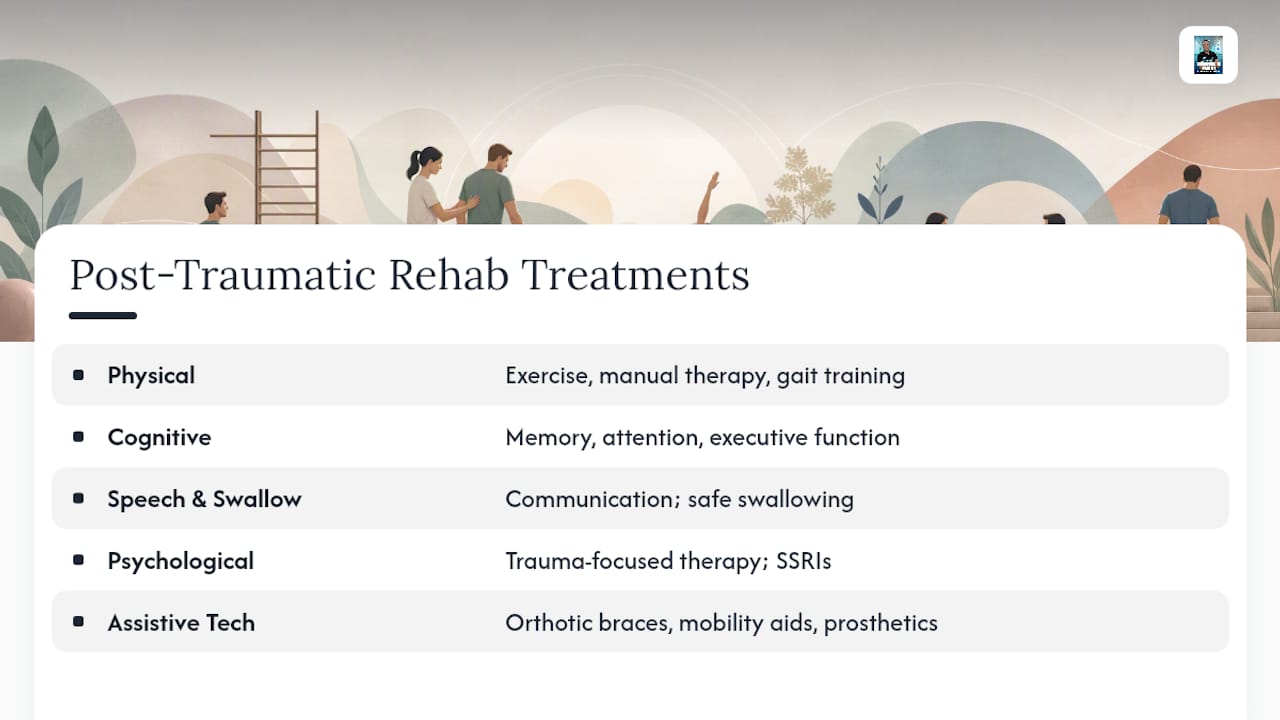
Physical interventions include therapeutic exercise, manual therapy, and gait training. For upper-limb deficits after TBI or stroke-like injury, constraint-induced movement therapy, deliberately restricting the unaffected limb to force use of the weaker one, is one of the more studied techniques for regaining function.
Cognitive rehabilitation targets memory, attention, and executive function through structured drills and compensatory strategies like memory notebooks or phone-based reminder systems. The Nationwide Children's Hospital guide to brain injury rehabilitation notes that therapy has to be tailored to the specific deficit and recovery stage rather than applied as a generic protocol, and that family education is treated as part of the plan, not an afterthought.
Speech and swallowing therapy addresses both communication and the physical mechanics of eating safely, especially critical after TBI where swallow reflexes can be impaired.
Psychological treatment covers everything from adjustment counseling to trauma-focused therapy. According to the Mayo Clinic, trauma-focused psychotherapies such as cognitive processing therapy and prolonged exposure carry the strongest evidence for treating PTSD, and graded exposure techniques help patients confront avoided situations, like driving again after a car accident, in a controlled, incremental way. Medications, particularly SSRIs like sertraline, are commonly used alongside therapy for co-occurring anxiety or depression.
Pain management blends medication, interventional procedures, and physical modalities like heat, cold, and manual therapy. This is where outpatient chiropractic and rehabilitative care overlap most directly with ongoing pain control, and it's a large part of how rehabilitation restores function long after the acute injury has healed.
Assistive technology and prosthetics round out the picture for patients whose injuries won't fully reverse. Orthotic braces, mobility aids, and custom prosthetics let patients function safely even when full restoration isn't the realistic endpoint.
Consider a 34-year-old construction worker with a moderate TBI and a fractured pelvis from a fall. His plan might combine physical therapy for pelvic weight-bearing progression, occupational therapy for relearning multi-step job tasks, cognitive rehab for attention deficits, and biweekly psychological sessions addressing anxiety about returning to heights. No single therapist could deliver that plan alone, and none of those pieces would work well in isolation.
A complementary look at sports injury rehabilitation covers similar modality logic for athletic injuries, useful context if your trauma involved a sports-related mechanism rather than a vehicle collision or fall.
How Rehabilitation Differs by Injury Type
Not every trauma follows the same recovery script. The injury itself dictates which complications to watch for and what a realistic outcome actually looks like.
Traumatic brain injury (TBI) rehab prioritizes cognitive retraining alongside physical recovery. Priorities include managing seizure risk, monitoring for mood and personality changes, and rebuilding attention and memory function step by step. The Brain Injury Association of America frames recovery around restoring function and maximizing independence, with community-based supports playing a larger role than in most other injury categories. Milestones often look like returning to part-time work before full-time, or driving locally before highway driving resumes.
Spinal cord injury rehab centers on mobility retraining, whether that means walking again or mastering wheelchair mobility, along with bowel and bladder management. Autonomic dysreflexia, a dangerous spike in blood pressure triggered by an unnoticed stimulus below the injury level, is a watch item unique to this population, along with pressure injury risk from reduced sensation and mobility.
Polytrauma and orthopedic trauma (multiple fractures, joint reconstruction, complex soft-tissue injury) rehab progresses in step with surgical healing timelines. Watch items include hardware complications, delayed union of fractures, and heterotopic ossification, abnormal bone growth in soft tissue that can limit joint motion after severe trauma.
Amputation rehab focuses on wound healing, prosthetic fitting, and gait retraining with a new limb configuration. Infection surveillance at the surgical site is critical early on, and psychological adjustment to limb loss typically runs alongside physical retraining rather than after it.
Realistic outcome framing matters across all four categories. Some patients achieve full restoration. Many achieve strong compensation instead, meaning they regain independence through adapted techniques or assistive devices rather than an identical return to their pre-injury baseline. Both outcomes count as rehabilitation success.
How Progress Gets Measured
Rehabilitation runs on measurement, not guesswork. Clinicians rely on a handful of standardized tools to track whether a patient is actually improving.
Common assessment tools include the Functional Independence Measure (FIM), which scores how much assistance a patient needs for daily tasks; timed gait tests that track walking speed and endurance; cognitive screening tools and formal neuropsychological testing for attention, memory, and executive function; and swallow studies for patients with TBI or airway-adjacent injuries.
Goals get built using the SMART framework, specific, measurable, achievable, relevant, and time-bound. A vague goal like "improve mobility" doesn't help anyone track progress. A SMART version looks more like: "Patient will walk 150 feet using a rolling walker with standby assistance within four weeks." That's a target a therapist can actually measure on a Tuesday and compare against the following Tuesday.
Measurement frequency varies by setting. Inpatient rehab typically reassesses weekly. Outpatient care usually reassesses every two to four weeks, or at defined milestones. If progress stalls for more than two consecutive assessment periods, that's the signal to revisit the plan, not push harder on the same approach. A stall usually means one of three things: the goal was set unrealistically, an underlying complication (like unmanaged pain or depression) is blocking progress, or the treatment approach itself needs to change.
Getting Home: Discharge Planning and Reintegration
Leaving a rehab facility is its own transition, and it goes wrong more often when it's treated as an afterthought instead of a planned step.
A solid discharge plan checks off several items before a patient walks out the door: confirmed adaptive equipment (walkers, shower chairs, grab bars), a home safety evaluation to catch fall hazards, medication reconciliation to avoid dangerous drug interactions between hospital and outpatient prescriptions, and scheduled follow-up appointments booked before discharge, not left for the patient to arrange later.
Vocational rehabilitation deserves its own conversation, and it should start well before a patient feels "ready" to return to work. Common supports include job modification (adjusted duties, reduced hours, ergonomic changes) and structured work trials that ease someone back into a role gradually rather than all at once.
Community resources fill the gap between clinical care and full independence:
- Peer support groups for TBI, spinal cord injury, or amputation survivors
- Continued outpatient physical, occupational, or speech therapy
- Assistive technology resource centers for equipment trials and funding guidance
- Local vocational rehabilitation agencies for job placement support
Family involvement belongs in this planning from the start, not bolted on at the end. Caregivers manage a large share of a patient's daily transition back to normal life, and including them in goal-setting sessions tends to produce more durable outcomes than treating recovery as a purely clinical, patient-only process.
Complications That Rehabilitation Aims to Prevent
Good rehabilitation isn't just about building function back up. It's equally about stopping predictable problems before they start.
The complications watch list includes deep vein thrombosis (DVT), joint contractures from prolonged immobility, chronic pain, pressure injuries in patients with limited mobility, depression and PTSD, surgical or wound infection, and heterotopic ossification in orthopedic and spinal cord injury cases.
Risk reduction leans heavily on timing and consistency:
- Early mobilization, getting a patient moving as soon as medically safe, cuts DVT and pulmonary complication risk substantially
- DVT prophylaxis through medication or compression devices when mobility is still limited
- Structured range-of-motion programs to prevent joint contractures before they set in
- Pressure-relief repositioning schedules for patients with reduced sensation or mobility
- Sleep support and mental health screening built into routine follow-up, not reserved for crisis moments
Any new symptom, sudden swelling, spreading pain, fever, or a mood shift that doesn't improve, warrants a call to the care team rather than a wait-and-see approach. Catching a complication early is almost always cheaper, faster, and less painful than treating it after it's established.
How to Choose a Rehabilitation Program
Picking a rehab program shouldn't be a coin flip. A short list of questions on your first visit tells you a lot about whether a program is built around genuine multidisciplinary coordination or just a rotating cast of specialists who rarely talk to each other.
- Ask directly whether the program uses a multidisciplinary team model, and who leads it.
- Ask how many hours of therapy per day or week you can expect, and in which disciplines.
- Ask what outcome measures they use to track your progress, and how often you'll be reassessed.
- Ask for a realistic timeline estimate, understanding it may shift as recovery unfolds.
- Ask about insurance coverage, sliding-scale options, and whether they'll provide an itemized treatment plan.
Selection criteria worth weighing beyond that conversation:
- Provider credentials and specific experience with your injury type
- Location and ease of access, since consistency of attendance drives outcomes more than almost any other factor
- How well the team communicates with you and with family members
- Whether goals are measurable and revisited regularly, not just set once and forgotten
On cost, don't assume the first quote is the only option. Ask specifically about sliding-scale pricing, whether your insurance requires pre-authorization, and request a written, itemized plan before committing. Programs that hesitate to provide one are worth a second look.
Sparkmed's Role in Outpatient Post-Injury Recovery
Sparkmed operates as a chiropractic clinic in North Miami, and the services offered there fit squarely into the outpatient and long-term phase of the recovery pathway described above, not the acute or post-acute inpatient stages.
Services relevant to post-injury recovery include:
- Spinal adjustments tailored to musculoskeletal injuries from car accidents, workplace incidents, and slip-and-fall events
- A $25 chiropractic adjustment option that doesn't require insurance, aimed at reducing the cost barrier to starting care
- Advanced modalities including ultrasound therapy and shockwave therapy for soft tissue and chronic pain management
- Heat and cold therapy for pain and inflammation control
- Multilingual support in English, Spanish, and Creole, plus Uber Health transport coordination for patients without reliable transportation
Patients should call Sparkmed for outpatient musculoskeletal recovery, chronic pain following an accident, and ongoing spinal or joint care once acute medical needs have been addressed. Patients with a moderate to severe TBI, spinal cord injury requiring inpatient rehab, or complex polytrauma needing coordinated hospital-based care should be referred to a specialized inpatient rehabilitation program first, with outpatient chiropractic care considered later in that recovery timeline. That progression mirrors the same holistic injury care model that treats the whole recovery arc rather than a single symptom.
A Publisher's Perspective on Recovery After Trauma
Recovery rarely moves in a straight line, and the patients who do best tend to be the ones whose care team plans for the setbacks instead of pretending they won't happen. Continuity matters more than intensity. A patient who sees the same provider consistently for eight weeks usually outpaces one who bounces between disconnected specialists for twice as long.
Family involvement isn't a nice add-on. It's often the difference between a plan that survives contact with daily life and one that collapses the first week home. Realistic goal setting, built collaboratively rather than handed down, keeps patients engaged even when progress slows. That collaborative approach shapes how outpatient care gets delivered at every early recovery stage.
Get Outpatient Care Started With Sparkmed
If your injury has moved past the hospital stage and you're dealing with ongoing musculoskeletal pain, stiffness, or mobility limits, Sparkmed offers a lower-barrier entry point than most outpatient clinics. The $25 chiropractic adjustment requires no insurance, which matters if you're still untangling a claim or waiting on coverage approval.
Booking is straightforward: call or request an appointment online, and bring any discharge paperwork, imaging reports, or medication lists from your hospital or urgent care visit. Sparkmed commonly treats post-accident musculoskeletal recovery, work injuries, and slip-and-fall trauma. If you're dealing with a moderate to severe TBI, a spinal cord injury, or complex polytrauma still requiring inpatient-level coordination, a specialized rehab program should come first, with outpatient chiropractic support as a later addition to that plan. Multilingual staff and Uber Health transport coordination are available for patients who need either. Check the clinic's accessibility statement for details on accommodations, or reach out directly to schedule your first visit.
Frequently Asked Questions
What is post-traumatic rehabilitation, in simple terms? It's coordinated care from multiple specialists, physical, cognitive, speech, and psychological, aimed at helping someone regain or adapt to lost function after a serious injury or brain trauma.
How long does trauma rehabilitation typically take? Timelines vary widely by injury severity. Mild injuries may resolve in weeks; TBI, spinal cord injury, and complex polytrauma often involve months of post-acute care followed by ongoing long-term outpatient support.
What's the difference between post-traumatic rehabilitation and post-traumatic stress treatment? Rehabilitation addresses the full recovery picture, physical and cognitive function included. Post-traumatic stress treatment specifically targets psychological symptoms like flashbacks and hypervigilance, often through trauma-focused therapy as one component within a broader rehab plan.
Can rehabilitation help if full recovery isn't possible? Yes. Many programs shift the goal from full restoration to safe, sustainable compensation, using assistive devices, adapted techniques, or prosthetics so a patient regains independence even without an identical return to pre-injury function.
Who decides which specialists I need on my rehab team? Typically a physiatrist or rehabilitation physician leads that assessment, often alongside a case manager, based on your specific injury, functional deficits, and personal goals.
Does insurance usually cover post-traumatic rehabilitation? Coverage varies by plan and injury type. Ask your provider for an itemized treatment plan and confirm pre-authorization requirements before starting a program, and look into sliding-scale options if coverage falls short.
This article is general information, not a substitute for advice from a qualified doctor. Consult a qualified healthcare professional about your own circumstances before acting on anything here.
Sources
For readers who want the clinical detail behind this overview, these sources carry guideline-level authority:
- Rehabilitation: MedlinePlus
- Rehabilitation after traumatic injury - NCBI Bookshelf - NIH
- PubMed: Three phases of polytrauma rehabilitation (abstract/article)
- VA/DoD Clinical Practice Guideline for Management of Posttraumatic Stress Disorder and Acute Stress Disorder