
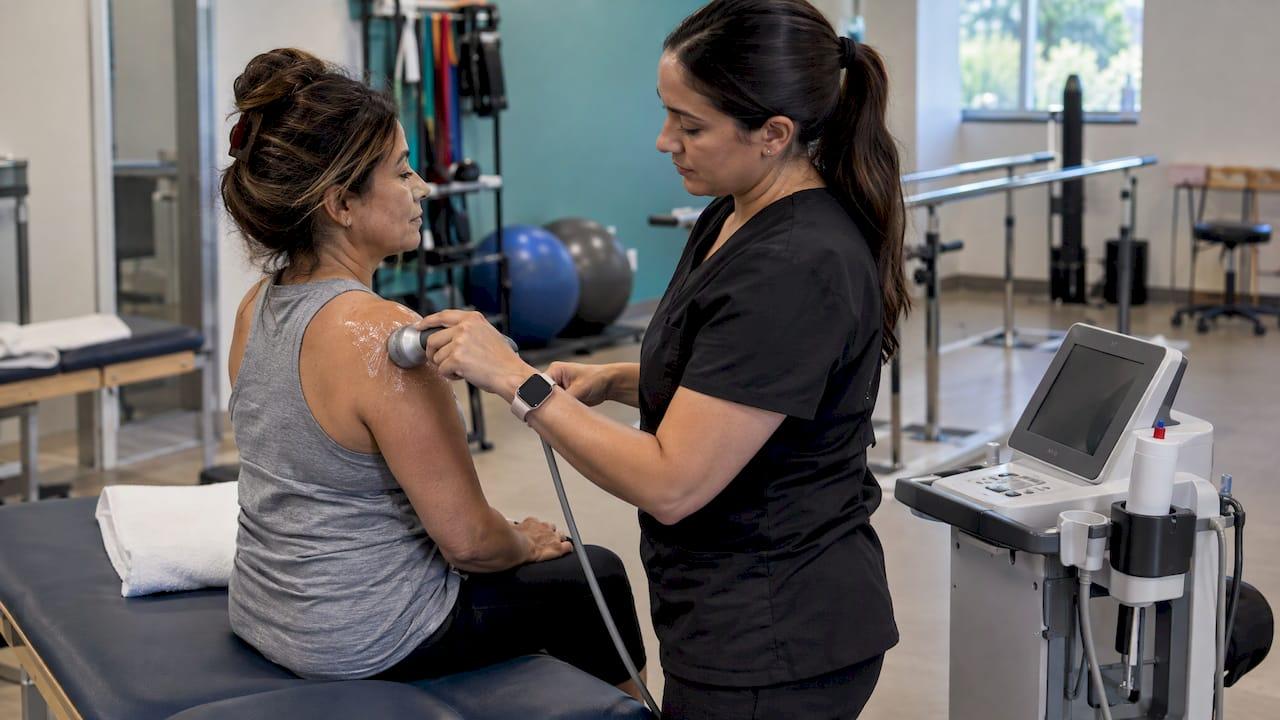
Therapeutic ultrasound for bursitis uses a hand-held probe and sound waves to warm the sore tissue around an inflamed bursa, the small fluid-filled cushion that sits between bone and tendon or muscle. It works best as one part of a recovery plan that also includes rest from the aggravating movement, guided exercise and hands-on care. If your bursitis started with a car accident, a fall at work or a slip-and-fall, we can examine the area, document it and build that plan with you at Sparkmed in North Miami.
TL;DR
- Therapeutic ultrasound is not the imaging scan you may know from a doctor's office. It sends sound waves into tissue to gently warm it and increase blood flow.
- Bursitis is usually diagnosed from your history and a physical exam. Imaging ultrasound or MRI is added when the bursa is deep or the cause is unclear.
- Ultrasound therapy is most useful alongside activity changes, exercise and other soft tissue treatments, not as a stand-alone fix.
- Sessions are short, but safety matters: tell your provider about pregnancy, implants, numbness, skin problems and any past reaction to heat.
- Redness, heat, fever or a sudden hot swollen joint needs a medical doctor the same day, not a therapy visit.
Table of Contents
- What bursitis is and why it flares after an injury
- How bursitis is diagnosed, and where imaging ultrasound fits
- How therapeutic ultrasound works on a bursa
- What a session looks like
- What the research says
- Where ultrasound fits in a complete bursitis plan
- Safety: who should be careful with therapeutic ultrasound
- Bursitis after a car accident or fall: what to do in the first week
- What it costs at Sparkmed
- Our view: treat the whole injury, not just the sore spot
- If you are in North Miami and hurting
- FAQ
- Sources
What bursitis is and why it flares after an injury
A bursa is a thin sac of fluid that lets tendons and muscles glide over bone. You have more than 150 of them, and the ones that cause the most trouble sit at the shoulder, hip, elbow and knee. When a bursa is irritated, it swells and every movement that squeezes it hurts.
Bursitis often comes from repetitive pressure, but trauma is a common trigger too. A seat belt that locks across your shoulder in a collision, a hip that lands on a wet floor, a knee that hits the dashboard: each can inflame a bursa, sometimes days after the event. That delay is why pain that seems to come from nowhere a week after a crash is worth having examined.
The usual picture, according to BMJ Best Practice, is localized pain and tenderness over the bursa, with visible swelling if the bursa sits close to the surface, such as at the elbow or kneecap.
How bursitis is diagnosed, and where imaging ultrasound fits
This is where people often mix up two different things that share a name.
Diagnostic ultrasound is imaging. It uses very short pulses of sound at low intensity, in the range of 2 to 12 MHz, to produce a picture. It does not change the tissue. Per the AIUM Bioeffects Committee overview, therapeutic ultrasound, by contrast, uses longer durations or higher intensities so the tissue actually changes, usually by warming.

Therapeutic ultrasound is a treatment. No picture is made. A provider moves a probe over the sore area to deliver energy.
For diagnosis, Mayo Clinic says bursitis is often identified from your medical history and a physical exam. X-rays can rule out other causes, and ultrasound or MRI can help confirm it. The Merck Manual adds that imaging is mainly used for deep bursae such as the one under the shoulder blade tip (the subacromial bursa), and that fluid may be drawn off with a needle when infection, bleeding or crystal disease is suspected.
In practice that means a good first visit is a careful exam: where it hurts, which movements reproduce it, what happened and when. If your pain follows a collision, that exam also creates the injury record that insurance claims depend on. If imaging is needed to separate bursitis from a tendon tear or a fracture, we say so and refer you for it.
How therapeutic ultrasound works on a bursa
The provider applies coupling gel to the skin, then moves the transducer in slow circles over the painful area. The sound waves travel into the tissue and create two effects, which the AIUM overview describes as warming tendons, muscle and other tissue to improve blood flow and support healing.
- Thermal effect. In continuous mode, the energy heats the tissue gently.
- Mechanical effect. In pulsed mode, the sound waves create tiny pressure changes in the tissue with much less heat.
A 2020 review by Papadopoulos and Mani notes the two effects overlap depending on the settings used. It also explains the frequency choice: 3 MHz for tissue close to the surface and 1 MHz for deeper tissue, because lower frequencies travel deeper. A bursa at the outer hip sits under thick muscle and fascia, so it calls for a different setting than one at the elbow.
What a session looks like
A therapeutic ultrasound session is one of the shortest things you will do in a visit. You sit or lie in a position that exposes the area, gel goes on, and the provider keeps the probe moving the whole time so no single spot overheats. You should feel mild warmth at most. Sharp or burning pain means the setting or technique needs to change, and you should say so right away.
How many sessions you need depends on how long the bursa has been irritated, where it is and how you respond. Ultrasound is typically paired with other work in the same visit: a spinal or joint adjustment where it is appropriate, soft tissue work, and exercises you can repeat at home. Our Ultrasound Therapy page lists it among the clinic's services, together with electrical stimulation, traction and decompression, and massage.
What the research says
The honest summary is that results depend on the joint, the settings and what else you are doing. Two findings are worth knowing.
Knees. A 2024 systematic review and meta-analysis of 10 trials found ultrasound therapy significantly more effective than comparison treatments for knee disorders (p=0.008). Pes anserine and prepatellar bursitis are common knee bursa problems, so this is the most relevant signal for that joint. We cover the same trial results in our write-up of where ultrasound helps knees.
Shoulders. A 2025 comparison study of 26 patients with subacute shoulder bursitis found that therapeutic ultrasound improved both pain and disability. The study was small and measured symptoms and function rather than changes seen on imaging, so it tells you what patients felt, which is the thing most people come in to change. If you are weighing other non-invasive options for sore joints, there is also a guide to red light therapy for arthritis that sets out how light-based treatment is used.
What this means for you: ultrasound is a reasonable tool to include, and the most reliable gains in bursitis come from combining it with the basics that every major medical source lists.

Where ultrasound fits in a complete bursitis plan
Mayo Clinic says bursitis most often settles with rest, ice and over-the-counter pain relievers such as ibuprofen or naproxen. If that is not enough, it lists physical therapy and strengthening exercises, short-term supports such as a cane, cushion or brace, and corticosteroid injections for shoulder or hip bursitis, with surgery rarely needed (Mayo Clinic). The Merck Manual says glucocorticoid injections give short-term relief, under six weeks, in shoulder bursitis, and that a flare after the injection usually starts within 24 hours and lasts no more than 48.
Here is how a typical plan for an accident-related bursitis stacks up:
| Stage | Goal | What it may include |
|---|---|---|
| First days | Calm the irritation | Relative rest, avoiding the painful movement, ice, over-the-counter pain relief if your doctor says it is safe for you |
| Early treatment | Reduce pain and stiffness | Ultrasound therapy, electrical stimulation, soft tissue work |
| Rebuilding | Restore movement and strength | Guided exercises, joint adjustments where appropriate, traction or decompression for related spine pain |
| Stubborn cases | Address tendon involvement | Shockwave therapy, which is commonly used when a tendon beside the bursa is also irritated |
Bursitis rarely occurs alone after trauma. The tendon or joint next to it is often strained as well, which is why a plan that treats the whole area tends to make more sense than a single modality. Our guide to soft tissue therapy explains how these techniques work together.
Safety: who should be careful with therapeutic ultrasound
Therapeutic ultrasound is a routine treatment, and it is delivered safely by keeping the probe moving, using the right setting and checking who it is for. The AIUM overview notes that no cumulative dose has been defined for ultrasound therapy, so unwanted effects such as burns or vascular injury can build up over repeated treatments. That is why the provider adjusts the intensity, keeps the probe moving and tracks how many sessions you have had.
Before your first session, tell your provider if any of these apply:
- You are pregnant or could be.
- You have a metal implant, pacemaker or other device.
- The area is numb, or you have reduced feeling in the skin.
- You have an open wound, skin infection or a known tumor in the area.
- You have a suspected fracture, or you have had a blood clot.
- You have had a bad reaction to heat treatments before.
Our list of ultrasound therapy contraindications walks through what patients should report.
When to see a medical doctor first. A bursa can become infected. Red, hot, rapidly swelling skin over a joint, especially with fever or chills, needs a medical evaluation the same day, because infected bursitis is treated with aspiration and antibiotics (BMJ Best Practice). Go to an emergency room for severe pain after a crash, numbness spreading down an arm or leg, or pain with chest symptoms. Our guide on shoulder blade pain after a crash explains which signs need imaging or emergency care.
Bursitis after a car accident or fall: what to do in the first week
- Get examined early. Symptoms of shoulder, hip or knee bursitis can show up days after a collision. An early exam links the problem to the event and gives you a baseline.
- Describe the mechanism. Where your body hit, how the belt locked, which way you fell. This helps the examiner find the likely injured structure.
- Keep records. Dates, symptoms, treatments and how pain limits daily tasks and work. Our article on documenting shoulder pain after a car accident shows what to write down.
- Avoid the aggravating position. Sleeping on the sore hip or leaning on the sore elbow keeps the bursa irritated.
- Start treatment in a structured way. Plan how many visits and which therapies, and review progress together. Our post on how many chiropractic visits you may need after a car accident helps you plan.
What it costs at Sparkmed
Published prices on our site: a chiropractic adjustment is $45, and a shockwave therapy session is $75. Monthly wellness plans are Essential at $149, Performance at $249 and Elite at $399 per month, all listed on our pricing page. Ultrasound therapy, electrical stimulation, massage therapy, traction and decompression, and the auto accident evaluation do not have a published price, so ask us when you book.
Our view: treat the whole injury, not just the sore spot
We have more than 20 years of experience treating accident victims, and what we see in the plan matters more than any single device. A bursa that hurts after a collision rarely hurts alone. The joint above it, the muscles around it and the way you move to protect it all change.
That is why we pair therapies instead of leaning on one. Ultrasound warms and prepares the tissue. Electrical stimulation and soft tissue work calm it. Adjustments and exercise restore the movement that the bursa was being squeezed by. When a tendon is also involved, shockwave therapy is available in the same clinic.
We also want the practical side to be easy. Our team speaks English, Spanish and Creole, we bill insurance directly, we document the injury thoroughly for claims, and we offer Uber Health transport in North Miami so that getting to the visit is not the obstacle.
Spark
If you are in North Miami and hurting
If you have joint pain after a crash, a work injury or a fall, Sparkmed can examine it, explain what is likely irritated and set up a treatment plan. Our services page lists ultrasound therapy, electrical stimulation, traction and decompression, massage therapy and the auto accident evaluation. Our chiropractic adjustments start at $45, and you can book through our main page.

We handle direct insurance billing and the injury documentation your claim needs, so you can focus on getting better.
FAQ
Is ultrasound therapy good for bursitis?
It is a commonly used treatment that warms the tissue and increases blood flow around the irritated bursa. Research results vary by joint, and a 2024 meta-analysis found significant benefit for knee conditions. It works best with activity changes and exercise.
Is therapeutic ultrasound the same as the ultrasound used to diagnose bursitis?
No. Diagnostic ultrasound makes an image using short, low-intensity pulses. Therapeutic ultrasound delivers more energy for longer to change the tissue, mainly by warming it. Your provider may use imaging when the bursa is deep or the cause is unclear.
Does ultrasound therapy hurt?
It should not. You may feel mild warmth under the probe. If you feel burning or sharp pain, say so right away so the provider can adjust the setting or the technique.
Can I get ultrasound therapy for bursitis caused by a car accident?
Yes. Bursitis can appear days after a collision, and an early exam documents the injury and guides treatment. At Sparkmed we evaluate accident injuries and bill insurance directly.
Sources
- AIUM Bioeffects Committee: Overview of Therapeutic Ultrasound Applications and Safety
- Papadopoulos and Mani, The Role of Ultrasound Therapy in the Management of Musculoskeletal Soft Tissue Pain, 2020
- Guan et al., Ultrasound therapy for pain reduction in musculoskeletal disorders, 2024
- Faisal et al., Comparison of Low-Level Laser Therapy and Therapeutic Ultrasound in Shoulder Bursitis, 2025
- Mayo Clinic: Bursitis diagnosis and treatment
- Mayo Clinic: Bursitis treatment options
- Merck Manual: Bursitis
- BMJ Best Practice: Bursitis
- Red light therapy for arthritis